The Envy the Jews Feel Towards Muslims; Their Wicked Plots Against Muslims
Allah states that the Jews envy the faithful and wish they could misguide them. Allah states that the punishment of this behavior will fall back upon them, while they are unaware. Allah criticizes them,
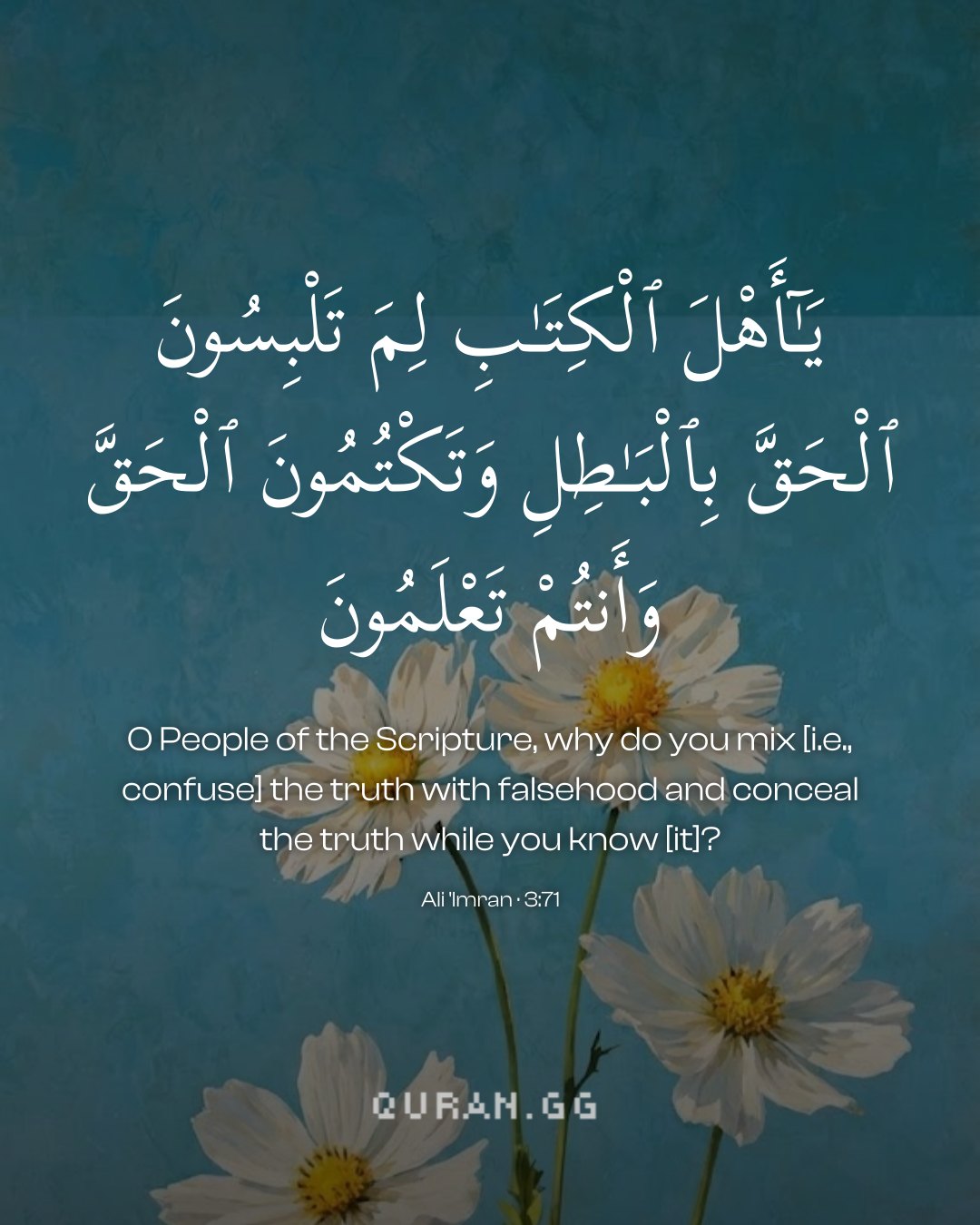
(O People of the Scripture: Why do you mix truth with falsehood and conceal the truth while you know) by hiding what is in your Books about the description of Muhammad , while you know what you do.
The words in أَنتُمْ تَشْهَدُونَ (you are yourselves a witness - 70) and in أَنتُمْ تَعْلَمُونَ (you know ( 71) should not be taken to mean that disbelief will become permissible for them if they do not attest to the truth or have no knowledge about it. This is because kufr (disbelief) is intrinsically an abominable thing to practice. This is prohibited under all conditions. However, the mention of kufr (disbelief) after knowledge and attestation is to increase the impact of reproachment.
Tazkirul Quran
Maulana Wahiduddin KhanOn ayahs 71–73
The Makkan polytheists called their religion the faith of Abraham. Jews and Christians too bracketed their religious history with that of Abraham. In every age people have used the names of their prophets and saints to justify their own additions to and inventions in religion. After the passage of time, people fail to differentiate between the original religion and its later version. The later version is ultimately taken to be the real religion. The atmosphere surrounding it is such that, when the call to return to true and pure religion is given, its opponents find the easiest way to discredit it is by making public allegations that the caller is against the religion handed down to them by their saints. One who is the true representative of the religion of ‘saints’ is now rejected in the name of former saints. This is because what his opponents hold up as their yardstick is not actually the original version of religion as given by the saints of the past. Instead it is the body of alterations and additions made by later followers and subsequently accepted as the ‘religion of the saints’. This is like drawing a veil of falsehood over the truth. That is, making pronouncements which are invalid from the religious and logical point of view. But since the public does not have the ability to analyze them, it deems them to be right and is thus distanced from the truth. The hanif (monotheist) is one who treads the straight path of monotheism and the non-hanif is one who deviates from the straight path, going instead into by-lanes. Sometimes the secondary aspects of religion are so emphasized by the interpretation put upon them that they appear to be the main foci, the actual core of religion. In this way its fundamentals lose their significance and people stray from the straight thoroughfare of monotheism into the byways of unimportant issues.
Uthmani text of the Madinah mushaf (King Fahd Complex). Translation: Saheeh International. Tafsir via Quran.com.