Allah states that in the Qur'an, there are Ayat that are Muhkamat, entirely clear and plain, and these are the foundations of the Book which are plain for everyone. And there are Ayat in the Qur'an that are Mutashabihat not entirely clear for many, or some people. So those who refer to the Muhkam Ayat to understand the Mutashabih Ayat, will have acquired the correct guidance, and vice versa. This is why Allah said,
هُنَّ أُمُّ الْكِتَـبِ
(They are the foundations of the Book), meaning, they are the basis of the Qur'an, and should be referred to for clarification, when warranted,
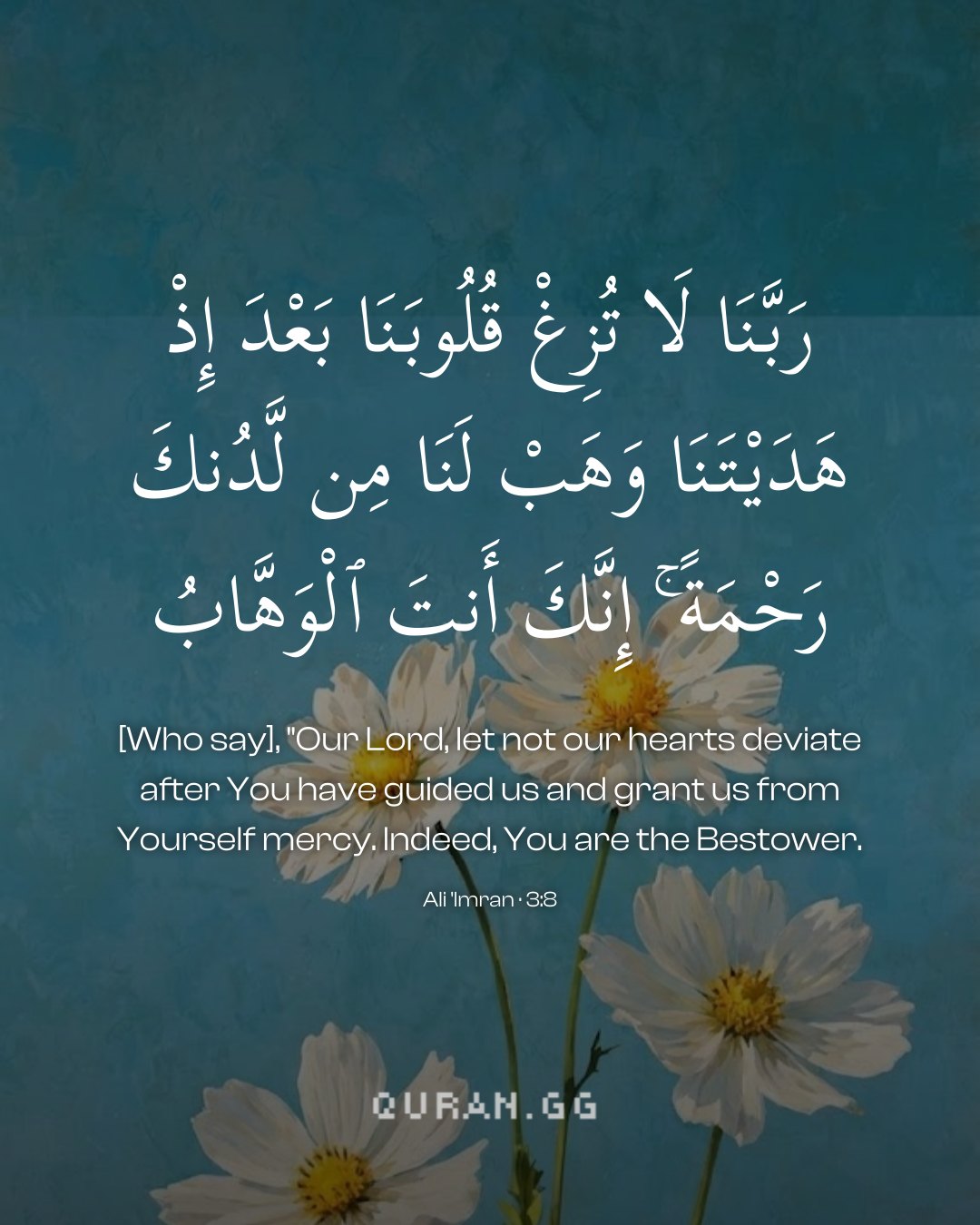
The previous verse mentioned 'those well-grounded in knowledge' who, in spite of their excellent knowledge, were not proud of their excellence. Instead of that, they elected to have faith in what comes from their Lord. The present verse mentions yet another excellence of theirs - that they pray for steadfastness on the right path, not for any worldly gains, but for salvation in the life-to-come.
Commentary
The first verse (8) shows us that guidance and straying are from Allah alone. When Allah intends to guide someone, He makes his heart tilt towards what is good and right; and when He decides to let someone go astray, He turns his heart away from the straight path.
This is just as it was said in a hadith of the Holy Prophet ﷺ There is no heart which is not there in between the two of Allah's fingers - He makes it firm on the truth as long as He wills, and turns it away from the truth when He wills.
He is Allah, absolute in power. He does what He wills. Therefore, those who are concerned about how to remain firm in their faith, they go to the source - requesting and praying Allah for steadfastness. The Holy Prophet ﷺ always used to pray for it as it appears in a hadith: یامقلب القلوب ثبت قلوبنا علی دینک ( O reverser of hearts, make our hearts firm on the faith chosen by You). (Mazhari)
Tazkirul Quran
Maulana Wahiduddin KhanOn ayahs 8–11
The correct academic and intellectual stand regarding the allegorical part of the Quran is for man to acknowledge his limitations. One should be content to have an abstract understanding of the things which cannot be grasped precisely by the senses. When, due to his imperfect sensory perception, man cannot have a total understanding of those realities, the practical approach should be not to make any attempt to determine the precise meaning in these matters. Instead, man should pray to God to save him from entanglement in fruitless discussions. He should pray to God to grant him such wisdom as will enable him to recognize his place and be content to repose his faith in those realities, without knowing all of their details. A Day is soon to come when these realities will come into full view, but it is not possible for man to comprehend them as long as he is still being put to the test in this life, by his Lord. The path of the intellect may be a slippery one, where the intellectual may slip and fall in failing to see things in their right perspective. He understands reality, but only when he looks at it from the proper angle. When he does so from another angle, it is quite possible that he will fail to assess it properly and will be a prey to misunderstandings. The greater wisdom for man is to learn the secret of seeing things from the correct standpoint.
Uthmani text of the Madinah mushaf (King Fahd Complex). Translation: Saheeh International. Tafsir via Quran.com.