Surah Ali 'Imran Ayah 86 (3:86) — Meaning & Tafsir | Quran.GG

Surah Ali 'Imran, Ayah 86

3:86 · Meaning and tafsir

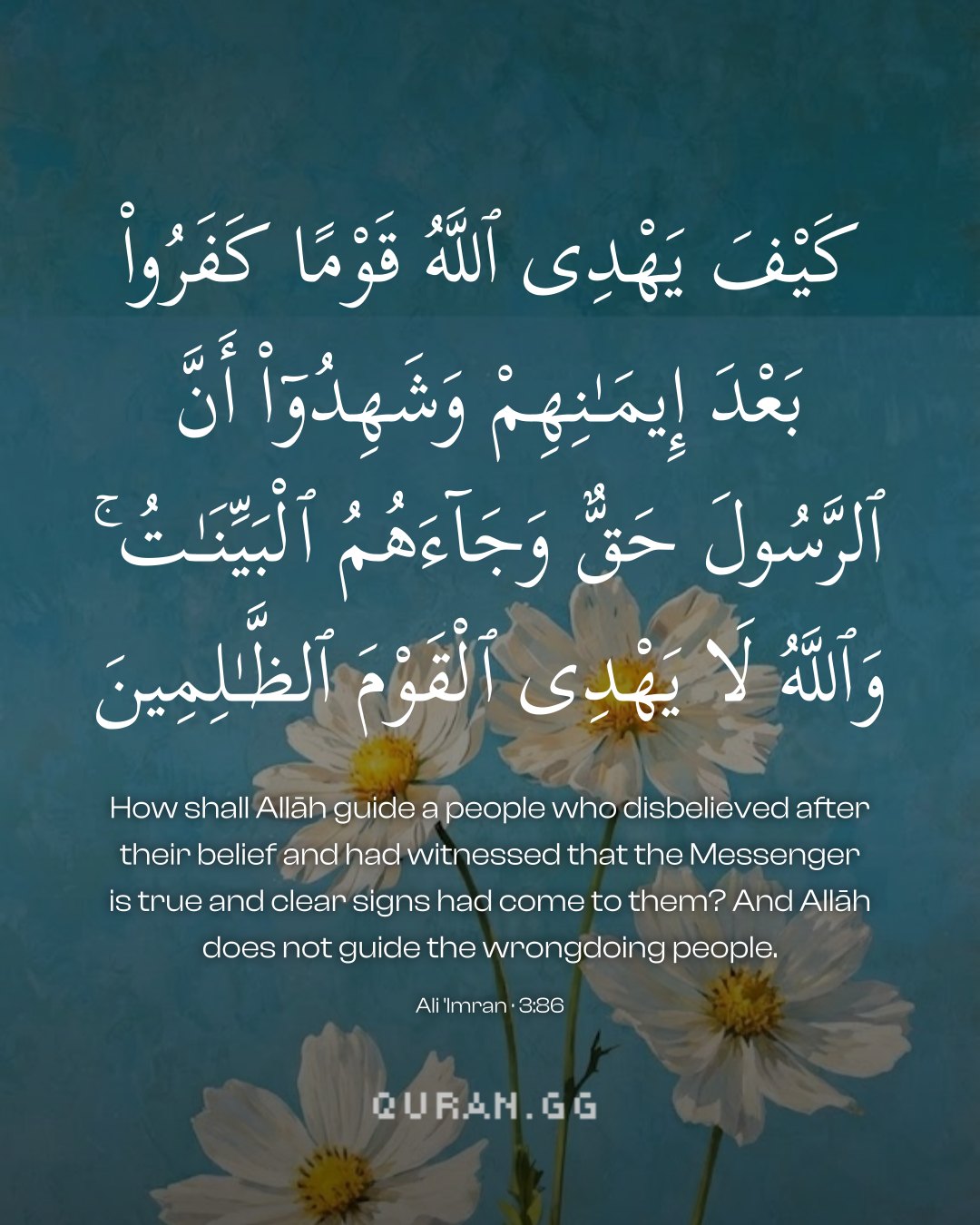
كَيْفَ يَهْدِى ٱللَّهُ قَوْمًا كَفَرُوا۟ بَعْدَ إِيمَـٰنِهِمْ وَشَهِدُوٓا۟ أَنَّ ٱلرَّسُولَ حَقٌّ وَجَآءَهُمُ ٱلْبَيِّنَـٰتُ ۚ وَٱللَّهُ لَا يَهْدِى ٱلْقَوْمَ ٱلظَّـٰلِمِينَ ٨٦

How shall Allāh guide a people who disbelieved after their belief and had witnessed that the Messenger is true and clear signs had come to them? And Allāh does not guide the wrongdoing people.

Surah Ali 'Imran 3:86 in Arabic with its translation: “How shall Allāh guide a people who disbelieved after their belief and had witnessed that the Messenger is…”

Make something with this ayah

Turn it into a video for Stories, Reels or TikTok, recited by the reciter you pick, or an image on a background you choose. Free, in your browser.

Download this image

Tafsir Ibn Kathir (abridged)

Allah Does Not Guide People Who Disbelieve After they Believed, Unless They Repent

Ibn Jarir recorded that Ibn `Abbas said, "A man from the Ansar embraced Islam, but later reverted and joined the polytheists. He later on became sorry and sent his people to, `Ask the Messenger of Allah ﷺ for me, if I can repent.' Then,

كَيْفَ يَهْدِى اللَّهُ قَوْمًا كَفَرُواْ بَعْدَ إِيمَـنِهِمْ

(How shall Allah guide a people who disbelieved after their belief) until,

فَإِنَّ اللَّهَ غَفُورٌ رَّحِيمٌ

(Verily, Allah is Oft-Forgiving, Most Merciful.) was revealed and his people sent word to him and he re-embraced Islam."

This is the wording recorded by An-Nasa'i, Al-Hakim and Ibn Hibban. Al-Hakim said, "Its chain is Sahih and they did not record it."

Allah's statement,

كَيْفَ يَهْدِى اللَّهُ قَوْمًا كَفَرُواْ بَعْدَ إِيمَـنِهِمْ وَشَهِدُواْ أَنَّ الرَّسُولَ حَقٌّ وَجَآءَهُمُ الْبَيِّنَـتُ

(How shall Allah guide a people who disbelieved after their belief and after they bore witness that the Messenger is true and after clear proofs came to them)

means, the proofs and evidences were established, testifying to the truth of what the Messenger was sent with. The truth was thus explained to them, but they reverted to the darkness of polytheism. Therefore, how can such people deserve guidance after they willingly leapt into utter blindness This is why Allah said,

وَاللَّهُ لاَ يَهْدِى الْقَوْمَ الظَّـلِمِينَ

(And Allah guides not the people who are wrongdoers.)

He then said,

أُوْلَـئِكَ جَزَآؤُهُمْ أَنَّ عَلَيْهِمْ لَعْنَةَ اللَّهِ وَالْمَلَـئِكَةِ وَالنَّاسِ أَجْمَعِينَ

(They are those whose recompense is that on them (rests) the curse of Allah, of the angels and of all mankind.)

Allah curses them and His creation also curses them.

خَـلِدِينَ فِيهَآ

(They will abide therein) in the curse,

لاَ يُخَفَّفُ عَنْهُمُ الْعَذَابُ وَلاَ هُمْ يُنظَرُونَ

(Neither will their torment be lightened nor will it be delayed or postponed.) for, the torment will not be lessened, not even for an hour. After that, Allah said,

إِلاَّ الَّذِينَ تَابُواْ مِن بَعْدِ ذَلِكَ وَأَصْلَحُواْ فَإِنَّ اللَّهَ غَفُورٌ رَّحِيمٌ

(Except for those who repent after that and do righteous deeds. Verily, Allah is Oft-Forgiving, Most Merciful.)

This Ayah indicates Allah's kindness, graciousness, compassion, mercy and favor on His creatures when they repent to Him, for He forgives them in this case.

Ma'arif al-Qur'an

Commentary

The removal of a doubt:

On a superficial view of the verse كَيْفَ يَهْدِي اللَّـهُ : 'How shall Allah give guidance...' (86), there emerges a doubt that whoever turns an apostate receives no guidance afterwards, although, the fact is contrary to this. There are many who, after having become apostates, re-embrace the faith and become recipients of guidance.

The answer is that the withholding of guidance mentioned here is in accordance with common usage. For instance, some criminal when punished by a certain ruler may say, 'I have been given a special treatment by the ruler with his own hands.' And in answer to him, it is said: 'Why are we going to give a special treatment to such a criminal?' That is, there is just no special treatment called for in this case, while it does not mean that such a person cannot, in any way, become deserving of special treatment even if he behaved well. (Bayern a1-Qur'an)

Tazkirul Quran

Discovering God is to find an eternal reality. It is to become a co-traveller or a travelling companion of the whole universe. Those who find God in this way, can rise above all kinds of prejudices. They recognize truth in all situations, whether the call of truth comes through an ‘Israelite prophet’ or an ‘Ishmaelite prophet’. But those who lead their lives on the level of community-oriented thinking can recognize the truth only when it comes to them from a member of their own community. If God selects as His messenger someone from outside their community, then the message he brings does not lodge in their minds, not even when their own hearts bear witness to the veracity of that message. Even if such ‘believers’ regard themselves as true believers, they will find their names deleted from the list of believers in the Hereafter. This is because they recognized the truth only in relation to their community rather than in relation to God. Not acknowledging a message of truth, which has been testified to by their own hearts, is the worst crime in the eyes of God. Such people will be condemned in the Hereafter and all creatures will join in this condemnation.

Uthmani text of the Madinah mushaf (King Fahd Complex). Translation: Saheeh International. Tafsir via Quran.com.