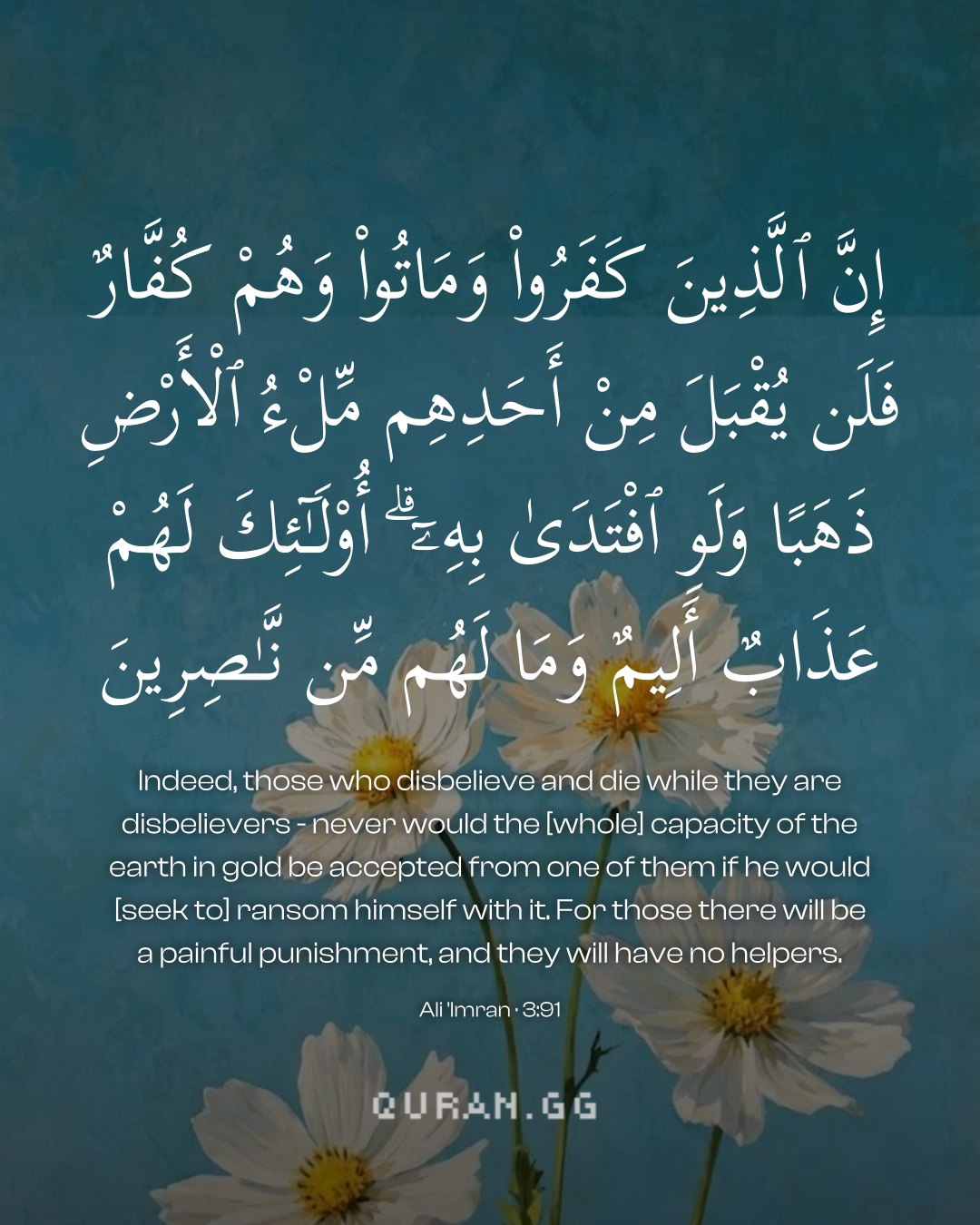
Indeed, those who disbelieve and die while they are disbelievers - never would the [whole] capacity of the earth in gold be accepted from one of them if he would [seek to] ransom himself with it. For those there will be a painful punishment, and they will have no helpers.
Neither Repentance of the Disbeliever Upon Death, Nor His Ransoming Himself on the Day of Resurrection Shall be Accepted
Allah threatens and warns those who revert to disbelief after they believed and who thereafter insist on disbelief until death. He states that in this case, no repentance shall be accepted from them upon their death. Similarly, Allah said,
(never will their repentance be accepted. And they are those who went astray.) to those who abandon the path of truth for the path of wickedness. Al-Hafiz Abu Bakr Al-Bazzar recorded that Ibn `Abbas said that some people embraced Islam, reverted to disbelief, became Muslims again, then reverted from Islam. They sent their people inquiring about this matter and they asked the Messenger of Allah . On that, this Ayah was revealed,
On a superficial view of the verse كَيْفَ يَهْدِي اللَّـهُ : 'How shall Allah give guidance...' (86), there emerges a doubt that whoever turns an apostate receives no guidance afterwards, although, the fact is contrary to this. There are many who, after having become apostates, re-embrace the faith and become recipients of guidance.
The answer is that the withholding of guidance mentioned here is in accordance with common usage. For instance, some criminal when punished by a certain ruler may say, 'I have been given a special treatment by the ruler with his own hands.' And in answer to him, it is said: 'Why are we going to give a special treatment to such a criminal?' That is, there is just no special treatment called for in this case, while it does not mean that such a person cannot, in any way, become deserving of special treatment even if he behaved well. (Bayern a1-Qur'an)
Tazkirul Quran
Maulana Wahiduddin KhanOn ayahs 91–96
Not acknowledging any truth external to their community appears to be a bid to save their faith. But in actuality it destroys their faith. God’s true believer lives on God’s continuous inspiration, so that one who confines himself to self-worship and community-worship will be blocking all paths to God’s blessing entering into him. After being deprived of God’s inspiration, what will there be left with which to nurture his faith?
Uthmani text of the Madinah mushaf (King Fahd Complex). Translation: Saheeh International. Tafsir via Quran.com.