The Great Success will be for Those Who have Taqwa
Allah informs about the happy people and what He has prepared for them of esteem, and eternal pleasure. Allah says,
إِنَّ لِلْمُتَّقِينَ مَفَازاً
(Verily, for those who have Taqwa, there will be a success;) Ibn `Abbas and Ad-Dahhak both said, "A place of enjoyable recreation." Mujahid and Qatadah both said, "They are successful and thus, they are saved from the Hellfire." The most obvious meaning here is the statement of Ibn `Abbas, because Allah says after this,
حَدَآئِقَ
(Hada'iq) And Hada'iq are gardens of palm trees and other things.
حَدَآئِقَ وَأَعْنَـباً - وَكَوَاعِبَ أَتْرَاباً
(And vineyards, and Kawa`ib Atrab,) meaning, wide-eyed maidens with fully developed breasts. Ibn `Abbas, Mujahid and others have said,
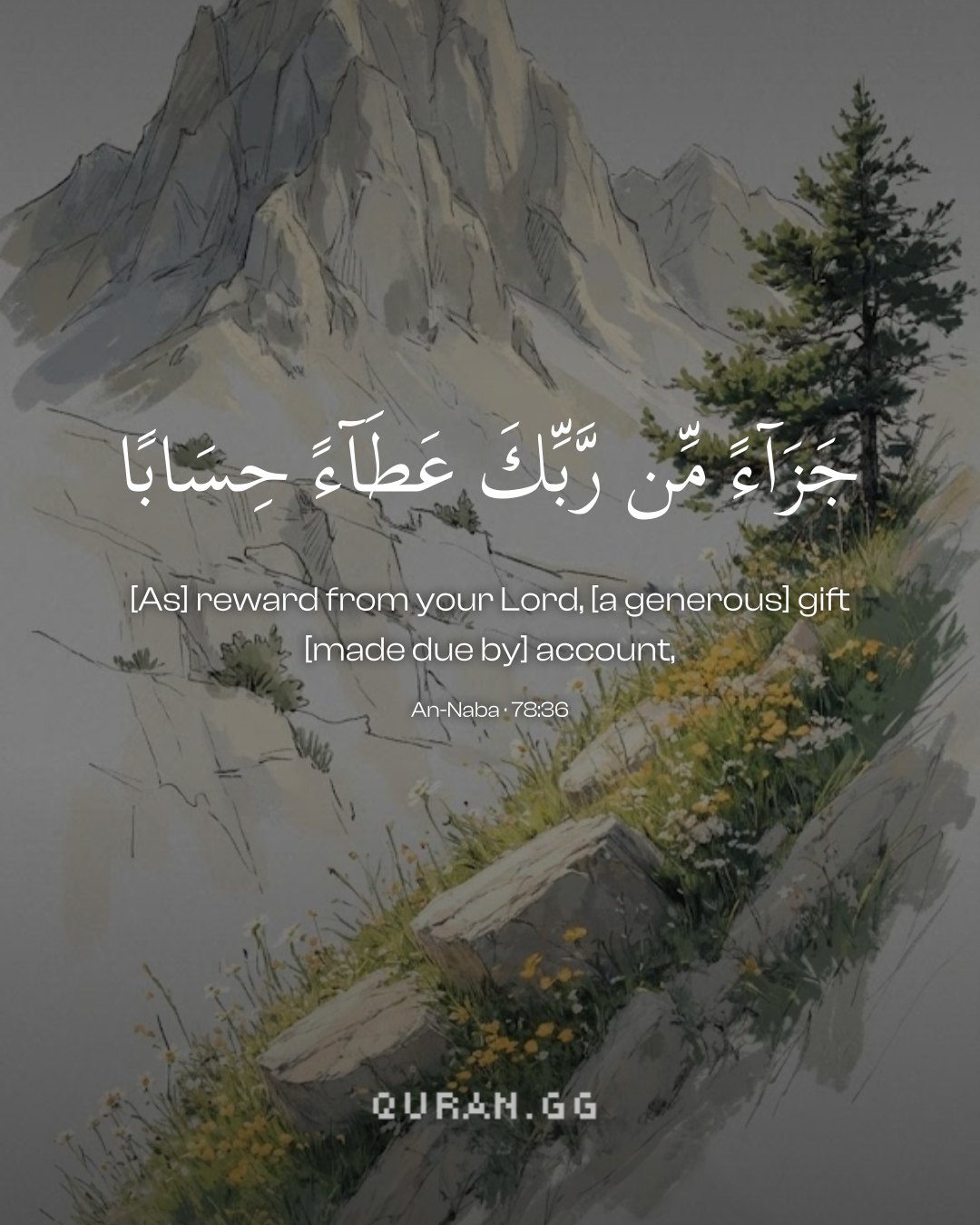
زَاءً مِّن رَّبِّكَ عَطَاءً حِسَابًا (this being a reward from their Lord, a suffering grant...78:36). The blessings of Paradise described above is the reward of the believers and is an abundant grant from their Lord. Here two things are mentioned. First, these blessings are a reward of their deeds. Secondly, they are a Divine grant. Apparently, they seem to be contradictory, because reward means receiving something in lieu of doing some service, whereas grant is given gratis. The Qur'an has combined the two words in order to indicate that the blessings of Paradise are reward for the inmates of Paradise only apparently, and in reality they are a Divine grant given to them gratis, because human deeds cannot be the reward of even those blessings which were given to him in the world, let alone the blessings of the Hereafter which depend entirely on Divine grace as is confirmed by the Tradition of the Holy Prophet ﷺ : "No one can enter Paradise merely by virtue of his deeds, unless Allah shows His grace." The Companions asked: "What about you, Messenger of Allah ﷺ . "He replied: "Nor will I enter Paradise merely by virtue of my action."
The word hisaban has two meanings: [ 1] a grant [ that is ] sufficient [ and ] abundant. This meaning is adapted from the following idiom: اَحسبتُ فُلاناً ای اَعطَیتُہ، ما یَکفِیہِ حَتَٰی قَالَ حَسبِی 'ahsabtu means that I gave him so much so that it was sufficient for him until he yelled out "enough, this is too much for me"; and [ 2] the second meaning 'balancing of account' and 'comparing'. Sayyidna Mujahid ؓ says that in this context the verse purports to say that the Divine grant will be given gratis to the inmates of Paradise. The grant will be in keeping with the degree of sincerity as reported in authentic Traditions. The deeds of the noble Companions are greater than the deeds of the rest of the Ummah. If a Companion were to spend in the way of Allah one mudd = [ 815, 39 grams ] and a non-Companion were to spend to the equivalent of Mount Uhud, the Companion's one mudd will weigh heavier than the mountain. And Allah knows best!
Tazkirul Quran
Maulana Wahiduddin KhanOn ayahs 35–40
The atmosphere of Paradise will be free of all vain talk and falsehood. Therefore, only those who can prove that they have the inclination to live their lives in this world without indulging in trivialities and deceit, will be chosen to inhabit the pure and sublime atmosphere of Paradise.
Uthmani text of the Madinah mushaf (King Fahd Complex). Translation: Saheeh International. Tafsir via Quran.com.