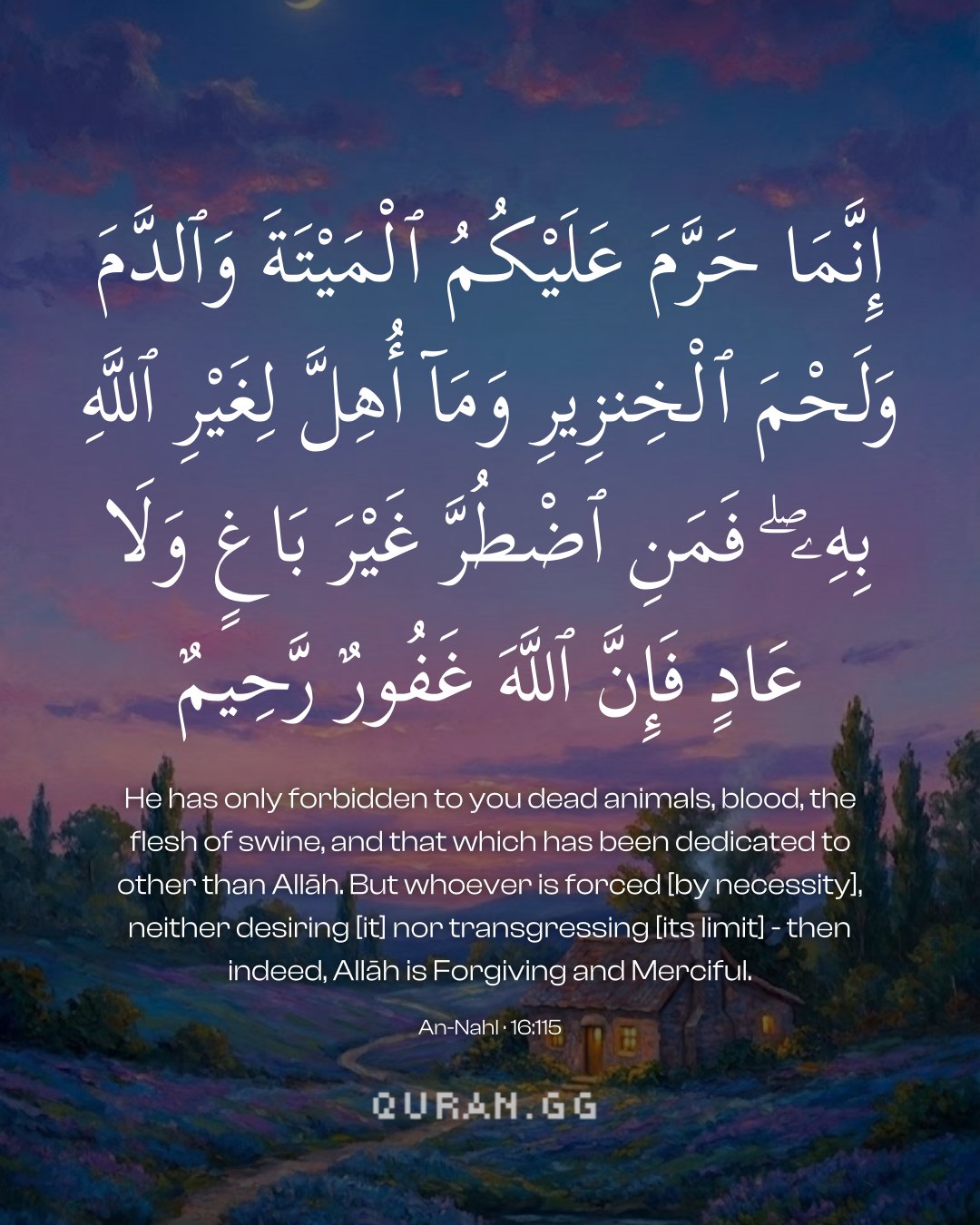
He has only forbidden to you dead animals, blood, the flesh of swine, and that which has been dedicated to other than Allāh. But whoever is forced [by necessity], neither desiring [it] nor transgressing [its limit] - then indeed, Allāh is Forgiving and Merciful.
The Command to eat Lawful Provisions and to be Thankful, and an Explanation of what is Unlawful
Allah orders His believing servants to eat the good and lawful things that He has provided, and to give thanks to Him for that, for He is the Giver and Originator of all favors, Who alone deserves to be worshipped, having no partners or associate. Then Allah mentions what He has forbidden things which harm them in both religious and worldly affairs, i.,e., dead meat, blood and the flesh of pigs.
وَمَآ أُهِلَّ لِغَيْرِ اللَّهِ بِهِ
(and any animal which is slaughtered as a sacrifice for other than Allah.) meaning, it was slaughtered with the mention of a name other than that of Allah. Nevertheless,
The restrictive particle: اَنَّمَا (innama: only) appearing in verse 115 seems to give the impression that things Haram are no more than the four mentioned in the verse. This impression emerges more clearly in another verse: قُل لَّا أَجِدُ فِي مَا أُوحِيَ إِلَيَّ مُحَرَّمًا (Say, I do not find, in what has been revealed to me, anything prohibited... - Surah a1-An` am, 6:145). It seems to be suggestive of nothing being Haram other than the things mentioned in the verse while the fact is that according to clarifications of the Qur'an and Sunnah and by the Consensus of the Muslim Ummah, there are many more things rated as Haram. The answer to this difficulty comes through deliberation into the context of these very verses which tells us that the purpose at this place is not to describe Halal and Haram as they are commonly understood. Instead, the purpose is to point out to what the mushrikin of the period of Jahiliyah had done. They had made many things Haram on their own although Allah Ta’ ala had never ordered them about their unlawfulness. It amounts to saying: Out of the things you have (arbitrarily) made out as Haram, only that which is really Haram is being mentioned here. A comprehensive explanation of this verse along with a detailed description of these four prohibitions has appeared in the Commentary of Surah al-Baqarah, Ma` ariful-Qur’ an, Volume I, pages 424-438, under Verses 173-174. Those interested may see it there.
Tazkirul Quran
Maulana Wahiduddin KhanOn ayahs 115–118
This verse relates to things which are eaten from day to day out of the eatable things created by God. All things are permissible (halal) with just a few exceptions. However, the ancient polytheists prohibited for themselves many things which were permissible. On the contrary, atheists have treated many things prohibited by God as being permissible for themselves. Both these approaches negate the spirit, which is intended to be developed in man through the bounties of food. Food is the most important of all man’s needs. It is a need which is experienced morning and evening. God desires that, whenever a man uses food, he should eat it considering it as a gift from God and he should be grateful to Him for it. But man has reversed the whole matter. In the ancient polytheistic period, they attributed these foods to false gods and in this way made it the means of remembering false gods instead of the one and only God. In the atheistic modern period, man having made the whole matter subject to his personal tastes, those things prohibited by God have been treated as permissible by him. This has resulted in the things created by God becoming mere foodstuffs to cater to his tastes at the dining table. If, under compulsion, anyone goes against the law of God regarding food, he should do it with a sense of shame and not with arrogance. In that way his mentality will be uncorrupted.
Uthmani text of the Madinah mushaf (King Fahd Complex). Translation: Saheeh International. Tafsir via Quran.com.