Signs in the Oceans, Mountains, Rivers, Roads and Stars
Allah tells us how He has subjected the seas, with their waves lapping the shores, and how He blesses His servants by subjecting the seas for them so that they may travel on them, and by putting fish and whales in them, by making their flesh permissible to eat - whether they are caught alive or dead - at all times, including when people are in a state of Ihram. He has created pearls and precious jewels in the oceans, and made it easy for His servants to recover ornaments that they can wear from the ocean floor. He made the sea such that it carries the ships which plow through it. He is the One Who taught mankind to make ships, which is the inheritance of their forefather Nuh. He was the first one to travel by ship, he was taught how to make them, then people took this knowledge from him and passed it down from generation to generation through the centuries, so that they could travel from country to country and from place to place, bringing goods from here to there and from there to here. Thus Allah says:
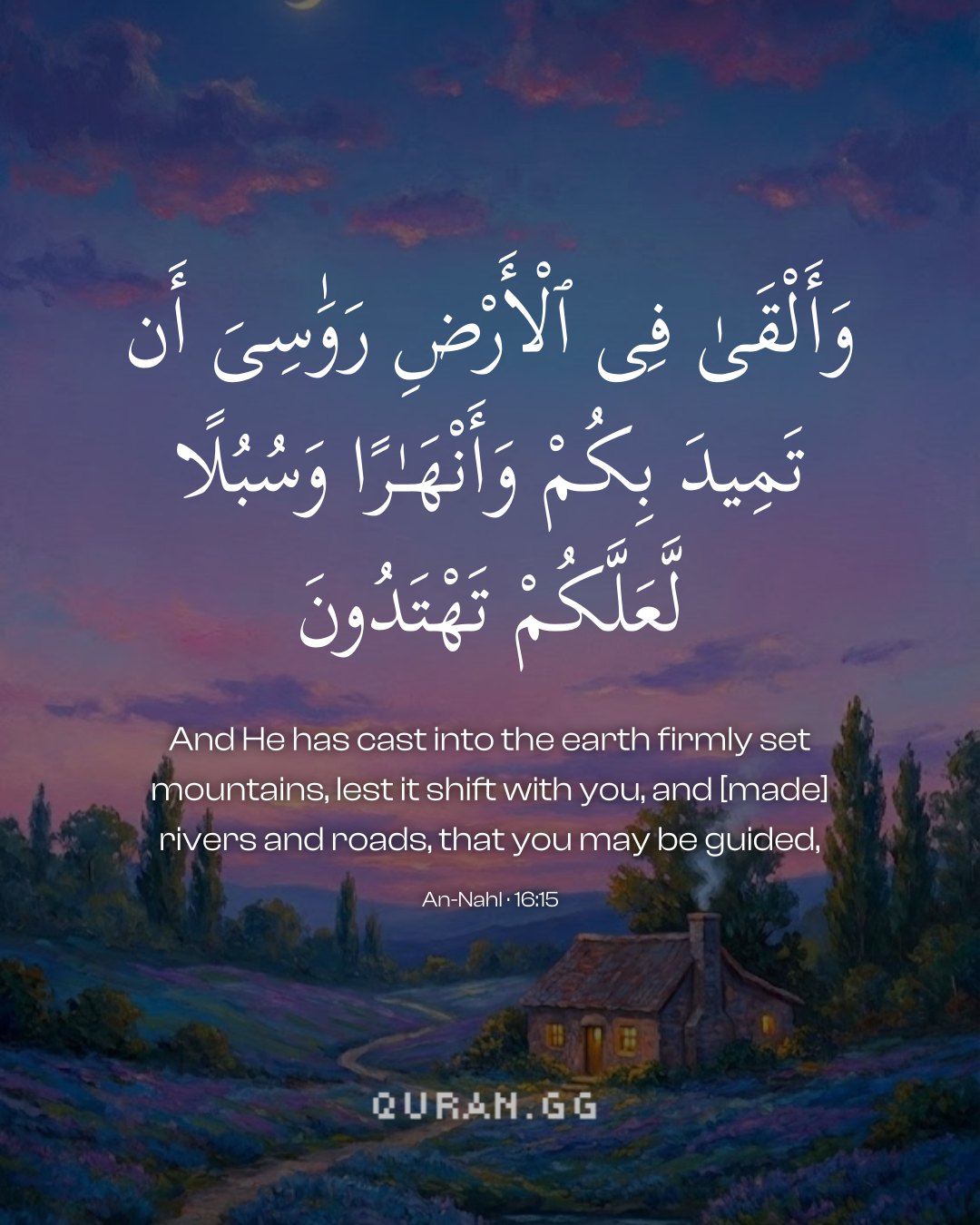
In Verse 16, it was said: وَأَلْقَىٰ فِي الْأَرْضِ رَوَاسِيَ أَن تَمِيدَ بِكُمْ (And He placed mountains on the earth, lest it should shake with you). The word: رَوَاسِيَ (rawasiya) is the plural of رَاسیۃ (rasiyah) which denotes a huge mountain. The word: تَمِیدَ (tamida) is a derivation from the verbal noun: مِيدَ (mayd) which means to shake or swing or sway from side to side (due to loss of balance).
The sense of the verse is that Allah Ta’ ala has not made the sphere of the Earth from components which are not solid and balanced, therefore, it is heavier on one side and lighter on some other. Its necessary outcome was that the Earth was to be taken as stationary, as commonly held by early thinkers; or, taken to be orbitally moving, as determined by some early and most modern scientists. Under both these views, this phenomenon would have caused terrestrial turbulence which is identified as shaking, swinging or swaying from side to side. To stop this turbulence and to provide a balance for the terrestrial composition, Allah Ta` ala placed on the Earth the weight of mountains so that it would not shake. As for its orbital movement like all planets which is the commonly held view from Pythagoras to modern scientists made more explicit through contemporary experiments, it is something which the Holy Qur’ an neither affirms nor rejects. In fact, this possible turbulence which has been stopped through the use of mountains should be more conducive to this orbital movement which is credited to the Earth like other planets. Allah knows best.
Tazkirul Quran
Maulana Wahiduddin KhanOn ayahs 14–15
If an iron bar is put into the sea, it will immediately sink to the bottom. But if the iron is moulded in the shape of a ship, it will start floating on the surface and will be capable of carrying heavy loads and going from one country to another. This is a special law of God by means of which He has made as huge a creation as the sea subservient to man’s interests. Similarly, by a wonderful under-sea arrangement, fresh food is provided in the shape of fish and, for the ornamentation of man, valuable pearls are formed in the oysters which live in the ocean. As for the disposition of the world’s natural features, God could have made various other arrangements. For example, there might have been no oceans or seas on the earth; or man could have been made capable of walking on the sea as he walks on land. But this was not God’s way. His purpose was to create in man a feeling of gratefulness. Not being able to walk on the sea, when a man boards a boat or a ship, he experiences a sense of gratefulness; he thinks that since he is unable to traverse the sea with the help of his legs, God has been kind enough to make it traversable by means of a boat or a ship; he again thinks that since he is not able to fly in space, God has created such conditions as now permit him to fly at great speed in an aeroplane. Such divine preferences have been built into the system of nature in order to awaken man’s consciousness and to create in him feelings of gratefulness and obligation towards his Lord, the Sustainer.
Uthmani text of the Madinah mushaf (King Fahd Complex). Translation: Saheeh International. Tafsir via Quran.com.