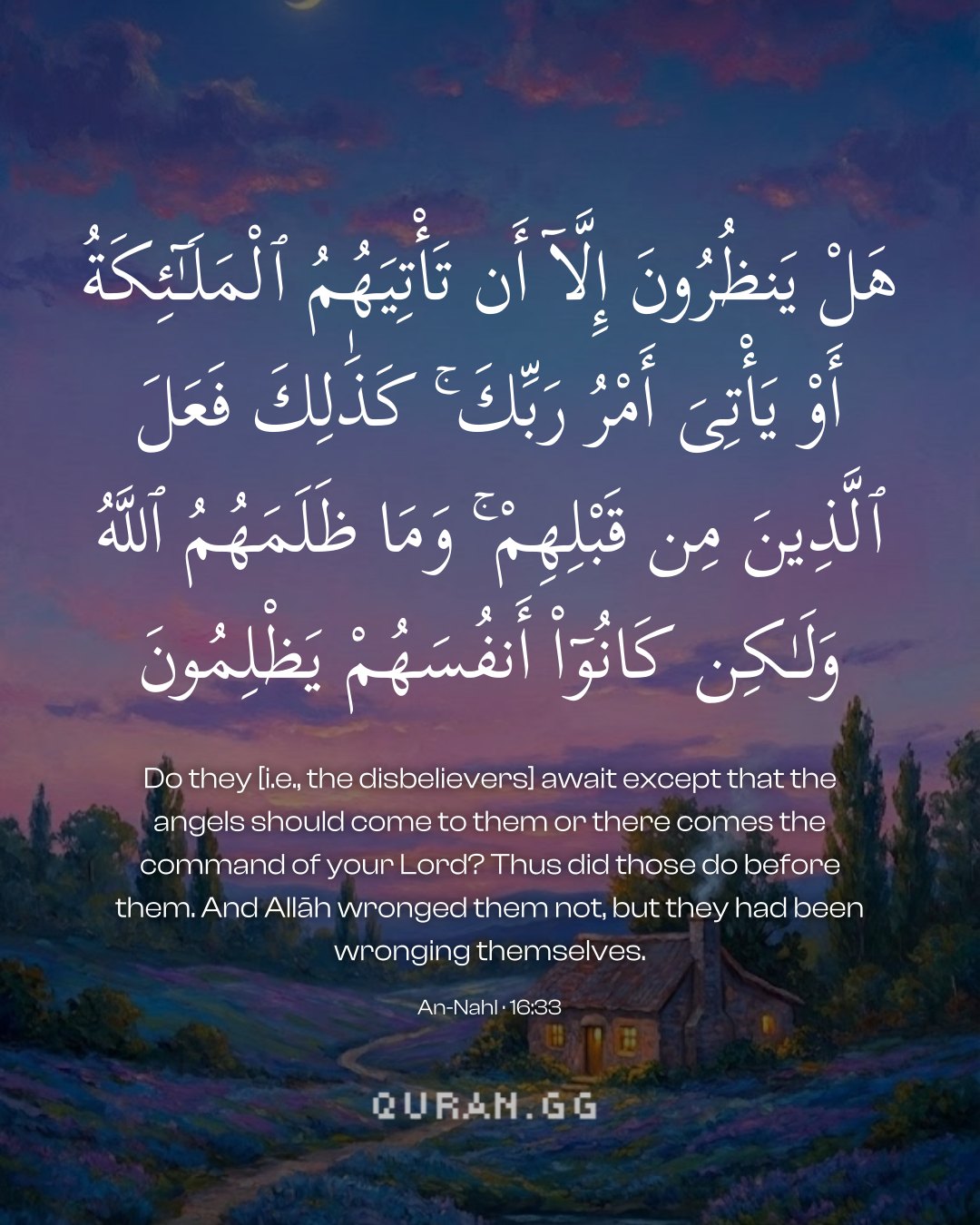
The Disbelievers' Refrain from Faith means that They were simply awaiting Punishment
Threatening the idolators for their persistence in falsehood and their conceited delusions about this world, Allah says: Are these people waiting only for the angels to come and take their souls Qatadah said:
أَوْ يَأْتِىَ أَمْرُ رَبِّكَ
(Or there comes the command of your Lord) means the Day of Resurrection and the terror that they will go through."
كَذَلِكَ فَعَلَ الَّذِينَ مِن قَبْلِهِمْ
(Thus did those before them.) means, thus did their predecessors and those who were like them among the idolators persist in their Shirk, until they tasted the wrath of Allah and experienced the punishment and torment that they suffered.
وَمَا ظَلَمَهُمُ اللَّهُ
(And Allah did not wrong them.) because by sending His Messengers and revealing His Books He gave them enough warning and clearly demonstrated His proofs to them.
وَلَـكِن كَانُواْ أَنفُسَهُمْ يَظْلِمُونَ
(but they were wronging themselves.) meaning, by opposing the Messengers and denying what they brought. For this reason Allah's punishment tormented them.
وَحَاقَ بِهِم
(they were surrounded) meaning, they were overwhelmed by the painful torment.
مَا كَانُواْ بِهِ يَسْتَهْزِءُونَ
(by that which they used to mock.) meaning, they used to make fun of the Messengers when they warned them Allah's punishment, and for this it will be said to them on the Day of Resurrection:
هَـذِهِ النَّارُ الَّتِى كُنتُم بِهَا تُكَذِّبُونَ
(This is the Fire which you used to belie.) (52:14).
Commentary
It will be recalled that, after describing the blessings of Allah and proving that He was unique in the creation of the universe, the text made a pointed reference to how the polytheists chose to stick to their own ways of error. In the present verses, the text describes how they, not content with their own straying, tried that others should also go astray like them. The punishment they would get for doing that has also been stated here. Earlier to that (24), there is a question about the Qur’ an, and the addressees of the question, at this place, are the polytheists. It is their haughty and ignorant answer which has been mentioned here along with a warning of consequences for this attitude. Then, after five verses (30), the same question has been addressed to believers who fear Allah which is followed by their answer, and where a promise of reward for it has been mentioned.
Continue reading the tafsir of ayahs 24–34 When those who are of a haughty mentality hear any discourse about God, their minds start working in perverse ways and they are, therefore, unable to learn a lesson from it. But one who fears God in his heart, will hear the discourse about God with full receptivity. For such a person, it becomes a source of spiritual realization; in it he sees glimpses of a higher reality. One of the main features of paradise is that everything is available there that a man desires. There are things there which are not available in this world to anybody —not even to the greatest kings. In the present world, due to man’s limitation and due to the unfavourable nature of external conditions, it never happens that man obtains whatever he wants. The concept that in paradise, man will find whatever he desires is of such allure that whatever sacrifice has to be made to enter paradise is negligible by comparison.
Uthmani text of the Madinah mushaf (King Fahd Complex). Translation: Saheeh International. Tafsir via Quran.com.