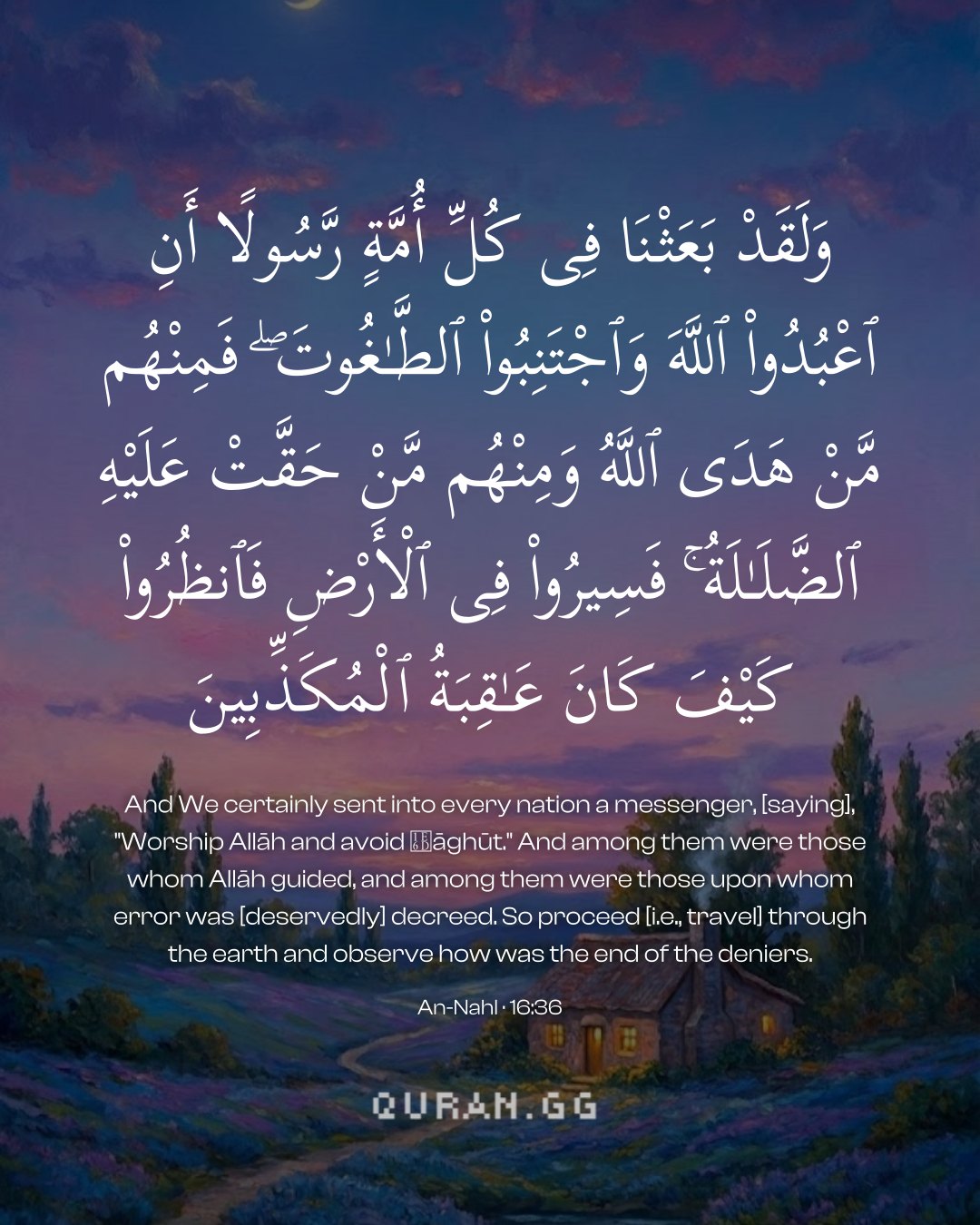
And We certainly sent into every nation a messenger, [saying], "Worship Allāh and avoid ṭāghūt." And among them were those whom Allāh guided, and among them were those upon whom error was [deservedly] decreed. So proceed [i.e., travel] through the earth and observe how was the end of the deniers.
The Idolators Argument that their Shirk was Divinely decreed, and the Refutation of this Claim
Allah tells us about the idolators delusion over their Shirk, and the excuse they claimed for it based on the idea that it is ordained by divine decree. He says:
((They say:) "If Allah had so willed, neither we nor our fathers would have worshipped any but Him, nor would we have forbidden anything without (a command from) Him.") They had superstitious customs dealing with certain animals, e.g. the Bahirah the Sa'ibah and the Wasilah and other things that they had invented and innovated by themselves, with no revealed authority. The essence of what they said was: "If Allah hated what we did, He would have stopped by punishing us, and He would not have enabled us to do it." Rejecting their confusing ideas, Allah says:
Has a Rasul of Allah appeared in India and Pakistan too?
From verse 36 in the present Surah: وَلَقَدْ بَعَثْنَا فِي كُلِّ أُمَّةٍ رَّسُولًا (And We did raise a messenger among every people), as well as from verse 24 of Surah Fatir: وَإِن مِّنْ أُمَّةٍ إِلَّا خَلَا فِيهَا نَذِيرٌ (And there is no group of people among whom there has not been a warner - 35:24), it outwardly appears that messen-gers may have also been sent to areas now known as India and Pakistan - whether residents of the area, or located in another country whose deputies or emissaries had reached there. Then, there is the verse of Surah Al-Qasas: لِتُنذِرَ قَوْمًا مَّا أَتَاهُم مِّن نَّذِيرٍ (so that you may warn a people unto whom came no warner - 28:46). The sense released by the verse is that no warner had come before him to the people unto whom the Holy Prophet ﷺ was sent. This can be answered by saying that this obviously refers to the people of Arabia who became the first addressees of the prophetic mission of Sayyidna Muhammad al-Mustafa ﷺ - the fact being that no prophet since Sayyidna Ismail (علیہ السلام) had appeared among them. Therefore, the title given to these people in the Holy Qur'an was "Ummiyyin" (the unlettered ones). This does not necessarily imply that no prophet came before him in the rest of the world as well. Allah knows best.
Tazkirul Quran
Maulana Wahiduddin KhanOn ayahs 35–36
An unheeding person justifies his departure from the truth in various ways and one such way is to maintain that everything in this world happens according to the will and pleasure of God. In view of this, his present behaviour can be treated as a result of the will of God. He maintains that he would not have been able to do wrong if his misdeeds had not been backed by the will of God. He says that if his actions were not to God’s liking, He would not have allowed him to continue those actions. In other words, it should have been the rule that whenever he did something against the will of God, He should have prevented him from doing it. Man talks in this way because he is not serious about truth and untruth. Had he been serious, he would have immediately understood that the liberty of action pertains to the creation plan of God according to which man is being tested in this world. It has nothing to do with God’s approval.
Uthmani text of the Madinah mushaf (King Fahd Complex). Translation: Saheeh International. Tafsir via Quran.com.