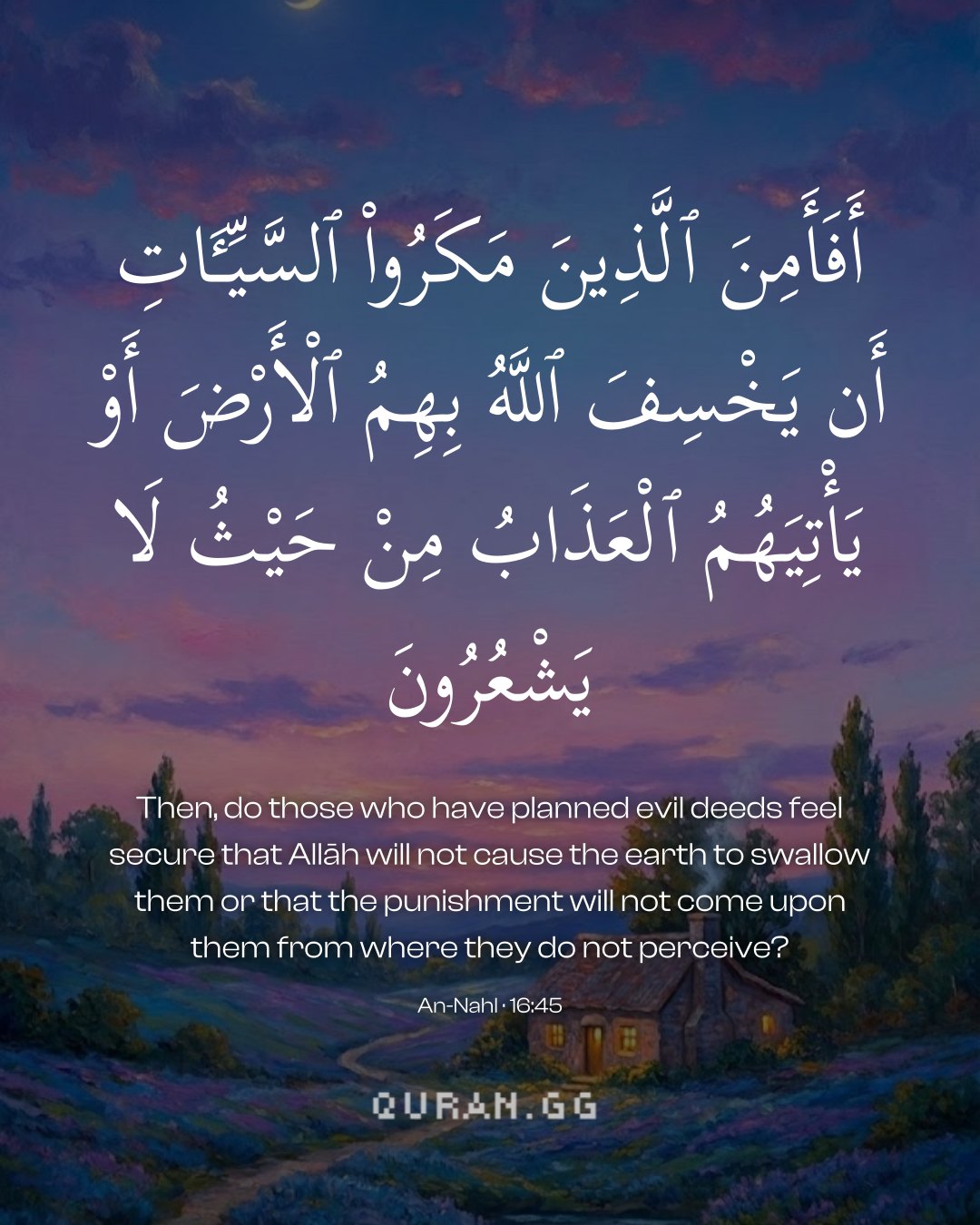
How the Guilty can feel Secure
Allah informs us about His patience, and how He delays the punishment for the sinners who do evil things and call others to do likewise, plotting to call others to do evil - even though He is able to make the earth swallow them or to bring His wrath upon them.
مِنْ حَيْثُ لاَ يَشْعُرُونَ
(from where they do not perceive it), meaning in such a way that they do not know where it comes from. As Allah says:
أَءَمِنتُمْ مَّن فِى السَّمَآءِ أَن يَخْسِفَ بِكُمُ الاٌّرْضَ فَإِذَا هِىَ تَمُورُ - أَمْ أَمِنتُمْ مِّن فِى السَّمَآءِ أَن يُرْسِلَ عَلَيْكُمْ حَـصِباً فَسَتَعْلَمُونَ كَيْفَ نَذِيرِ
(Do you feel secure that He Who is over the heaven (Allah), will not cause you to sink into the earth, when it quakes Or do you feel secure that He Who is over the heaven (Allah), will not send a storm of stones upon you Then you shall know how My warning really is.) (67:16-17).
أَوْ يَأْخُذَهُمْ فِى تَقَلُّبِهِمْ
(Or that He may punish them in the midst of their going to and fro) meaning, when they are busy with their daily business, travel, and other distracting activities. Qatadah and As-Suddi said:
تَقَلُّبِهِمْ
(Their going to and fro) means their journeys." As Allah says:
أَفَأَمِنَ أَهْلُ الْقُرَى أَن يَأْتِيَهُم بَأْسُنَا بَيَـتاً وَهُمْ نَآئِمُونَ - أَوَ أَمِنَ أَهْلُ الْقُرَى أَن يَأْتِيَهُمْ بَأْسُنَا ضُحًى وَهُمْ يَلْعَبُونَ
(Did the people of the towns feel secure against the coming of Our punishment by night while they were asleep Or, did the people of the towns feel secure against the coming of Our punishment in the forenoon while they were playing) (7:97-98)
فَمَا هُم بِمُعْجِزِينَ
(so that there be no escape for them (from Allah's punishment)) meaning, it is not impossible for Allah, no matter what their situation.
أَوْ يَأْخُذَهُمْ عَلَى تَخَوُّفٍ
(Or that He may punish them where they fear it most) meaning, or Allah will take from them what they most fear, which is even more frightening, because when the thing you most fear to happen does happen, this is even worse. Hence Al-`Awfi reported that Ibn `Abbas said that,
أَوْ يَأْخُذَهُمْ عَلَى تَخَوُّفٍ
(Or that He may punish them where they fear it most) means that Allah is saying: If I wish, I can take him after the death of his companion and after he has become frightened of that.' This was also reported from Mujahid, Ad-Dahhak, Qatadah and others. Then Allah says:
فَإِنَّ رَبَّكُمْ لَرَؤُوفٌ رَّحِيمٌ
(Indeed your Lord is full of kindness, Most Merciful.) meaning, because He does not hasten to punish, as was reported in the Two Sahihs:
«لَا أَحَدَ أَصْبَرُ عَلَى أَذًى سَمِعَهُ مِنَ اللهِ، إِنَّهُمْ يَجْعَلُونَ لَهُ وَلَدًا وَهُوَ يَرْزُقُهُمْ وَيُعَافِيهِم»
(No one is more patient in the case of hearing offensive speech than Allah, for they attribute to Him a son, while He alone is giving them provision and good health.) And it is also recorded in Two Sahihs,
«إِنَّ اللهَ لَيُمْلِي لِلظَّالِمِ حَتَّى إِذَا أَخَذَهُ لَمْ يُفْلِتْه»
(Allah will let the wrongdoer continue until, when He begins to punish him, He will never let him go.) Then the Messenger of Allah ﷺ recited:
وَكَذلِكَ أَخْذُ رَبِّكَ إِذَا أَخَذَ الْقُرَى وَهِىَ ظَـلِمَةٌ إِنَّ أَخْذَهُ أَلِيمٌ شَدِيدٌ
(Such is the punishment of your Lord when He seizes the (population of) towns while they are doing wrong. Indeed, His punishment is painful, (and) severe) (11:102) And Allah says:
وَكَأَيِّن مِّن قَرْيَةٍ أَمْلَيْتُ لَهَا وَهِىَ ظَـلِمَةٌ ثُمَّ أَخَذْتُهَا وَإِلَىَّ الْمَصِيرُ
(And many a township did I give respite while it was given to wrongdoing. Then I punished it. And to Me is the (final) return (of all).) (22:48)
Commentary
In verses appearing previously: ثُمَّ يَوْمَ الْقِيَامَةِ يُخْزِيهِمْ (Then, on the day of Judgment, He will put them to disgrace - 27), disbelievers were warned against the punishment of the Hereafter. In the present verses, they have been further warned that it is also possible that they are caught in the punishment from Allah right here in this world much before the pun-ishment of the Hereafter, may be you are sunk into the earth you are sitting on, or you are seized by the punishment of Allah coming from a direction totally inconceivable for you. This is how it happened during the Battle of Badr when they received a punishment at the hands of some ragtag Muslims arrayed against their thousand strong armed young-men, something they would have never perceived as possible. Or, it was also probable that they be seized by some Divine punishment while roaming about freely, such as, they be hit by a fatal disease, or that they run into an accident by falling down from some height, or simply die by colliding against some hard object. Also possible is yet another form of punishment when punishment may not come all of a sudden, but a general decrease sets in causing wealth, health, fitness, means of sustenance and comfort and peace go on shrinking so much so that the day comes when the people so punished disappear from the face of the earth for/good.
The word: تَخَوُّفٍ (takhawwuf) appearing in verse 47 is obviously a derivation from: خَوف (khawf: fear, apprehension). Some commentators have explained this verse in terms of this very sense by saying that one group of people be seized in punishment so that the second group gets apprehensive. Similarly, the second group is seized in punishment which makes the third group become apprehensive. Finally, struck with dread sequentially, comes the end for all of them.
But, the early exegete of the Qur’ an, Sayyidna ` Abdullah ibn ` Abbas ؓ and Mujahid and other Imams of Tafsir have taken the word: تَخَوُّفٍ (takhawwuf) in the sense of: تَنَقُّص (tanaqqus). So, it is in accordance with this Tafsir that it has also been translated in the later sense of 'reducing or decreasing gradually.'
The noble tabi i Sa'id ibn al-Musaiyyab says: When Sayyidna ` Umar ؓ also faced some hesitation about the sense of this word, he addressed the Sahabah from the Minbar and asked them as to what they understood to be the meaning of 'takhawwuf? The audience at large remained silent. But, a person from the tribe of Hudhayl submitted: 0 Commander of the Faithful, this is a particular idiom of our tribe. We use this word in the sense of tanaqqus, that is, to decrease gradually. Sayyidna ` Umar asked: Do the Arabs use this word in the sense of tanagqus in their poetry? He said that they do, and cited a couplet by Abu Kabir al-Hudhali, a poet from his tribe, in which this word was used in the sense of decreasing gradually. Thereupon, Sayyidna ` Umar said: 0 people, learn about the poetry of Jahiliyyah because there lies the key to the explanation of your Book and the sense of your speech.
For the Understanding of Qur'an, a Passing Knowledge of Arabic is Not Sufficient
The first thing the report referred to above proves is that the ability to speak and write the Arabic language is not enough for the understanding of Qur'an. Rather, necessary for this purpose is a level of effeciency and awareness which could help one understand the classical work done during the early period of the Arabs of Jahiliyyah - because the Qur’ an has been revealed in that language and idiom. Learning Arabic literature on that level is incumbent on Muslims.
Reading Poets from Jahiliyyah is Permissible, Even if Full of Pagan Absurdities
This also tells us that, in order to understand the Qur'an and to understand the Arabic language and its usage during the period of Jahiliyyah, it is permissible to read and teach the poetry of that period. Though, it is obvious that such poetry will be full of pagan themes and customs highlighting pagan sayings and doings counter to Islam. But, such was the need to understand the Qur’ an that reading and teaching it was declared to be permissible.
Uthmani text of the Madinah mushaf (King Fahd Complex). Translation: Saheeh International. Tafsir via Quran.com.