The Unseen belongs to Allah and only He has Knowledge of the Hour
Allah tells us of the perfection of His knowledge and ability to do all things, by telling us that He alone knows the Unseen of the heavens and the earth. No one knows anything about such things except for what Allah informs about as He wills. His complete power, which no one can oppose or resist, means that when He wants a thing, He only has to say to it "Be!" and it is, as Allah says:
وَمَآ أَمْرُنَآ إِلاَّ وَحِدَةٌ كَلَمْحٍ بِالْبَصَرِ
(And Our commandment is but one as the twinkling of an eye.) (54:50) meaning, whatever He wills happens in blinking. Thus Allah says here:
وَمَآ أَمْرُ السَّاعَةِ إِلاَّ كَلَمْحِ الْبَصَرِ أَوْ هُوَ أَقْرَبُ إِنَّ اللَّهَ عَلَى كُلِّ شَىْءٍ قَدِيرٌ
Continue reading the tafsir of ayahs 77–79 Commentary
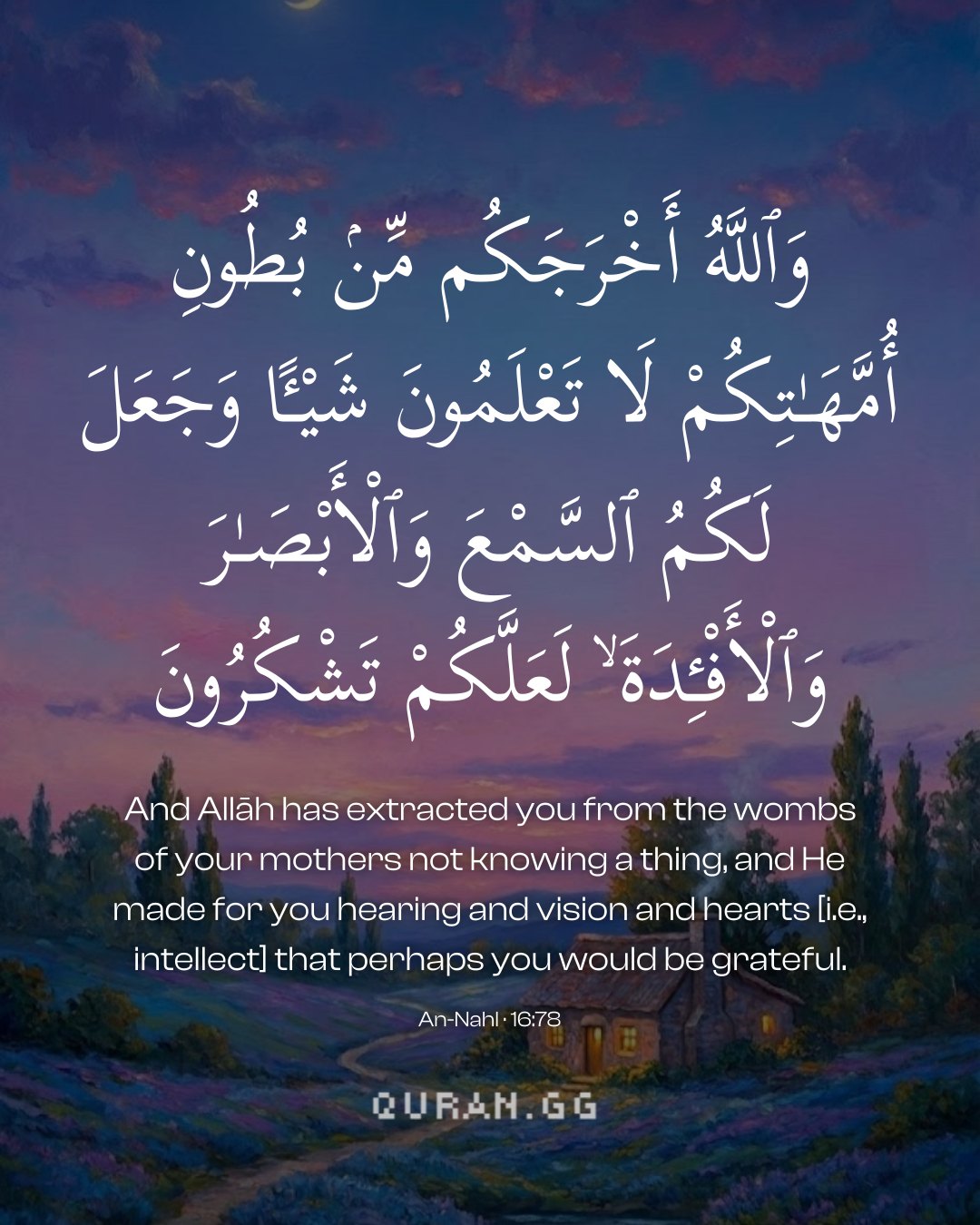
The Divine statement: لَا تَعْلَمُونَ شَيْئًا (when you knew nothing - 78) indicates that knowledge is not an ingrained personal excellence of man. When born, man has no knowledge or skill. Then, in proportion to growing human needs, man is made to absorb some knowledge, bit by bit, directly from Allah Ta’ ala in which no role is played by the parents or teachers. First of all, man was taught to cry. This one qualification alone provides all he needs at that time. Hungry or thirsty, he cries. Feels hot or cold, he cries. If some other discomfort bothers him, he would still cry. Nature has poured a special kind of love in the hearts of the father and the mother for the needs of the infant, because of which, when they hear the sounds made by the child, they become all too eager to find out what is bothering the baby, and all too willing to remove the problem. If the child was not inducted into this act of crying as part of his or her early education from a side no less than that of Allah Himself, who else could have trained the child to employ this skill and start crying like that as and when there be some need. Along with it, Allah Ta’ ala also taught the child, inspiration-wise, that he or she should use gums and lips to suck milk, the child's energy food, from the breast of the mother. If this education and training was not natural and direct, no teacher anywhere could dare make this newborn learn to pout and move the mouth right and suck nipples on the breast. Thus, with the increase in the needs of the child, nature took care of teaching its charge directly without the intermediary link of the father and mother, in a manner almost spontaneous and self-regulating. After the passage of some time, the child starts learning a little by hearing parents and others around say what they do, or pick up a few tips by seeing a few things around. This, then, creates in the child the ability to understand sounds heard and things seen.
Therefore, after: لَا تَعْلَمُونَ شَيْئًا (when you knew nothing) in the verse under comment, it was said: وَجَعَلَ لَكُمُ السَّمْعَ وَالْأَبْصَارَ وَالْأَفْئِدَةَ (and He made for you ears, eyes and hearts). It means: Though, human beings knew nothing about anything at the early stage of their birth, but nature had installed in their very frame of existence novel instruments to fulfill their need to learn. Out of these instruments, the first to be mentioned was سَمَع 'sam’ a', that is, the faculty of hearing which precedes perhaps for the reason that the very first knowledge, and the most of it, comes through nothing but ears. In the beginning, eyes are closed, but ears hear. Furthermore, if we were to think about it, we shall not fail to realize that the amount of information one acquires in a whole life time is mostly what has been heard with ears. Information collected visually is much less than that.
After these two, comes information which one deduces by deliberating into things heard and seen. According to the statements of the Qur'an, this is a function of the human heart. Therefore, stated at number three is: أَفْئِدَةَ (afidah) which is the plural of: فُواد fu’ ad which means the heart. Scientists identify the human brain as the center of understanding and reason. But, the statement of the Qur'an tells us that though the brain plays a role in this process of reasoning, yet the real center of knowledge and reason is the heart.
On this occasion, Allah Ta'a1a has mentioned the faculties of hearing, seeing and understanding. Speech was not mentioned because speech plays no role in the acquisition of knowledge. It is, rather, a source of the expression of knowledge. In addition to that, according to Imam Al-Qurtubi, the word: سَمَع 'sam’ a" (hearing) is inclusive of نُطق nutq (speech) as a corollary, as experience bears out that a person who hears speaks as well. A person deprived of the power of speech remains deaf in the ears as well. Perhaps, the reason why a dumb person cannot speak lies in the person's very inability to hear any sounds which could make learning to speak through hearing possible. وَاللہُ اَعلم Wallahu a` lam: 'And Allah knows best' is a standard appendage to conclusions where definite knowledge about a subject in flux is not available or accessible or reliable. For a believer, this serves as a safety device against the possibility of having made any false statements, which may be a sin.
When a human being is born, he is already the possessor of eyes, ears, and a brain, yet he is quite helpless and totally dependent on others. He might possibly—under a different scheme of things—have been born with the ability to use his wonderful faculties of seeing, hearing and thinking in the way that an adult would. But if things did not happen in this way, it was by design. Man was meant to experience his own helplessness as a baby and then to appreciate his mental and physical growth through adolescence to maturity as a gift from God. This process was meant to engender in him feelings of gratitude and a deep sense of obligation to his Maker. But such feelings emerge only when a man utilizes his God-given capacities in the right manner. His eyes, ears and heart should not be so attracted to worldly, ephemeral glamour that these may stop one from penetrating the realms of the unseen.
Uthmani text of the Madinah mushaf (King Fahd Complex). Translation: Saheeh International. Tafsir via Quran.com.