Allah knows Every Matter, whether Small or Big, and He rewards Each according to His or Her Deeds
Allah asserts that He is the King and Owner of the heavens and earth and that He is independent of the need for anyone. He is the authority over His creation and rules them with justice. He created the creation in truth,
لِيَجْزِىَ الَّذِينَ أَسَاءُواْ بِمَا عَمِلُواْ وَيِجْزِى الَّذِينَ أَحْسَنُواْ بِالْحُسْنَى
(that He may requite those who do evil with that which they have done, and reward those who do good, with what is best.) He recompenses each according to his or her deeds, good for good and evil for evil.
Qualities of the Good-doers; Allah forgives the Small Faults
Allah stated that the gooddoers are those who avoid major sins and immoral sins. They sometimes commit minor sins, but they will be forgiven these minor sins and covered from exposure, as Allah mentioned in another Ayah;
Continue reading the tafsir of ayahs 31–32Ma'arif al-Qur'an
Mufti Muhammad Shafi
Allah Forgives the Small Faults, Al-Lamam
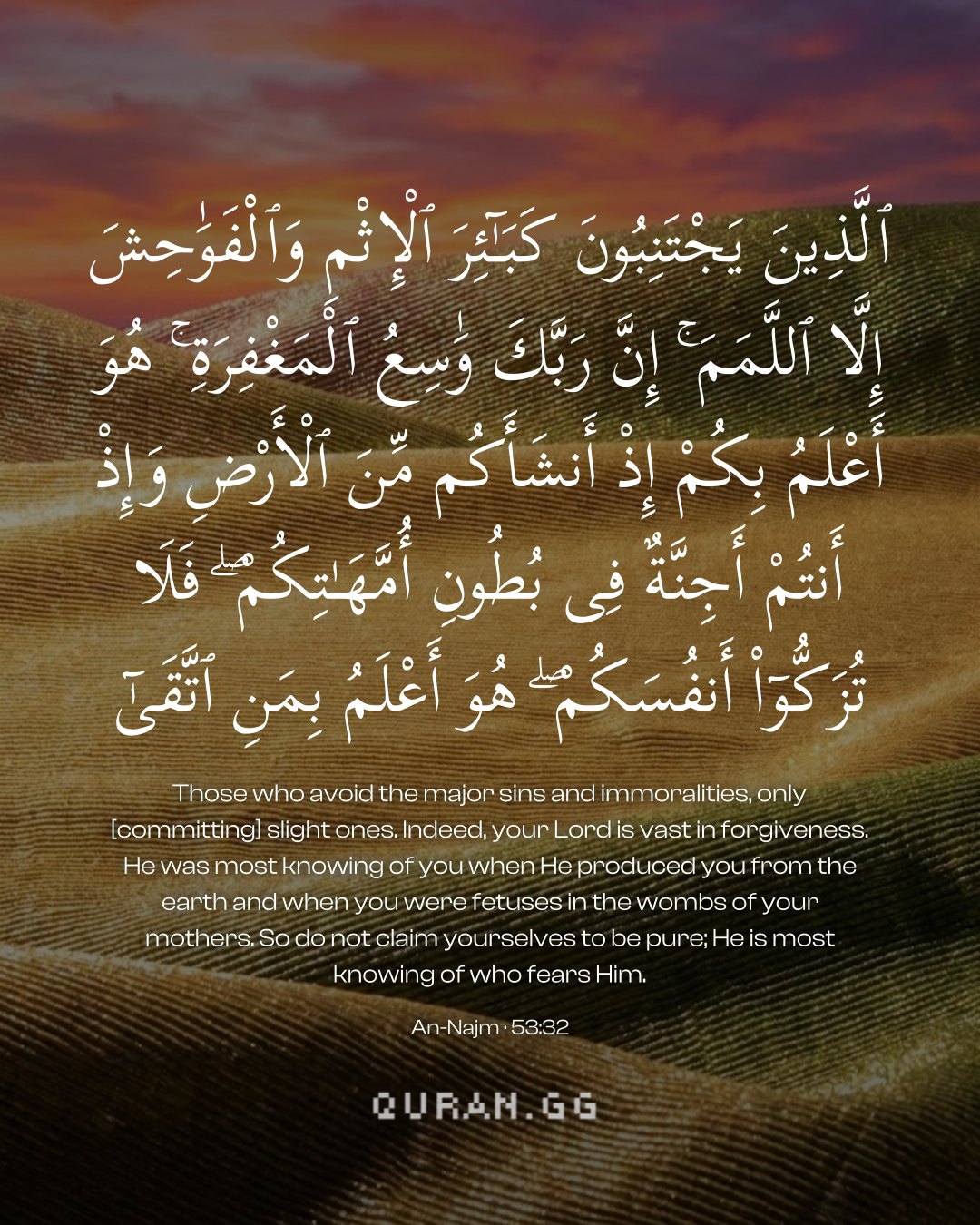
الَّذِينَ يَجْتَنِبُونَ كَبَائِرَ الْإِثْمِ وَالْفَوَاحِشَ إِلَّا اللَّمَمَ (those who abstain from the major sins and from shameful acts, except minor involvements....53:32) The preceding verse praises those who follow the right guidance of Allah and do good deeds. In the present verse, it is stated that the good-doers are those who avoid major sins and, especially immoral sins and shameful deeds. There is one exception made by the expression lamam [ which will be elaborated upon later ].It means that they sometimes do commit minor sins [ lamam ] but that does not exclude them from the category of being muhsinin [ good-doers ].
The Companions and their followers interpret the word لَمَم lamam in two different ways:
[ 1] Some commentators are of the view that it refers to small faults and minor errors which in Surah An-Nisa' has been described as sayyi'at: إِن تَجْتَنِبُوا كَبَائِرَ مَا تُنْهَوْنَ عَنْهُ نُكَفِّرْ عَنكُمْ سَيِّئَاتِكُمْ " (if you abstain from the major (sins) out of what you have been forbidden from We shall write off your minor sins - 4:31". Ibn-Kathir has reported this from Sayyidna Ibn ` Abbas and Abu Hurairah ؓ
[ 2] Some other scholars have held that lamam means, a sin that a person commits incidentally and then repents. After repentance, he never repeats it. Ibn Kathir has reported a narration from Ibn Jarir, first through Sayyidna Mujahid, and again through Sayyidna ` Ata', from Ibn ` Abbas ؓ and through Hasan Basri (رح) from Sayyidna Abu Hurairah ؓ . The gist of that narration too is that even if a person were to commit a major sin incidentally and repents, he will not be excluded from the ranks of the God-fearing people. Verse [ 135] of Surah 'Al-` Imran:
[ 3]
وَالَّذِينَ إِذَا فَعَلُوا فَاحِشَةً أَوْ ظَلَمُوا أَنفُسَهُمْ ذَكَرُوا اللَّـهَ فَاسْتَغْفَرُوا لِذُنُوبِهِمْ وَمَن يَغْفِرُ الذُّنُوبَ إِلَّا اللَّـهُ وَلَمْ يُصِرُّوا عَلَىٰ مَا فَعَلُوا وَهُمْ يَعْلَمُونَ ﴿135﴾
And those who, when they happen to commit a shameful act or wrong themselves, remember Allah, then, seek forgiveness for their sins - and who is there to forgive sins except Allah? - and do not persist in what they have done, knowingly. [ 3:135]
It should be noted that overwhelming majority of scholars concur that if a person persists in a minor sin and continues to do it in a determined way so that it becomes a habit, it will no longer be a minor sin, but will turn into a major sin. Therefore, Maulana Ashraf ` Ali Thanawi (رح) has explained the word lamam as those small sins in which the doer does not persist.
Definition of Major and Minor Sins
This subject is taken up in full detail in Surah An-Nisa' in this book Vol. 2/pp 404-410, under verse [ 31] إِن تَجْتَنِبُوا كَبَائِرَ مَا تُنْهَوْنَ عَنْهُ "If you abstain from major [ sins ] out of what you have been forbidden from, We shall write off your minor sins..." , [ q.v.].
هُوَ أَعْلَمُ بِكُمْ إِذْ أَنشَأَكُم مِّنَ الْأَرْضِ وَإِذْ أَنتُمْ أَجِنَّةٌ فِي بُطُونِ أُمَّهَاتِكُمْ (He knows you more than anyone else [ from a time ] when He created you from the earth and when you were embryos in the wombs of your mothers...53:32) The word ajinnatun is the plural of janin which means embryo or foetus. This verse purports to say that man does not have knowledge of himself as much as Allah knows him. When he went through the various phases of his creation in his mother's womb, he did not have any knowledge or sense. But his Creator knows fully well how wisely He was creating him. Thus he is made aware of his inability and lack of sufficient knowledge. Having said this, he is further made aware of the fact that any good he does is not his personal accomplishment. The ultimate source of his achievement is Allah: It is Allah who has given him limbs, organs and other parts of the body to perform the righteous deeds; it is He who has equipped him with the ability to move his limbs; then He has created the urge, will and determination to perform righteous actions. Hence, not even the greatest righteous, pious and God-fearing person has the right to pride upon his works and behave arrogantly. Besides, no one yet knows what the end result of his activities will be. Yet the end result is the most important factor in our life. Therefore, pride and arrogance is meaningless.
The concluding part of the verse puts it thus:
فَلَا تُزَكُّوا أَنفُسَكُمْ هُوَ أَعْلَمُ بِمَنِ اتَّقَىٰ
So, do not claim purity [ from faults ] for your selves. He knows best who is God-fearing... (53:32).
In other words, the merit of a person lies not only in his outer actions, but in taqwa in one's heart and in his inner moral excellence and uprightness which endures till his death. Only Allah knows who is perfect in this quality.
Sayyidah Zainab bint Abi Salamah ؓ was named by her parents as Barrah which means 'righteous or upright'. The Holy Prophet ﷺ recited the concluding part of this verse فَلَا تُزَكُّوا أَنفُسَكُمْ (Do not claim purity for your selves.) and suggested the name be changed. Therefore, they changed her name to 'Zainab'. Imam Ahmad records on the authority of ` Abdur-Rahman Ibn Abi Bakrah ؓ that a person praised another person in the presence of the Holy Prophet ﷺ . He stopped him and said "If you have to praise a person, then say, 'according to my knowledge the person appears to be upright and God-fearing وَلَا اُزَکِّی عَلَی اللہِ - and I cannot say that he is so` in the sight of Allah as well'.
Uthmani text of the Madinah mushaf (King Fahd Complex). Translation: Saheeh International. Tafsir via Quran.com.