Chastising Those Who disobey Allah and stop giving Charity
Allah the Exalted chastises those who turn away from His obedience,
فَلاَ صَدَّقَ وَلاَ صَلَّى - وَلَـكِن كَذَّبَ وَتَوَلَّى
(So he (the disbeliever) neither believed nor prayed! But on the contrary, he belied and turned away!)(75:31-32),
وَأَعْطَى قَلِيلاً وَأَكْدَى
(And gave a little, then stopped) Ibn `Abbas said, "Gave a little, then stopped giving." Similar was said by Mujahid, Sa`id bin Jubayr, `Ikrimah, Qatadah and several others. `Ikrimah and Sa`id said: "Like the case of a people who dig a well, during the course of which they find a rock preventing them from completing their work. So they say, `We are finished' and they abandon the work." Allah's statement,
Continue reading the tafsir of ayahs 33–41Ma'arif al-Qur'an
Mufti Muhammad Shafi
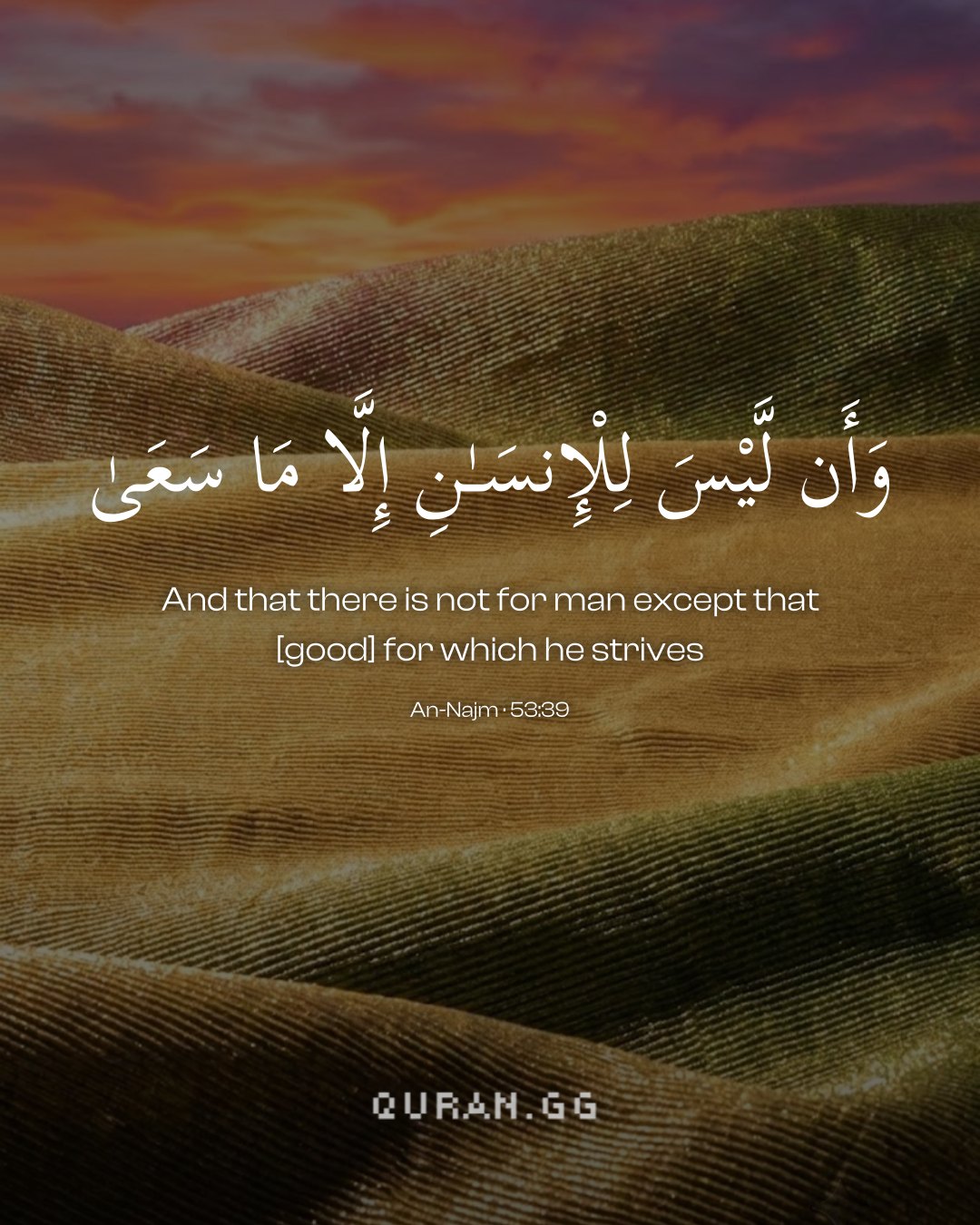
The second injunction is contained in verse [ 39[وَأَن لَّيْسَ لِلْإِنسَانِ إِلَّا مَا سَعَىٰ
(and that a man does not deserve but [ the reward of ] his own effort,....53:39) The summary of this verse is that just as no person shall carry the burden of sin of any other, so shall he benefit only from the good that he himself has done. It is not the case that a person performs a righteous act instead of someone else, and the latter is absolved of his responsibility. For example, if a person performs the obligatory prayers and fasts on behalf of somebody else, the latter will not be absolved of his religious duties and obligations. He is still liable for them. Likewise, if a person embraces faith on behalf of somebody else, the latter cannot be regarded as a believer.
Thus interpreted, no juristic problems arise in connection with this verse. However, some superficial questions do arise regarding Hajj and Zakah. In times of necessity Shari` ah permits to perform Hajj on behalf of somebody else, or pay Zakah on his behalf with his permission. How is this possible? A careful analysis of the two situations does not pose any problem: In the case of Hajj-e-Badal, the sender of a person to perform this type of pilgrimage bears the expenses himself, 2 and thus it is his [ the sender's ] own act for which he will be rewarded. In the case of Zakah, appointing someone to pay is also the act of the person who made the appointment, and not that of the appointee. Therefore, the two cases are not in conflict with verse [ 39].
(2). It should be kept in mind that this is allowed only when one is unable to perform Hajj due to a physical constraint, and therefore his obligation becomes limited to sending someone else with his own expense. (Muhammad Taqi Usmani)
Offering Reward of Good Deeds to others
In the foregoing section we have explained that verse [ 39] means that no person can perform an obligatory act, such as faith, prayers and fasts, on behalf of some other person to free him of his religious duties. He will be able to benefit only from the good he himself has done. This, however, does not imply that a person cannot perform supererogatory acts and proffer their reward to someone else. There is ample textual evidence of Shari'ah that a person can supplicate or give charity or do any other good deed and proffer its reward to others. Further, there is an overwhelming consensus of the Ummah on this issue. (Ibn Kathir)
However, only Imam Shafi` i (رح) differs on this issue. He says that the reward of recitation of the Qur'an cannot be proffered to anyone else. He takes the above verse in a general sense and argues that the rewards of the purely bodily acts of worship, such as the prayer, fasting and recitation of the Qur'an and so on, cannot be passed on to any other person. According to Imam Abu Hanifah (رح) and majority of the leading jurists, it is permissible. They are that just as it is possible to pray for and proffer the reward of charity to another person, so likewise it is possible to recite the Qur'an and perform other voluntary prayers to pass the reward to another person who will receive it. Qurtubi says, in his Tafsir, a large number of Traditions bear testimony to the fact that a believer will receive the reward of the righteous acts of another person. Tafsir Mazhari has, on this occasion, collected all the relevant Traditions which prove that another person does receive the benefit of اِیصِالِ ثَوَاب Isal-e-Thawab (proffering the reward of good acts).
The foregoing verses have elaborated on two issues with reference to the scriptures of Prophets Musa and Ibrahim (علیہما السلام) [ 1] No one will bear the burden of another's sin and punishment; and [ 2] No one shall be freed of his Shar’ i obligations, unless he himself performs them. These two rules of law were available in the Shari’ ah of all the Prophets. However, they are especially mentioned in relation to Musa and Ibrahim (علیہما السلام) probably because in their days an evil custom had taken deep root that the son used to be killed instead of the father; and father, brother, sister or some other member of the family used to be killed instead of the son. The Shari’ ah of these prophets abolished all the evil customs of the Dark Age.
Uthmani text of the Madinah mushaf (King Fahd Complex). Translation: Saheeh International. Tafsir via Quran.com.