Dawud and Sulayman (peace be upon them), the organization of Sulayman's Troops and His passage through the Valley of the Ants
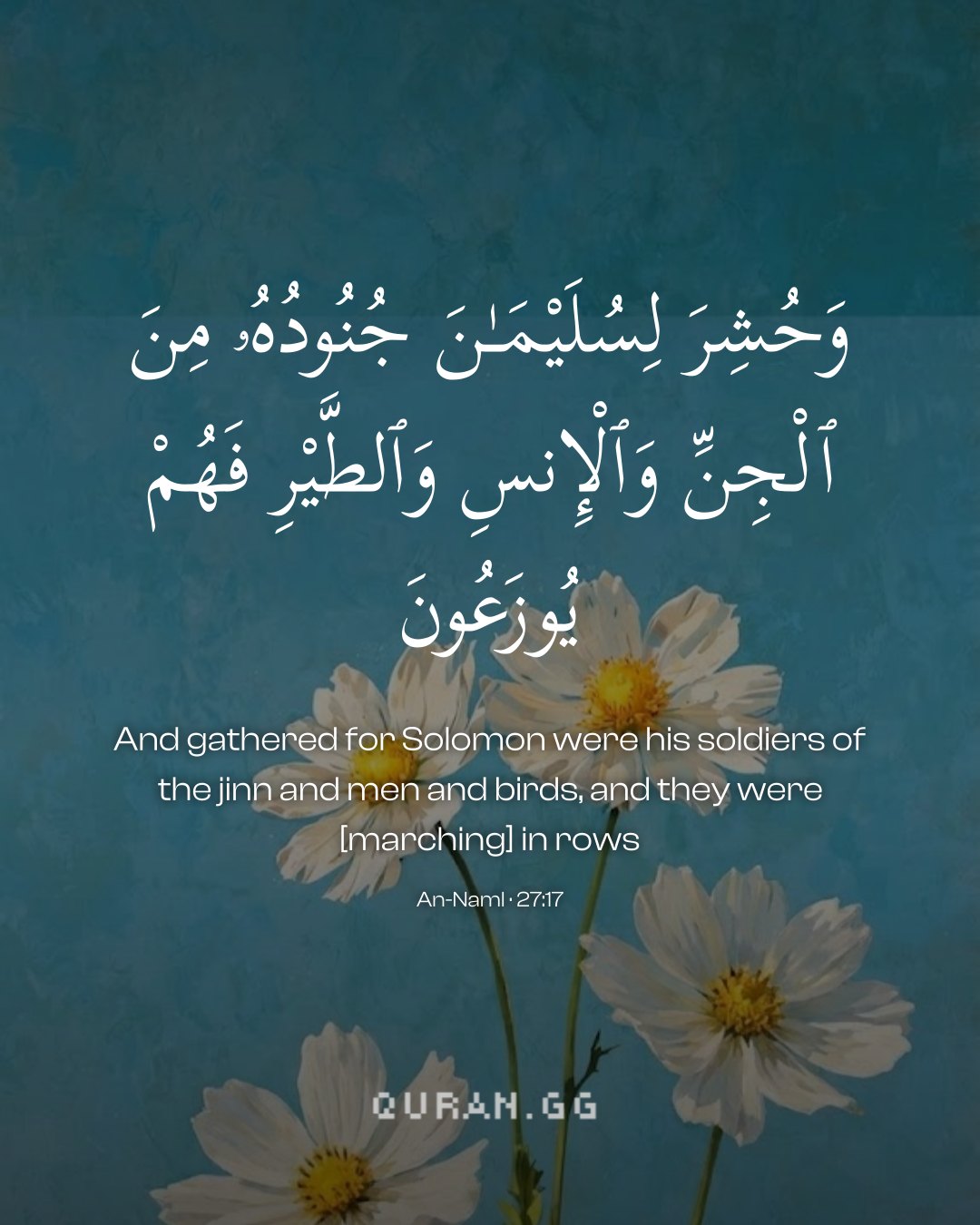
Here Allah tells us about the great blessings and favors which He bestowed upon two of His servants and Prophets, Dawud (David) and his son Sulayman (Solomon), peace be upon them both, and how they enjoyed happiness in this world and the Hereafter, power and authority in this world, and the position of being Prophets and Messengers. Allah says:
(And indeed We gave knowledge to Dawud and Sulayman, and they both said: "All the praises and thanks be to Allah, Who has preferred us above many of His believing servants!")
وَوَرِثَ سُلَيْمَانُ دَاوُودَ (And Sulaiman inherited Dawud - 27:16). The inheritance mentioned in this verse is not the inheritance of wealth and property, because the Holy Prophet ﷺ has clearly declared that the prophets do neither inherit the property of anyone nor does their property is inherited by anyone. Tirmidhi and Abu Dawud have reported from Sayyidna Abu darda' ؓ that the Holy Prophet ﷺ has said, ` Ulama' (men of knowledge) are the inheritors of prophets, but the prophets did not leave dirhams or dinars (wealth) as their inheritance; instead, they have left knowledge as their heritage. Al-Kulaini, the famous Shiite scholar, has reported from Sayyidna Ja'far As-sadiq that he said, "Sayyidna Sulaiman علیہ السلام was the inheritor of Sayyidna Dawud (علیہ السلام) ، and the Holy Prophet ﷺ was the inheritor of Sayyidna Sulaiman (علیہ السلام) . (Ruh from al-Kulaini). This statement makes the issue very clear that the inheritance is used here in the sense of heritage of knowledge (because nobody can claim that the Holy Prophet ﷺ inherited the property of Sulaiman (علیہ السلام) . Rationally speaking also, here inheritance cannot mean wealth, because when Sayyidna Dawud (علیہ السلام) died he had 19 sons, hence if inheritance of wealth was meant to be distributed, then all these sons would have been entitled for the inheritance, and it cannot be exclusive to Sayyidna Sulaiman علیہ السلام alone. It is, therefore, quite clear that the inheritance meant here is the one in which the brothers were not included and only Sayyidna Sulaiman (علیہ السلام) was the inheritor. This could only be the inheritance of knowledge and prophethood. Along with that inheritance, Allah Ta’ ala also graced him with the empire of Sayyidna Dawud (علیہ السلام) and furthermore control over the Jinns, birds, animals and the wind. In the light of these proofs, the narration of Tabrasi is proved to be wrong in which he has regarded inheritance as that of wealth on authority of some Imams of Ah1-ul-Bait. (Ruh)
David was the prophet and king of the Children of Israel. His son, Solomon, succeeded him as prophet and king. Solomon’s empire extended from Palestine to Transjordan. God had given him different kinds of useful knowledge. Also, he was blessed with many things by way of miracles, for example, his ability to understand the language of birds, train them and use them to transmit messages, etc. Solomon enjoyed extraordinary superiority over his contemporaries. But this superiority only created a feeling of humility in him. Whatever he had he considered a direct gift from God. The period of Solomon’s empire extended from 965 B.C. to 926 B.C.
Uthmani text of the Madinah mushaf (King Fahd Complex). Translation: Saheeh International. Tafsir via Quran.com.