How the Hoopoe came before Sulayman and told Him about Saba'
Allah says:
فَمَكَثَ غَيْرَ بَعِيدٍ
(But (the hoopoe) stayed not long,) meaning, he was absent for only a short time. Then he came and said to Sulayman:
أَحَطتُ بِمَا لَمْ تُحِطْ بِهِ
(I have grasped which you have not grasped) meaning, `I have come to know something that you and your troops do not know.'
وَجِئْتُكَ مِن سَبَإٍ بِنَبَإٍ يَقِينٍ
(and I have come to you from Saba' with true news.) meaning, with true and certain news. Saba' (Sheba) refers to Himyar, they were a dynasty in Yemen. Then the hoopoe said:
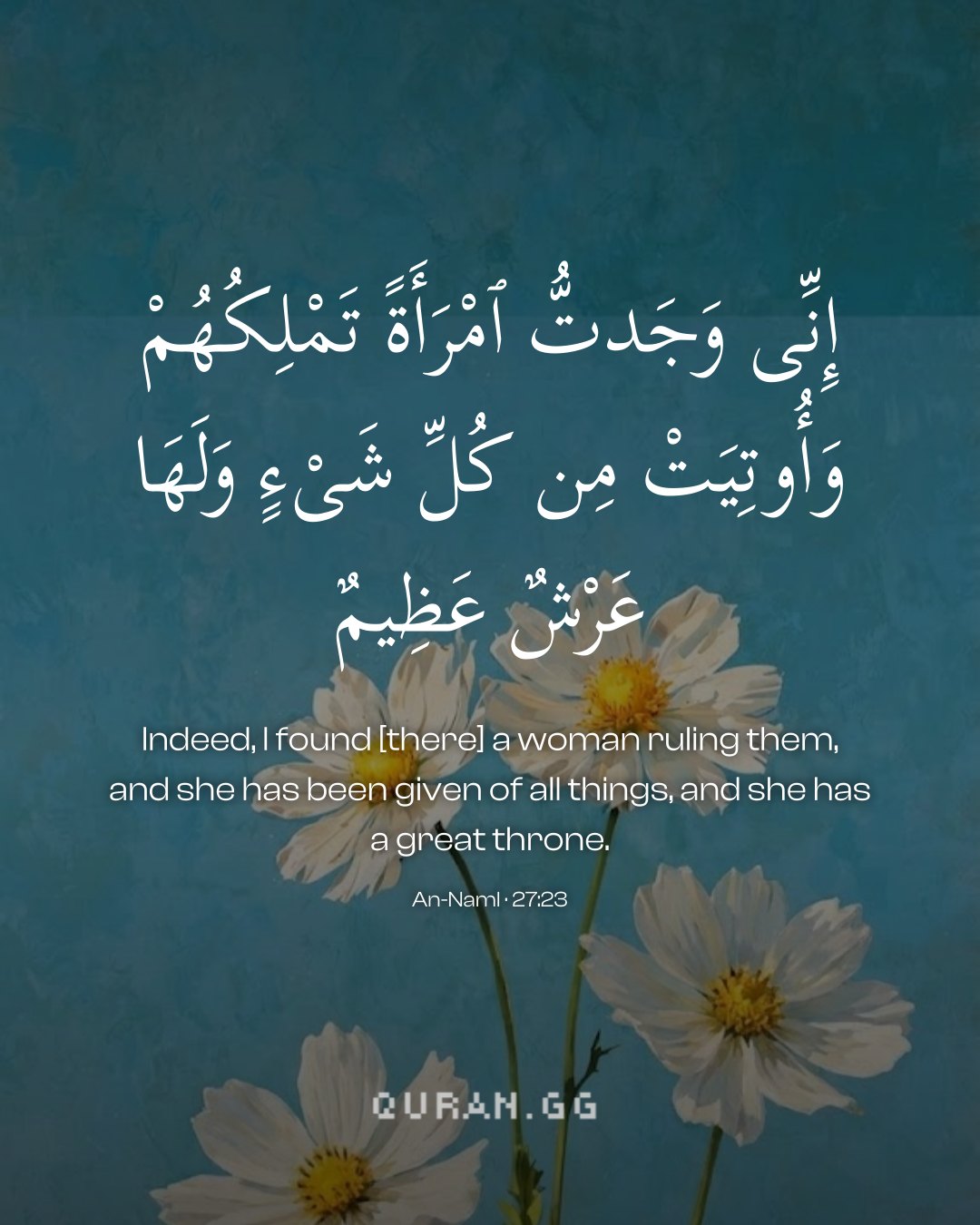
إِنِّى وَجَدتُّ امْرَأَةً تَمْلِكُهُمْ
(I found a woman ruling over them,) Al-Hasan Al-Basri said, "This is Bilqis bint Sharahil, the queen of Saba'." Allah's saying:
Continue reading the tafsir of ayahs 22–26Ma'arif al-Qur'an
Mufti Muhammad Shafi
إِنِّي وَجَدتُّ امْرَأَةً تَمْلِكُهُمْ
I have found a woman ruling over them, - 27:23
The name of this woman is given in the history as Bilqis, daughter of Sharahil. But in some other narrations, it is mentioned that her mother was a jinni whose name was Bal'amah, daughter of Shisan. (Wuhaib b. Jarir has reported this from Khalil Ibn Ahmad, Qurtubi) Her grandfather, Hudahud, was a great king and controlled the entire land of Yemen. He had forty sons. All these sons became kings. Her father, Surah, had married a jinni woman, who gave birth to her (Bilqis). Different reasons are given for his marriage to a jinni. One of them being that he used to say with arrogance "No one from you is a match for me; hence I will not marry. It is because I do not like marrying outside my matching clan". As a result of this, people got him married to a jinni woman. (Qurtubi) Perhaps it was his conceit that he deemed his own people as not his equal. This did not go well with the Divine writ and he was made to marry a jinni woman, who was neither from his family nor his kind or race.
Is it permissible to marry a jinni?
Some people have expressed doubt on the question, because they thought the jinns are not capable of reproducing like the humans. Ibn-al-` Arabi has opined in his commentary that this is a wrong conception. It is established through authentic ahadith that jinns also possess all the requisites of reproduction and the essentials of male and female, as in humans.
There is another aspect to this question from the angle of Islamic law. That is, whether it is permissible for a man to marry a jinni woman? On this aspect there are different views of the Islamic jurists. Some have ruled that it is permissible, while others have ruled it out, because of their different kind, like the animals. In the book named as (آکام المرجان فی أحکام الجانّ ) this subject is discussed in detail, where some incidents are quoted mentioning that Muslim men married Muslim jinni women, and they also gave birth to children. Here this subject is irrelevant, because the father of Bilqis, who married the jinni woman, was not a Muslim. Hence, the question of permissibility does not arise here. In Islamic law the lineage is based on father, and the father of Bilqis was a human. Therefore, Bilqis would also be regarded as a human. In some narrations, marriage of Sulaiman (علیہ السلام) with Bilqis is mentioned. Even if these narrations are correct, it does not corroborate permissibility to marry a jinni woman, because Bilqis herself was not a jinni, though her mother might have been one. Only Allah knows best. The marriage of Sulaiman (علیہ السلام) will be discussed later in this commentary.
Is it permissible for a woman to be king or the head or Imam of a people?
It is reported in Sahih al-Bukhari on the authority of Sayyidna Ibn ` Abbas ؓ ، that when the Holy Prophet ﷺ learnt that the people of Persia have made the daughter of Kisra as their queen, he (ﷺ) said لَن یُّفلِحَ قَومُ وَلَّوا اَمرَھُم اِمرأَۃً . That is, "Those people will never prosper who give control of authority to a woman". It is for this verdict that scholars are unanimous on the point that the control of a government, an empire or caliphate cannot be assigned to a woman. Rather the greater imamah (al-imamah al-kubra) is also allowed only to men folk, like the Imamah for prayers. As for Bilqis being the queen of Saba', it does not make it to be a religious decree, unless it is proven that Sayyidna Sulaiman (علیہ السلام) had married her, and then retained her as the queen. This assumption is not proven by any authentic narration, which could be trusted for the purpose of legislation of religious laws.
وَأُوتِيَتْ مِن كُلِّ شَيْءٍ
She has been given of everything - 23
It means that whatever services are needed to a king or an aristocrat according to their time, they all were available to her. It is, however, obvious that those things that were not invented by then, their unavailability is not in conflict with this verse.
وَلَهَا عَرْشٌ عَظِيمٌ (And she has a great throne - 23) Literal meaning of ` Arsh (عَرش) is throne of the empire. A narration is attributed to Sayyidna Ibn ` Abbas ؓ ، ' that the length of the throne of Bilqis was eighty yards, its breadth was forty yards and height thirty yards. It was profusely decorated with pearls, red rubies, topaz and olivine, and its legs were studded with precious stones and pearls. Its curtains were made of silk and fine cloth. The throne was secured within seven buildings, one within the other, all well protected and locked.
Uthmani text of the Madinah mushaf (King Fahd Complex). Translation: Saheeh International. Tafsir via Quran.com.