Allah commands His Messenger to inform all of creation that no one among the dwellers of heaven and earth knows the Unseen, except Allah.
إِلاَّ اللَّهُ
(except Allah) This is an absolute exception, meaning that no one knows this besides Allah, He is alone in that regard, having no partner in that knowledge. This is like the Ayat:
(Verily, Allah, with Him is the knowledge of the Hour, He sends down the rain) (31:34). until the end of the Surah. And there are many Ayat which mention similar things.
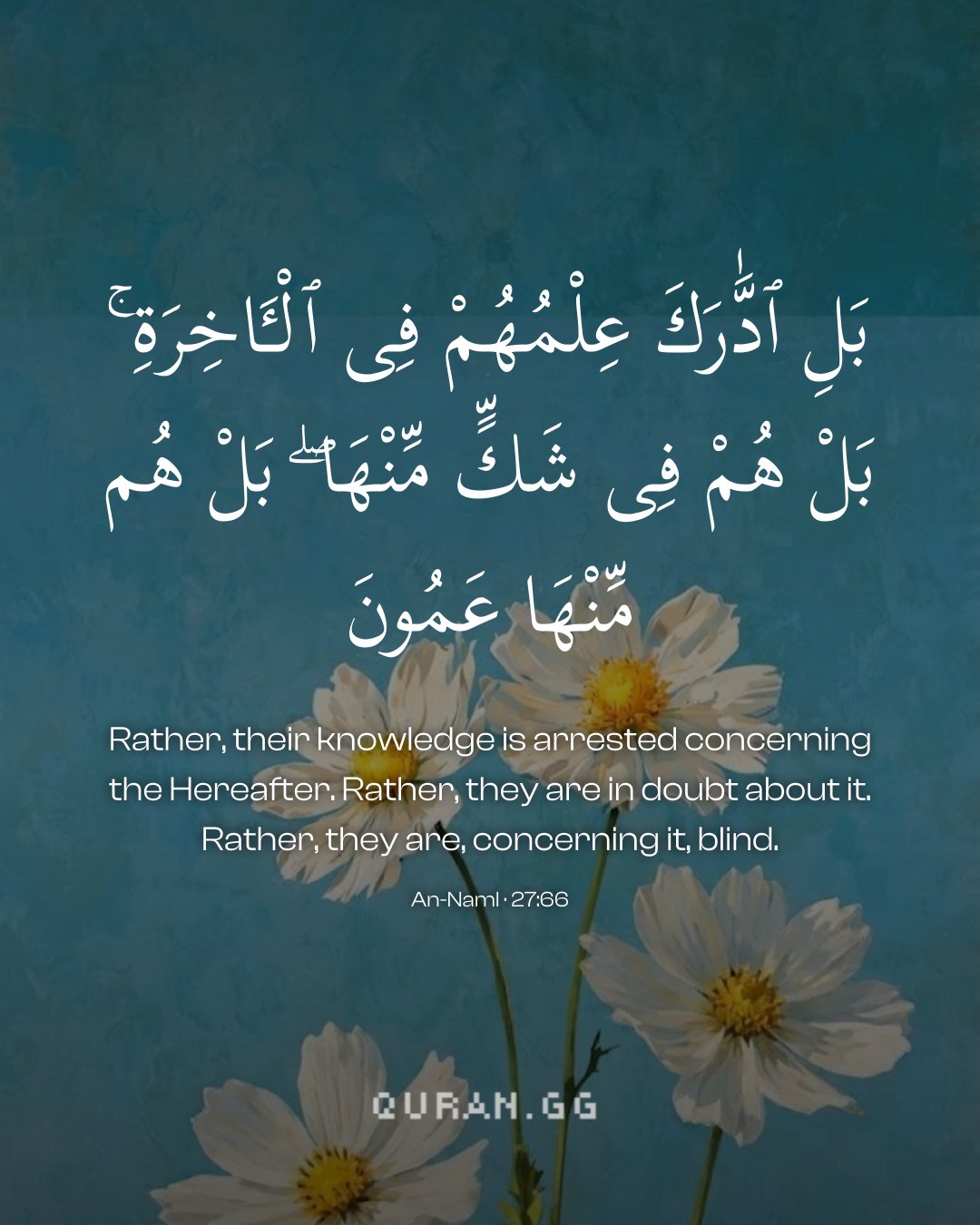
Rather, their knowledge failed in the matter of Hereafter. Rather, they are in doubt about it. Rather, they are blind to it. 27:66.
There are different recitations for the word اِدّٰرَکَ (iddaraka) and their meanings are also different. Those who are interested should refer to different commentaries for the details. It is enough to understand here that some commentators have taken it to mean "completion" and have explained the verse thus: "Their knowledge and understanding will be completed in the Hereafter", because then the truth about every thing shall be laid bare. But knowledge of truth at that time will be of no avail, because they had been contradicting the Hereafter in the world. But some other commentators have taken the word in the meaning of 'having failed' and 'hating been lost'. The sense in this case would be that their knowledge about the Hereafter was lost, and they could not understand what it was.
Tazkirul Quran
Maulana Wahiduddin KhanOn ayahs 64–68
The needs of man are fulfilled as a result of the perfect co-ordination between all the factors in the Universe. We must ask who, other than Almighty God, can assemble all the favourable factors on such a large scale? Similarly, the displacement of a nation or race and another nation taking its place, the sailing of a ship, and in the modern age the flying of an aeroplane in darkness as well as in daylight by taking advantage of technological advances, the rising of water vapour from the sea and its subsequent descent in the shape of rain. The creation of things out of nothing and their resurrection, the provision of all kinds for man on a large scale—all these result solely from the instrumentality of Almighty God. This is true of all of the world’s events. Here, to cause a single event to take place, it is necessary to activate innumerable factors, and this can be done only by that Being who has control of the whole universe. In this context, how foolish it is to make anybody other than God the centre of adoration and worship!
Uthmani text of the Madinah mushaf (King Fahd Complex). Translation: Saheeh International. Tafsir via Quran.com.