The Necessity of Referring to What Allah has Revealed for Judgement
Allah says to His Messenger, Muhammad ﷺ,
إِنَّآ أَنزَلْنَا إِلَيْكَ الْكِتَـبَ بِالْحَقِّ
(Surely, We have sent down to you the Book in truth) meaning, it truly came from Allah and its narrations and commandments are true. Allah then said,
لِتَحْكُمَ بَيْنَ النَّاسِ بِمَآ أَرَاكَ اللَّهُ
(that you might judge between men by that which Allah has shown you,) In the Two Sahihs, it is recorded that Zaynab bint Umm Salamah said that Umm Salamah said that the Messenger of Allah ﷺ heard the noise of disputing people close to the door of his room, and he went out to them saying,
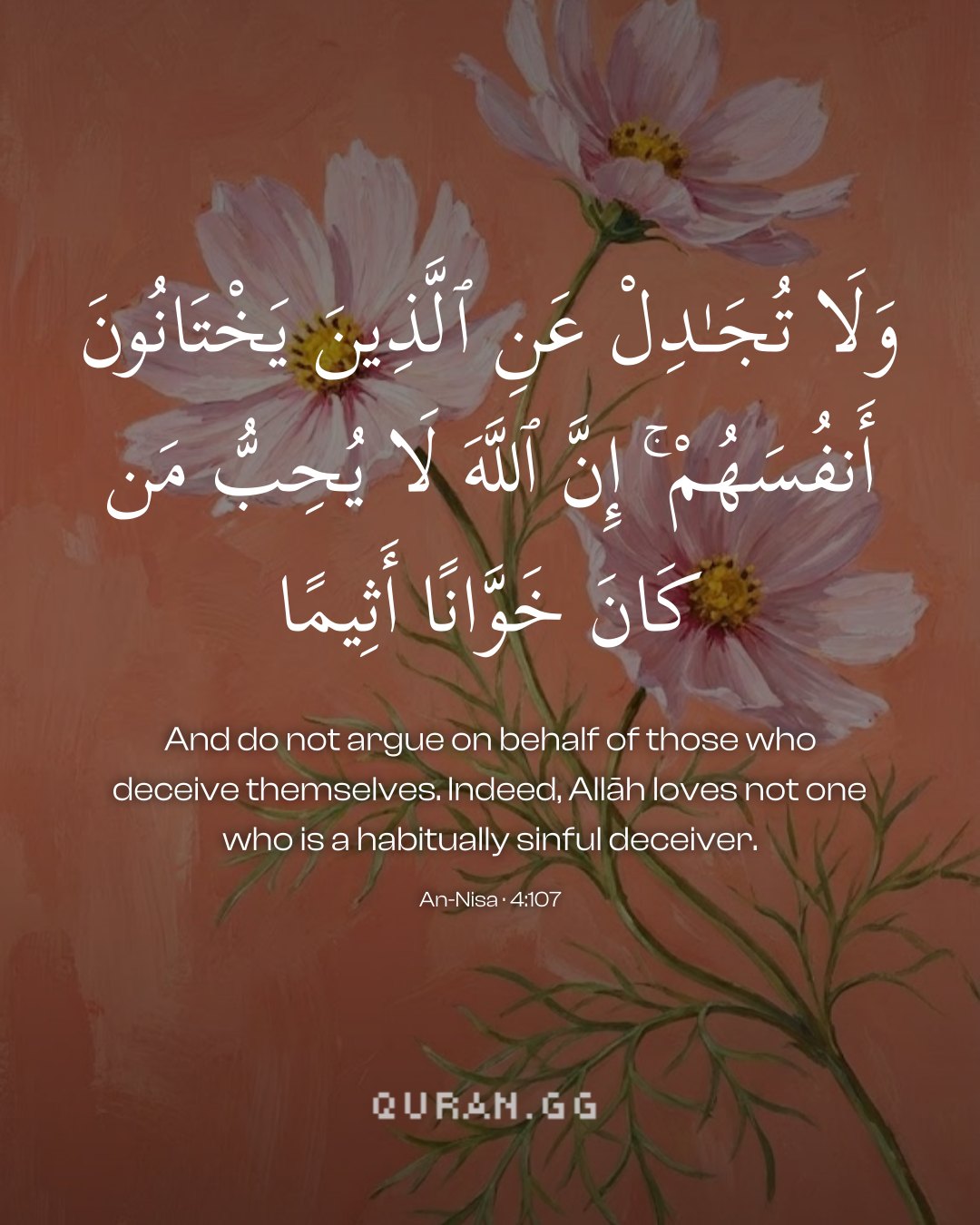
In the third verse (107), it has been emphatically asserted once again that the Messenger of Allah should not defend those who are disloyal and treacherous, for Allah does not like them.
Tazkirul Quran
Maulana Wahiduddin KhanOn ayahs 106–107
Living along with others is a need felt by every human being. It is this need that creates the nation or the community. A man has his strength enhanced a thousand times by association with his own community. However, something which initially came into existence as a human need for social cohesion, gradually takes on the status of a social religion. The community or the nation becomes a goal in itself. This leads to the mentality, ‘My community right or wrong. It is my community, whether based on truth or falsehood.’ Thus people consider their own circle as important and that of others as unimportant. It is considered that a man belonging to their own circle, even if he is in the wrong, must be supported, while another associated with a different group or community, though right and justified, receives no support. A group with this mentality can be said to have taken communal expediencies and group bias as the criteria by which to judge right and wrong. On the contrary one should regard God’s command as the standard by which to make judgements. If someone errs, he must be checked without prejudice or favouritism. If someone stands for truth, he must be supported—even though associated with another group. Even in a situation where two persons are involved, one from one’s own group and the other from some other group, matters must be looked into on the basis of truth and untruth, ignoring all other considerations. One should always associate oneself with the truth.
Uthmani text of the Madinah mushaf (King Fahd Complex). Translation: Saheeh International. Tafsir via Quran.com.