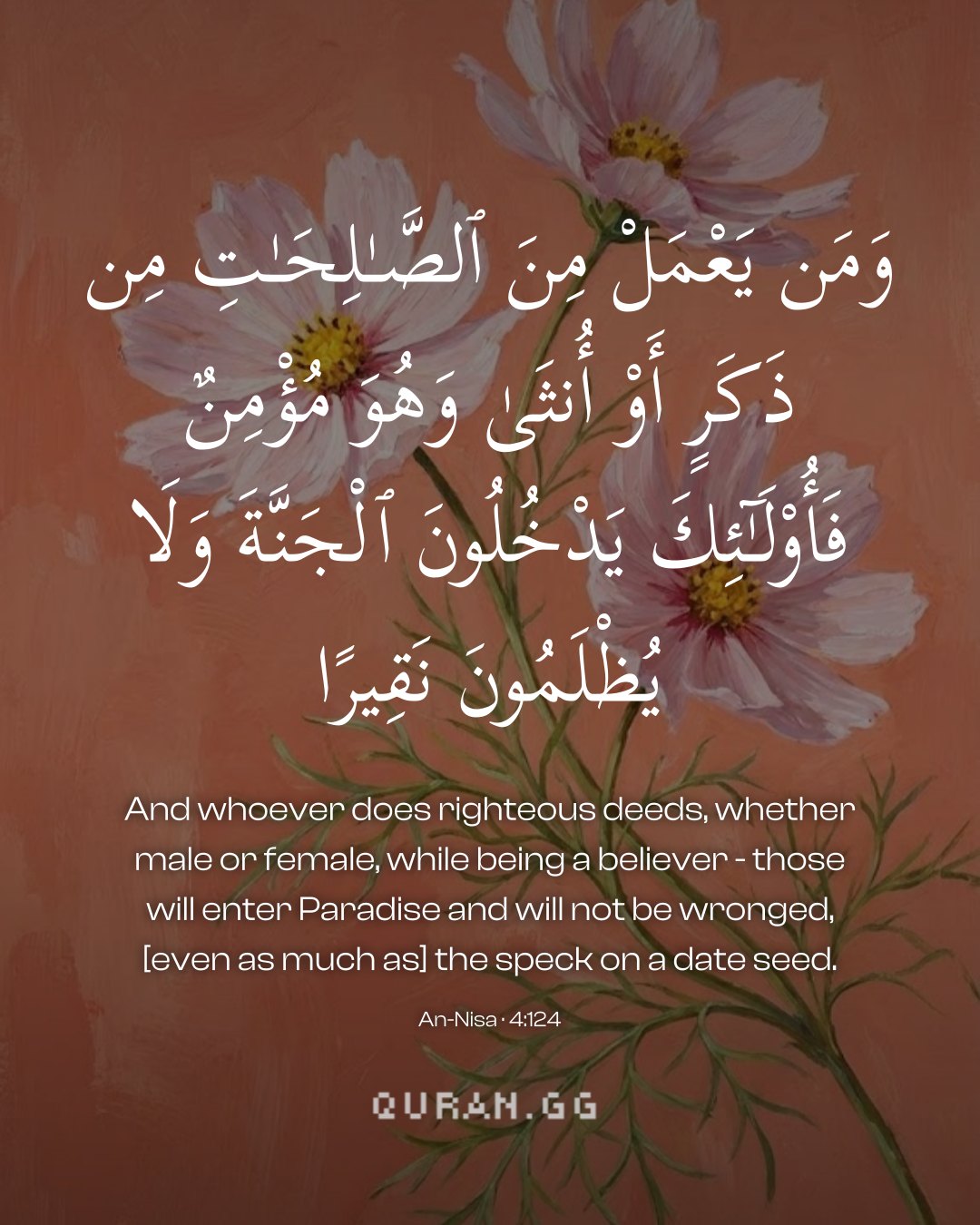
And whoever does righteous deeds, whether male or female, while being a believer - those will enter Paradise and will not be wronged, [even as much as] the speck on a date seed.
Success is Only Achieved by Performing Righteous Deeds, not Wishful Thinking
Qatadah said, "We were told that the Muslims and the People of the Scriptures mentioned their own virtues to each other. People of the Scriptures said, `Our Prophet came before your Prophet and our Book before your Book. Therefore, we should have more right to Allah than you have.' Muslims said, `Rather, we have more right to Allah than you, our Prophet is the Final Prophet and our Book supersedes all the Books before it.' Allah sent down,
(It will not be in accordance with your desires (Muslims), nor those of the People of the Scripture (Jews and Christians), whosoever works evil, will have the recompense thereof),
Verse 124 says: وَمَن يَعْمَلْ مِنَ الصَّالِحَاتِ مِن ذَكَرٍ أَوْ أُنثَىٰ وَهُوَ مُؤْمِنٌ فَأُولَـٰئِكَ يَدْخُلُونَ الْجَنَّةَ وَلَا يُظْلَمُونَ نَقِيرًا ﴿124﴾. It means a man or woman who does good deeds, subject to the condition that such deeds issue forth from true faith, shall certainly go to Paradise fully rewarded for all his or her deeds without being wronged in the least. The hint given here is that the People of the Book or other non-Muslims may also have some good deeds of their own, but, since their faith is not sound, therefore, those deeds of theirs are not acceptable. As for Muslims, since their faith is sound and their deeds too are good, therefore, they are the successful ones, and superior to others.
Acceptability in the sight of Allah: A Criterion
The fourth verse (125) lays down a criterion to help determine correctly as to who is acceptable in the sight of Allah, and who is not. This criterion has two components. Any shortfall in either of the two components makes all efforts go waste. A careful look will reveal that all strayings into error and evil, wherever they may be in this wide world, are triggered because of a shortfall in one of these two components. Compare Muslims with non-Muslims. Or, compare the different sects, groups and parties within the Muslim community itself. You will come across the same two points of reference - any deviation from either is bound to land one in disgrace.
Tazkirul Quran
Maulana Wahiduddin KhanOn ayahs 124–125
When the People of the Book, that is, believers in God and the Hereafter, become engrossed in the world, they do not do so by refusing to believe in God and the existence of the Hereafter. What they do is believe in these realities in the formal sense while, in practice, devoting all their efforts to worldly acquisition. They are very serious about the attainment of worldly honour and glory. They know that to achieve success in this world one must struggle. But for the attainment of Paradise, wishful thinking alone is believed to suffice. For instance, through the blessing of some saint, association with a certain group, recitation of some words and phrases, in short, by such cheap formulae or superficial actions, it is hoped that they will be saved from the raging fire of Hell and be ushered into Heaven. Such wishful thinking, in whatever beautiful words it may have been couched, is not going to come to their rescue. God’s system is established on such firm grounds that all divine verdicts are based on realities and not on wishful thinking. In God’s court everyone will be judged exactly in accordance with his actions. There will be nothing other than the law of justice promulgated by God Himself to influence His decisions.
Uthmani text of the Madinah mushaf (King Fahd Complex). Translation: Saheeh International. Tafsir via Quran.com.