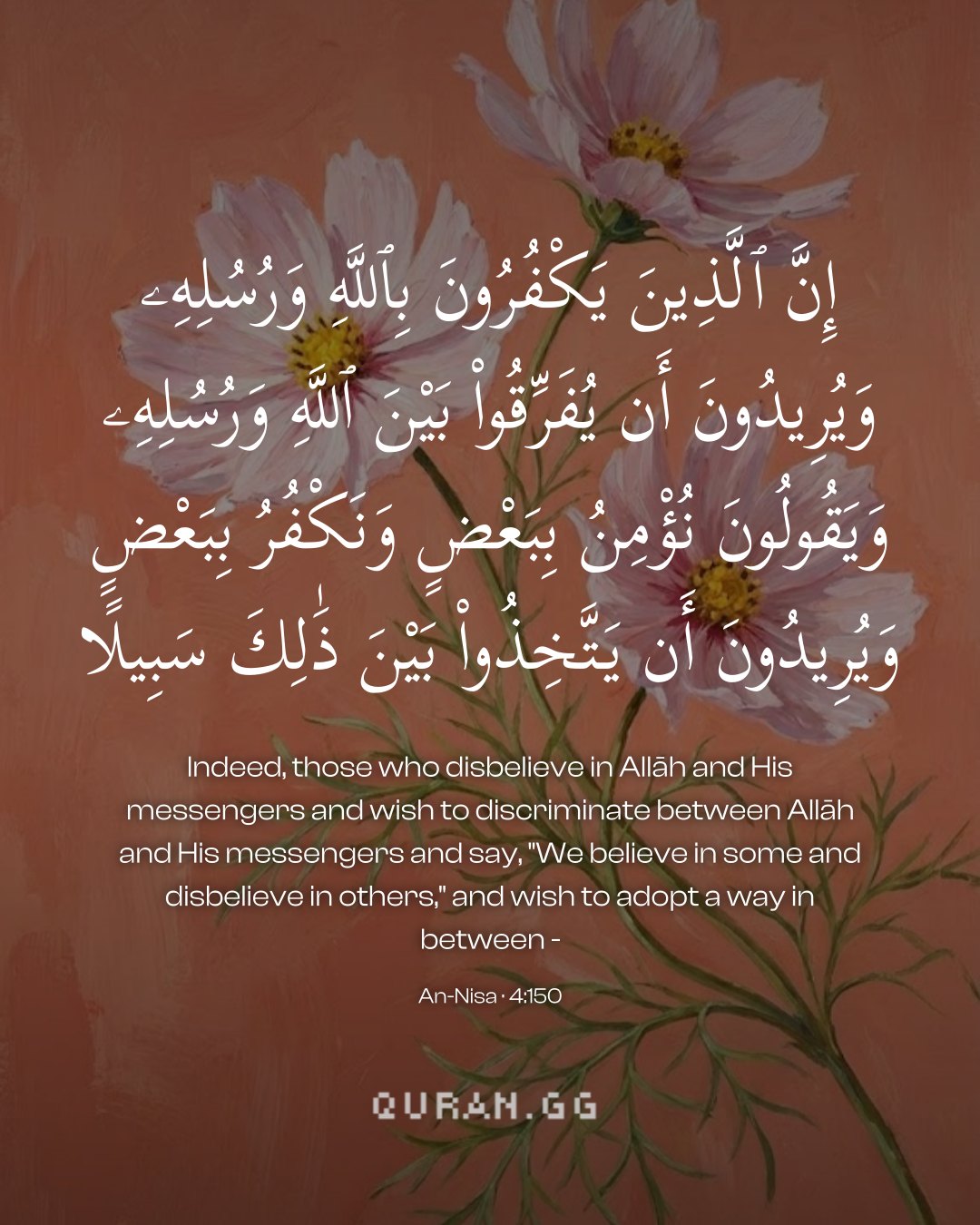
Indeed, those who disbelieve in Allāh and His messengers and wish to discriminate between Allāh and His messengers and say, "We believe in some and disbelieve in others," and wish to adopt a way in between -
Believing in Some Prophets and Rejecting Others is Pure Kufr
Allah threatens those who disbelieve in Him and in His Messengers, such as the Jews and Christians, who differentiate between Allah and His Messengers regarding faith. They believe in some Prophets and reject others, following their desires, lusts and the practices of their forefathers. They do not follow any proof for such distinction, because there is no such proof. Rather, they follow their lusts and prejudices. The Jews, may Allah curse them, believe in the Prophets, except `Isa and Muhammad, peace be upon them. The Christians believe in the Prophets but reject their Final and Seal, and the most honored among the prophets, Muhammad, peace be upon him. In addition, the Samirah (Samaritans) do not believe in any Prophet after Yuwsha` (Joshua), the successor of Musa bin `Imran. The Majus (Zoroastrians) are said to believe only in a Prophet called Zoroaster, although they do not believe in the law he brought them casting it behind them, and Allah knows best. Therefore, whoever rejects only one of Allah's Prophets, he will have disbelieved in all of them, because it is required from mankind to believe in every prophet whom Allah sent to the people of the earth. And whoever rejects one Prophet, out of envy, bias and personal whim, he only demonstrates that his faith in other Prophets is not valid, but an act of following desire and whim. This is why Allah said,
إِنَّ الَّذِينَ يَكْفُرُونَ بِاللَّهِ وَرُسُلِهِ
(Verily, those who disbelieve in Allah and His Messengers...) Thus, Allah describes these people as disbelievers in Allah and His Messengers;
(saying, "We believe in some but reject others," and wish to adopt a way in between.) Allah then describes them;
أُوْلَـئِكَ هُمُ الْكَـفِرُونَ حَقّاً
(They are in truth disbelievers.) meaning, their disbelief in the Prophet they claim to believe in is clear. This is because their claimed faith in a certain Messenger is not true, for had they truly believed in him, they would have believed in other Messengers, especially if the other Messenger has a stronger proof for his truthfulness. Or at least, they would have strived hard to acquire knowledge of the truth of the other Messenger. Allah said,
وَأَعْتَدْنَا لِلْكَـفِرِينَ عَذَاباً مُّهِيناً
(And We have prepared for the disbelievers a humiliating torment.) This is just punishment for belittling the Prophets whom they disbelieved in, by ignoring what the Prophet brought to them from Allah, and because they are interested in the insignificant possessions of this world. Or, their behavior could be the result of their disbelief in the Prophet after they were aware of his truth, just as the Jewish rabbis did during the time of Muhammad, the Messenger of Allah ﷺ . The Jews envied the Messenger because of the great prophethood that Allah gave him, and as a consequence, they denied the Messenger, defied him, became his enemies and fought against him. Allah sent humiliation upon them in this life, that shall be followed by disgrace in the Hereafter,
(And they were covered with humiliation and misery, and they drew on themselves the wrath of Allah.) in this life and the Hereafter. Allah's statement,
(And those who believe in Allah and His Messengers and make no distinction between any of them,) This refers to the Ummah of Muhammad ﷺ who believe in every Book that Allah has revealed and in every Prophet whom Allah has sent. Allah said,
(The Messenger believes in what has been revealed to him from his Lord, and (so do) the believers. All of them believe in Allah.) (2:285). Allah then states that He has prepared great rewards for them, tremendous favor and a handsome bounty,
أُوْلَـئِكَ سَوْفَ يُؤْتِيهِمْ أُجُورَهُمْ
(We shall give them their rewards;) because of their faith in Allah and His Messengers,
وَكَانَ اللَّهُ غَفُوراً رَّحِيماً
(and Allah is Ever Forgiving, Most Merciful.) for their sin, if they have any.
Ma'arif al-Qur'an
Mufti Muhammad ShafiOn ayahs 150–151
Salvation depends on Islam
This clear verdict of the Holy Qur'an has exposed the rudderless and crooked ways of those who, in an effort to appear tolerant in dealings with peoples of other faiths, would like to present their religion and religious beliefs as gifts on a platter. By doing so, they wish to tell - despite and contrary to the clear injunctions of the Qur'an and Sunnah - people of other faiths that Muslims do not think that salvation depends on Islam alone and a Jew could keep to his or her creed and a Christian to his or hers and yet, both could look forward to salvation; though, they deny all prophets or at least some of them, for which reason this verse has declared them to be the kind of disbelievers who are destined for Hell.
There is no doubt about the fact that Islam stands unmatched in its attitude to non-Muslims in matters of justice and fairness, sympathy and goodwill, favour and tolerance. But, good favours can be made within the limits of one's rights and possessions. Religious principles and articles of faith are not our property which we could donate or present to somebody. Of course, Islam is generous and benevolent in its teachings of tolerance and good treatment with non-Muslims, but it is also equally cautious and firm in the defence of its frontiers. It maintains its essential approach of all possible sympathy and maximum tolerance with non-Muslims, but, at the same time, Islam absolves itself decisively from all forms of disbelief and customs woven around it, declaring Muslims as a people distinct from non-Muslims - and yet, it provides full protection to their national hallmarks. In short, Islam prefers to keep not only the acts of worship Muslims perform distinct from those of others, but also its way of life in a society, the examples of which abound in the Qur'an and Sunnah.
Had Islam believed in the possibility of salvation through every religion or community, it would have had no right to lay so much stress on spreading the message (Tabligh تَبلِیغ) of Islam, almost to the limit of staking property and life for it. This would have been wrong in principle and quite contrary to dictates of reason. In fact, by accepting such a premise, the very coming of the noble Prophet, may the blessings of Allah and peace be upon him, and the revelation of the glorious Qur'an, is rendered, God forbid, redundant. And, lest we miss, the entire Jihad carried out by the noble Prophet ﷺ and the rightly-guided Caliphs ؓ becomes meaningless, rather reduced to nothing but the lust for more land.
In this case, some people have fallen victims to doubt by a misreading of verse 62 in Surah al-Baqarah which is cited below:
Surely, those who believed in Allah, and those who happened to be Jews and Christians, and the Sabeans - whosoever believes in Allah and in the Last Day, and does good deeds - they have their reward with their Lord. And there is no fear for them nor shall they grieve.
Since, in this verse, rather than giving the full detail of what constitutes faith, only belief in Allah and in the Last Day has been considered sufficient, those who try to understand the Qur'an through an incomplete study have misunderstood the whole idea. They assumed that simply believing in Allah and the Last Day is enough for salvation and that believing in prophets is no condition for it: Thus, they failed to understand that the Qur'an has its own terminology in which Belief in Allah, in order to be acceptable, has to be in conjunction with Belief in the Prophet. Otherwise, even the Satan admits that there is a God and that He is One. The Holy Qur'an has itself clarified the real issue in the following words:
So, if they believe in the like of what you believe in, they have certainly found the right path. And if they turn away, they are nothing but in antagonism. Then Allah will suffice you against them, and He is the All-Hearing, the All-Knowing. (2:137)
In other words, we can say that their faith will be valid and trust-worthy only when they have the same faith as common Muslims do, a faith in which Belief in the Prophet is indispensably necessary with Belief in Allah. Otherwise, if they do not do that, let it be understood that they are the ones who wish to create dissension. After that, for them, Allah will be sufficient on your behalf, and He is the One who hears everything and He is the One who knows everything.
As for the verses under discussion, it has been clearly declared that anyone who rejects even one of the prophets of Allah is an avowed disbeliever (kafir) and a recipient of the punishment of Hell. So, let us remember that Belief in Allah, in order to be valid, has to be with Belief in the Prophet. If the Belief in the Prophet is not there, even referring to Belief in Allah as such will not be correct.
Tazkirul Quran
Maulana Wahiduddin KhanOn ayahs 149–151
In spite of knowing Islam to be the true religion, the hypocrites do not want to abandon their worldly interests. Due to this mentality they are distracted, being fully devoted neither to the demands of their religion nor to their worldly interests. They fall between two stools, vacillating between faith and infidelity—between the interests of this world and the Hereafter. Such people remain deprived of God’s succour, which can be earned only by perseverance in God’s cause. Such hypocritical people cannot save themselves from the wrath of God, regardless of how many showy actions they may have performed. In spite of the observance of Islam for appearance’s sake, they are far from it in respect of reality. That is why their reward will be meted out to them in accordance with what they were in reality, and not what they were in terms of appearance. However, even if one errs, God does not become one’s enemy. If wrongdoers are ashamed of their misdeeds, change their life style, divert their full attention to God and take to His path wholeheartedly, then He will surely forgive them. In life one often comes to know about some shortcoming or fault, or vice of oneself, be it of a religious or worldly nature, through the people around oneself. But God disapproves of public criticism that defames the person concerned. Everyone has the right to give his counsel with the motive of reforming that individual. But the counselling should be done in private, not in public. If something needs to be said in public to check that vice from spreading in society, the wrongdoer should not be named. The reference to the vice should be in general terms. Day in and day out God overlooks people’s crimes. His servants too should follow this divine principle. However, one who has been oppressed or who has suffered a wrong is permitted to tell people about the wrong or oppression he has suffered. Nevertheless, it is better for him to exercise patience and forgive the one who wronged him. In this way the victim shows that he cares for the loss of the Hereafter more than any loss incurred in this world. For the thought of a greater loss renders a small loss insignificant. This is what happens with a true believer who really dreads the onset of Doomsday.