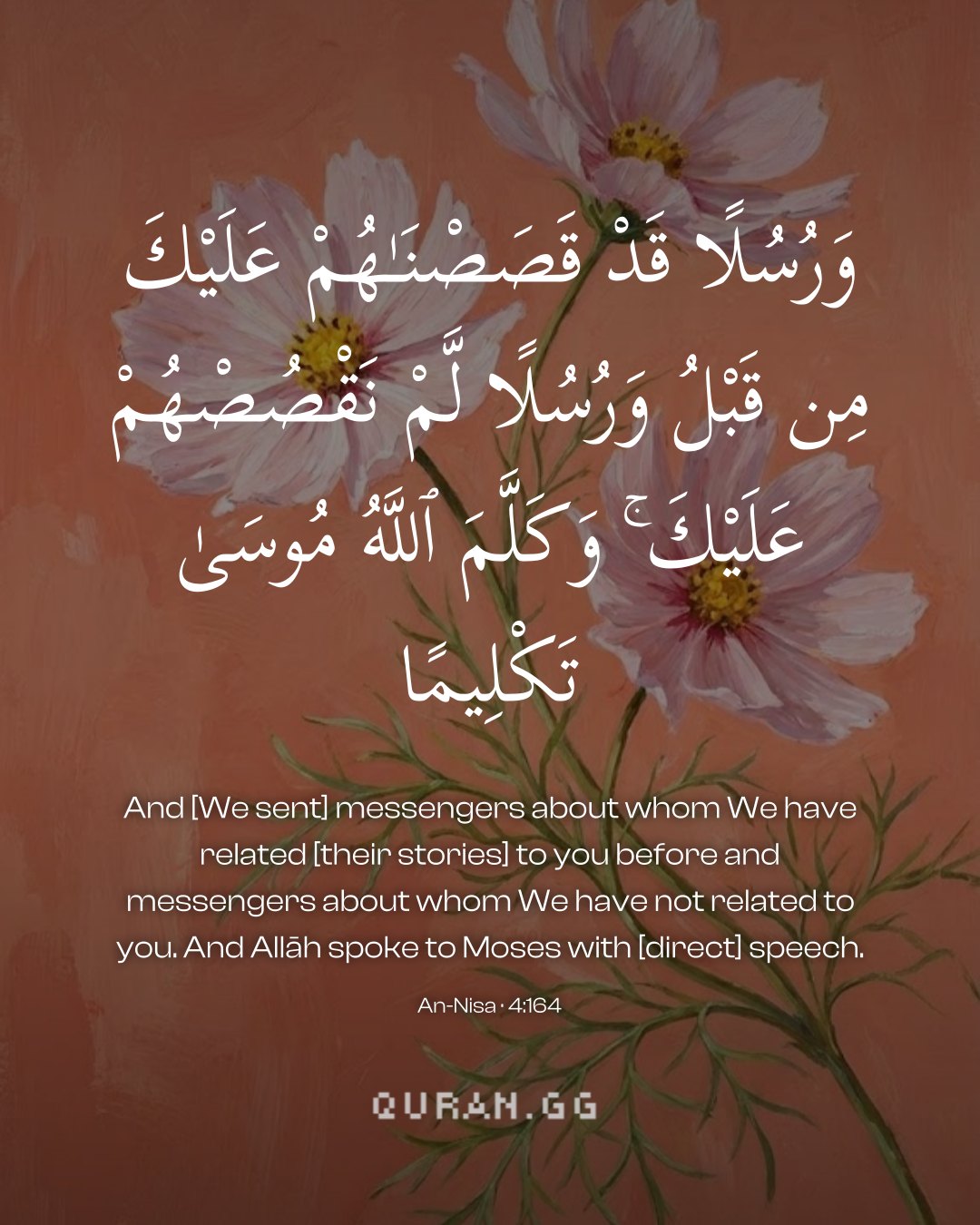
And [We sent] messengers about whom We have related [their stories] to you before and messengers about whom We have not related to you. And Allāh spoke to Moses with [direct] speech.
Revelation Came to Prophet Muhammad ﷺ, Just as it Came to the Prophets Before Him
Muhammad bin Ishaq narrated that Muhammad bin Abi Muhammad said that `Ikrimah, or Sa`id bin Jubayr, related to Ibn `Abbas that he said, "Sukayn and `Adi bin Zayd said, `O Muhammad! We do not know that Allah sent down anything to any human after Musa.' Allah sent down a rebuttal of their statement,
(Verily, We have inspired you (O Muhammad) as We inspired Nuh and the Prophets after him.)" Allah states that He sent down revelation to His servant and Messenger Muhammad ﷺ just as He sent down revelation to previous Prophets. Allah said,
In verse 164 which opens with the words: وَرُسُلًا قَدْ قَصَصْنَاهُمْ عَلَيْكَ And, (We have sent down) some Messengers We have already told you about ...', after a brief mention of prophets who appeared after Sayyidna Nuh (علیہ السلام) ، a special citation has been made of the greatest prophets from among them. The purpose is to tell us that they are all prophets and Wahy comes to prophets via different modes. It could be an angel with a message. It could also be a written Book. Sometimes Almighty Allah talks directly to His Messenger. In short, when Wahy comes, no matter in what mode or manner it does, acting in accordance with it becomes obligatory. Therefore, the saying of Jews that they would believe only if there comes to them a written Book like the Torah, otherwise they would not, is to say the least, being short on sense and tall on disbelief.
As reported by Sayyidna Abu Dharr al-Ghifari ؓ ، the Holy Prophet ﷺ said: Almighty Allah has sent one hundred and twenty four thousand prophets out of which three hundred and thirteen were Shari` ah-bearing Messengers of Allah. (Qurtubi)
Tazkirul Quran
Maulana Wahiduddin KhanOn ayahs 162–164
When a group opts for a self-styled religion instead of the divine religion, it decides upon certain self-styled signs to show its religious status. According to the temperament and circumstances of its members, it formulates new rules about what is lawful and what is unlawful, and by sedulously observing them, it shows that it adheres to religion more than others do. The religion of such people is based on excessive care for certain outward forms, as opposed to paying proper attention to the spirit of the religion’s rules. By fully observing the form they are completely satisfied that they have been following their religion to the letter. Such so-called adherents of religion are not afraid of deriving worldly benefits from the ways forbidden by God and they are not afraid of putting obstacles in the path of the divine caller. Such people will be bracketted with the patently irreligious, far from being grouped along with truly religious people. There were certain people among the Jews, like ‘Abdullah ibn Salam, who believed in the Prophet Muhammad and fully supported him. Those who are not caught up in human interpolations in their religion; who have discovered the original divine religion; who have risen above the mentality of prejudice, blind imitation of their community’s ways and opportunism, find no obstacle to their recognizing the truth and surrendering themselves to it. They can see the truth despite all kinds of mental blocks. These are the people who will be ushered into the Paradise God has prepared for them.
Uthmani text of the Madinah mushaf (King Fahd Complex). Translation: Saheeh International. Tafsir via Quran.com.