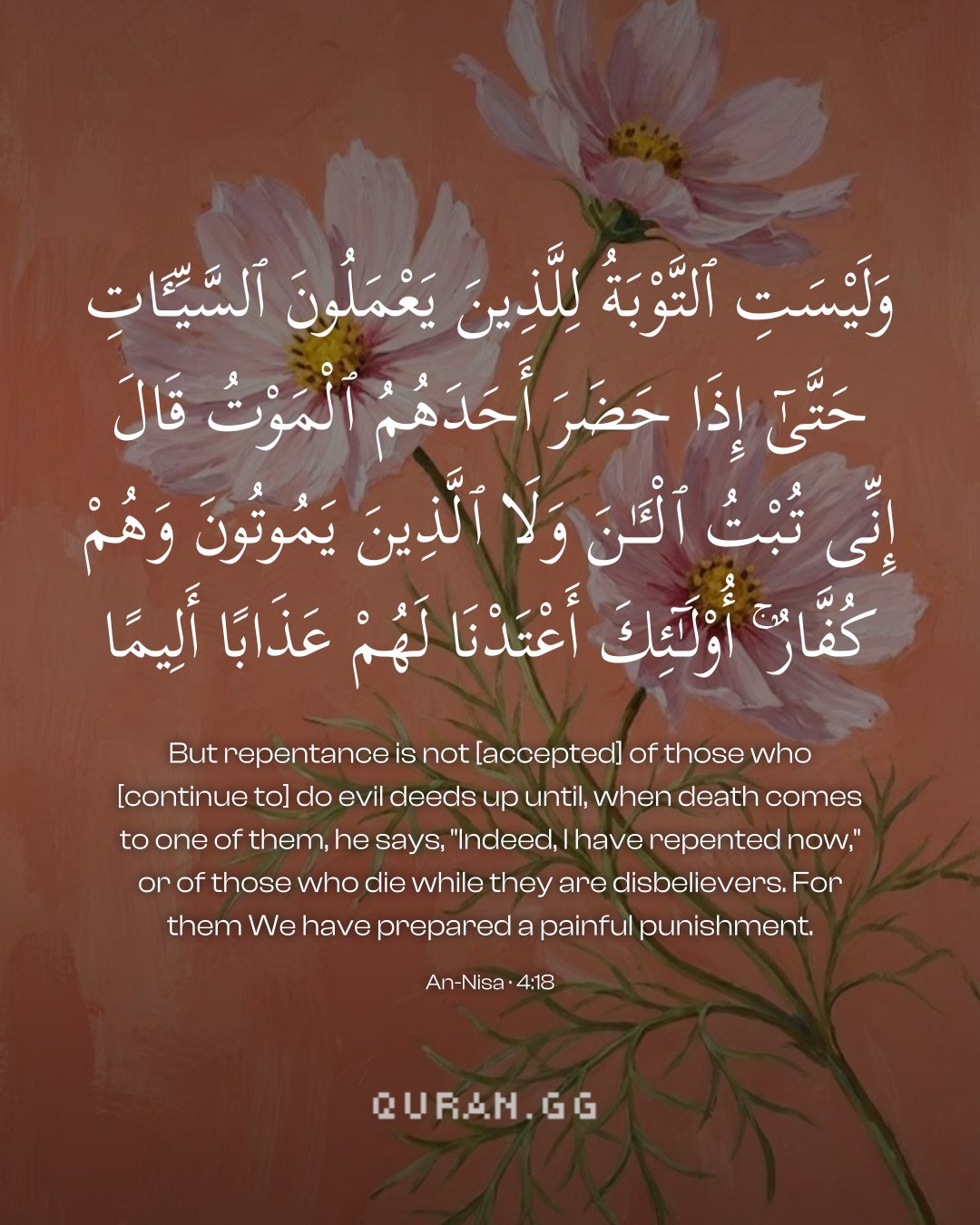
But repentance is not [accepted] of those who [continue to] do evil deeds up until, when death comes to one of them, he says, "Indeed, I have repented now," or of those who die while they are disbelievers. For them We have prepared a painful punishment.
Allah states that He accepts repentance of the servant who commits an error in ignorance and then repents, even just before he sees the angel who captures the soul, before his soul reaches his throat. Mujahid and others said, "Every person who disobeys Allah by mistake, or intentionally is ignorant, until he refrains from the sin." Qatadah said that Abu Al-`Aliyah narrated that the Companions of the Messenger of Allah ﷺ used to say, "Every sin that the servant commits, he commits out of ignorance." `Abdur-Razzaq narrated that, Ma`mar said that Qatadah said that, the Companions of the Messenger of Allah ﷺ agreed that every sin that is committed by intention or otherwise, is committed in ignorance." Ibn Jurayj said, "Abdullah bin Kathir narrated to me that Mujahid said, `Every person who disobeys Allah (even willfully), is ignorant while committing the act of disobedience."' Ibn Jurayj said, "`Ata' bin Abi Rabah told me something similar." Abu Salih said that Ibn `Abbas commented, "It is because of one's ignorance that he commits the error." `Ali bin Abi Talhah reported that Ibn `Abbas said about the Ayah,
Repentance was mentioned in the previous verse. Now, given in the present two verses are conditions under which repentance is or is not accepted.
Commentary
Repentance from a deliberate sin
At this point, it should be noted that the Holy Qur'an has used the words "in ignorance" which apparently gives an impression that the repentance may be accepted when a sin is committed unintentionally and unknowingly. But if it is committed deliberately, it will not be acceptable. However, according to the explanation of this verse given by the noble Companions, may Allah be pleased with them all, the word, جھالہ 'jahalah" (ignorance) here does not mean that a sinning person is not aware of a sin as sin, or has no intention or volition to commit a sin. Instead, it means that it was the insensitivity and heedlessness of a person towards the evil end of sin and its ultimate punishment which became the cause of his audacity to venture into sin, even though he knew a sin as sin, and had approached it with intention and volition as well.
Repentance does not mean simply uttering certain words like, ‘I repent’ or ‘tawbah’. It should not be mere lip service. It means the intense realization of one’s wrongdoing. If a sinner sincerely repents the error of his ways, he experiences an agonizing condition at par with self-punishment. God will surely pardon one who thus repents due to His intense fear. However, He does not accept the repentance of those who daringly and insensitively and knowingly continue to disobey and transgress, paying no heed to any warning and saying ‘I repent’ only when death is staring them in the face. Nor does the repentance of those who admit their sins only after witnessing the horrors of the Hereafter have any meaning for the Almighty. The essence of contrition is that the wrongdoer should turn to his Lord, so that the Lord also turns to him. Repentance (tawbah) is for one who commits a wrongful act under the influence of a momentary emotion or passion, but who is soon made by his conscience to realize his fault; who renounces evil ways and returns to righteousness, reforming his life according to the divine law. This shows genuine penitence. One who thus repents is like the man who, after straying away, returns to his home.
Uthmani text of the Madinah mushaf (King Fahd Complex). Translation: Saheeh International. Tafsir via Quran.com.