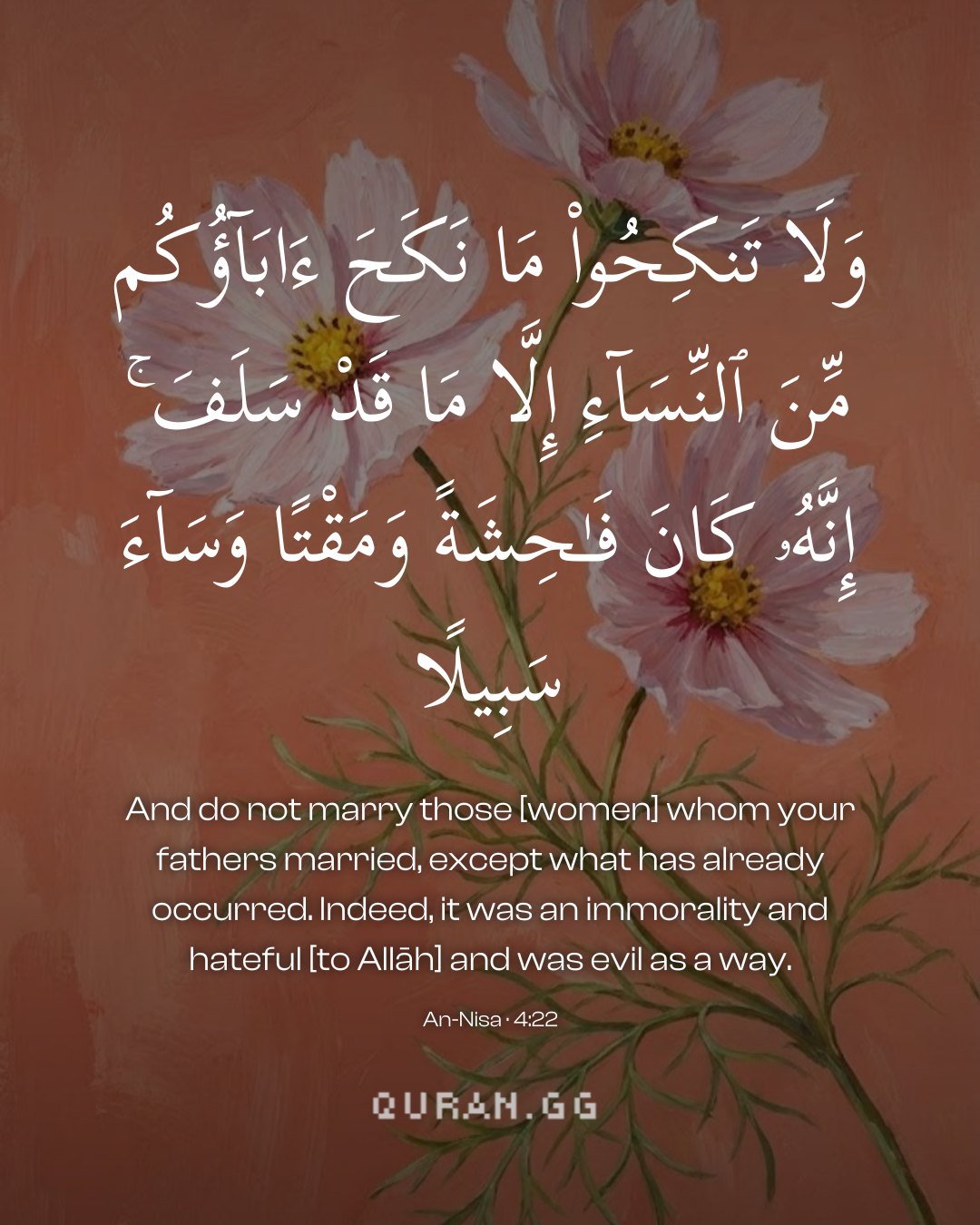
And do not marry those [women] whom your fathers married, except what has already occurred. Indeed, it was an immorality and hateful [to Allāh] and was evil as a way.
(O you who believe! You are not permitted to inherit women against their will,) "Before, the practice was that when a man dies, his male relatives used to have the right to do whatever they wanted with his wife. If one of them wants, he would marry her, give her in marriage, or prevent her from marriage, for they had more right to her than her own family. Thereafter, this Ayah was revealed about this practice,
The present verses are an extension of the description of evil practices common in Jahiliyyah which have been taken up earlier. A detailed discussion appears in the Commentary.
Commentary:
These verses give details of محرَّمات muharramat, that is, women with whom marriage is prohibited. Some of them are prohibited forever, never becoming lawful under any condition. Some are not permanently prohibited. They become lawful under some particular circumstances.
There are three kinds of permanently-prohibited women referred to in the first category. They are those by kinship, by fosterage and by relationship through marriage, and are permanently prohibited. The kind mentioned at the end remains prohibited until they are bound in marriage with someone else.
An explanation of the verses follows with relevant part of the verse appearing in the lead: وَلَا تَنكِحُوا مَا نَكَحَ آبَاؤُكُم (And do not marry those of women whom your fathers had married) (verse 22): During the days of Jahiliyyah, people had no qualms when they went ahead and married the wife of their father after his death. In this verse, Allah Almighty has prohibited this shameful practice; an evil which invites His wrath. How can someone keep calling a woman his mother for a long time and yet stoop so low as to make her his wife after the death of the father?
Ruling:
Marrying the legally wedded wife of the father has been declared unlawful in this noble verse. There is no restriction here to indicate marital consummation by the father. So, the fact that the father has married a woman is enough to forbid the son from entering into marriage with that woman. It will never be lawful. Similarly, it is not correct for the father to marry the wife of his son, even if the marriage of the son is limited to formal 'nikah' and his wife have not yet come to live with him. (Ibn ` Abidin)
Tazkirul Quran
Maulana Wahiduddin KhanOn ayahs 22–23
The maxim ‘the past is past’ relates not just to marriage, but stands out as a general principle of wisdom. Whenever any change takes place in life, whether at the family or the national level, many affairs of the past, looked at by modern standards, appear to be wrong on all such occasions. Orders based on things which have now become irrelevant give rise to innumerable problems. The right approach is, therefore, to forget the past and direct one’s efforts to reforming the present and future. The advice in verse 19, ‘if you dislike them, it may be that you dislike something which God might make a source of abundant good’ may appear here with regard to the relationship between husband and wife, but it is a form of general guidance as well. It is commonly found that the Quran, while giving guidance on a specific matter, also sets forth profound advice of a general nature which may concern a human being’s entire life. Living collectively is an essential condition for human life in this world. No one can survive alone. However, due to the variations of temperament among individuals, some irritants inevitably crop up. In such a situation the only practicable approach is to ignore complaints, avoid friction and endeavour to maintain peaceable relationships. It often happens that one detects some shortcoming in his companion and becomes annoyed with it. Instead, if he ponders over the matter, it will be evident that there are few situations which do not have their unfavourable aspects. Adversities sometimes become a test of patience; sometimes act as a stimulus to turn to God in repentance and sometimes their very vexing nature teaches an important lesson.
Uthmani text of the Madinah mushaf (King Fahd Complex). Translation: Saheeh International. Tafsir via Quran.com.