Tafsir Ibn Kathir (abridged)
Ismail ibn Kathir
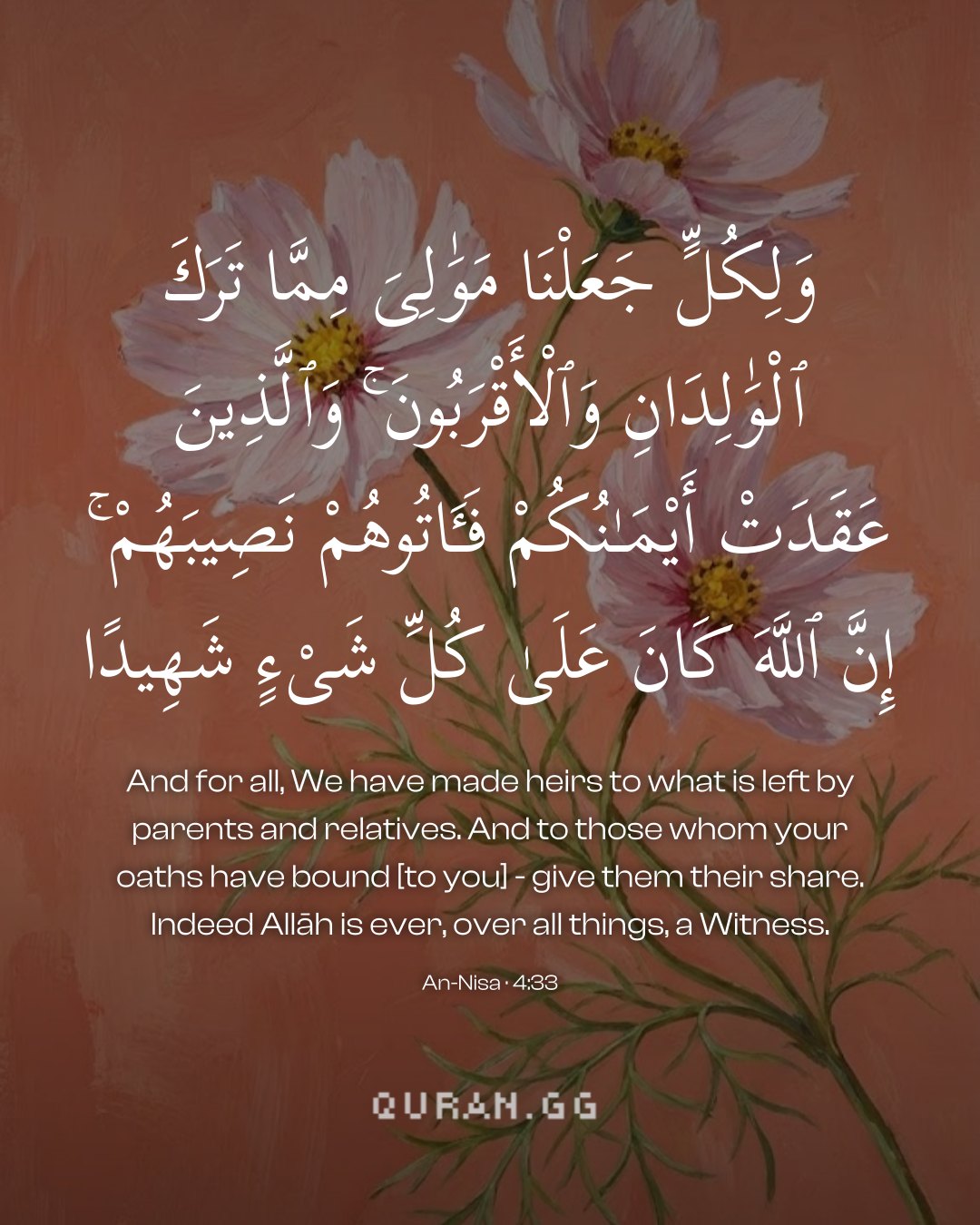
وَلِكُلٍّ جَعَلْنَا مَوَالِىَ
(And to everyone, We have appointed Mawali) means, "Heirs." Ibn `Abbas was also reported to have said that Mawali refers to relatives. Ibn Jarir commented, "The Arabs call the cousin a Mawla." Ibn Jarir continued, "Allah's statement,
مِّمَّا تَرَكَ الْوَلِدَنِ وَالاٌّقْرَبُونَ
(of that (property) left by parents and relatives.) means, from what he inherited from his parents and family members. Therefore, the meaning of the Ayah becomes: `To all of you, O people, We appointed relatives (such as children) who will later inherit what you inherited from your own parents and relatives." Allah's statement,
وَالَّذِينَ عَقَدَتْ أَيْمَـنُكُمْ فَـَاتُوهُمْ نَصِيبَهُمْ
(To those also with whom you have made a pledge (brotherhood), give them their due portion.) means, "Those with whom you have a pledge of brotherhood, give them their share of inheritance, thus fulfilling the ratified pledges that you gave them. Allah has witnessed all of you when you gave these pledges and promises." This practice was followed in the beginning of Islam, but was later on abrogated when Muslims were commanded to fulfill the pledges (brotherhood) they had already given, but to refrain from making any new pledges after that. Al-Bukhari recorded that Ibn `Abbas said,
وَلِكُلٍّ جَعَلْنَا مَوَالِىَ
(And to everyone, We have appointed Mawali) "meaning, heirs;
وَالَّذِينَ عَقَدَتْ أَيْمَـنُكُمْ
(To those also with whom you have made a pledge (brotherhood)) When the emigrants came to Al-Madinah, the emigrant would inherit from the Ansari, while the latter's relatives would not inherit from him because of the bond of brotherhood which the Prophet established between them (the emigrants and the Ansar). When the verse,
وَلِكُلٍّ جَعَلْنَا مَوَالِىَ
(And to everyone We have appointed Mawali) was revealed, it cancelled (the pledge of brotherhood regarding inheritance)." Then he said, "The verse,
وَالَّذِينَ عَقَدَتْ أَيْمَـنُكُمْ فَـَاتُوهُمْ نَصِيبَهُمْ
(To those also with whom you have made a pledge (brotherhood), give them their due portion.) remained valid for cases of co-operation and mutual advice, while the matter of inheritance was excluded and it became permissible to assign something in one's will to the person who had the right of inheriting before."
In the injunctions of inheritance appearing previously, it was mentioned that, given the conditions, for a male there is a share equal to that of two females. There are other proved aspects of male precedence as well. So, Sayyidah Umm Salmah رضی اللہ تعالیٰ عنہا once said to the Holy Prophet ﷺ Our share in the inheritance is half. Then, there are such and such elements of difference between us and men...'
Her purpose was not to raise an objection. Rather, she wished to be a man and to deserve the merits restricted for men. There were other women who wished: Had we been men, we would have taken part in Jihad and the merit of Jihad would have been ours.'
Continue reading the tafsir of ayahs 32–33 Disparity, i.e. the difference between individuals in this world, is in accordance with God’s creation plan. Some are physically and mentally less endowed than others; some are born in favourable and some in unfavourable conditions; some have powerful resources and some barely exist with just minimal resources. The latter become jealous of the former, finding them in a superior position. This situation leads to envy, enmity and conflict in social life. But it is totally wrong to make an assessment of oneself or of others judging solely by externals, as these are of importance only in this world. One receives them only to leave them behind. The issues of real importance, i.e. success and achievement in the Hereafter, have nothing to do with worldly possessions. Success in the Hereafter depends rather on those actions which have been performed in this world with the sole intention of seeking God’s pleasure. It is, therefore, most wise to insulate oneself from envy, and to pray to God for strength, and to continue to direct one’s efforts towards success in the Hereafter. Wherever a group of people live together, whether as a family or as a country, it is necessary to have a leader to take charge. Authority will undisputedly rest in one single person. According to God’s plan for this world, man has been chosen to become the head of the family and has been endowed with the inborn abilities needed to discharge this responsibility. The biological and physiological differences between man and woman are in conformity with God’s creation plan. If there are some who wish to go against God’s plan, they will only cause perversion and discord. For, nature will continue to go ahead creating men and women according to the divine scheme of things, whereby men will be endowed with the qualities needed as protectors and guardians and women will have the quality of submission to be able to assist them without prejudice to the faculties that nature has endowed them with. But, if men and women are given opposite and conflicting roles to perform in social activities, the result will be nothing but perversion in social life.
Uthmani text of the Madinah mushaf (King Fahd Complex). Translation: Saheeh International. Tafsir via Quran.com.