Allah Wrongs Not Even the Weight of a Speck of Dust
Allah states that He does not treat any of His servants with injustice on the Day of Resurrection, be it the weight of a mustard seed or a speck of dust. Rather, Allah shall reward them for this action and multiply it, if it were a good deed. For instance, Allah said,
وَنَضَعُ الْمَوَزِينَ الْقِسْطَ
(And We shall set up balances of justice) Allah said that Luqman said,
(O my son! If it be (anything) equal to the weight of a mustard seed, and though it be in a rock, or in the heavens or in the earth, Allah will bring it forth). Allah said,
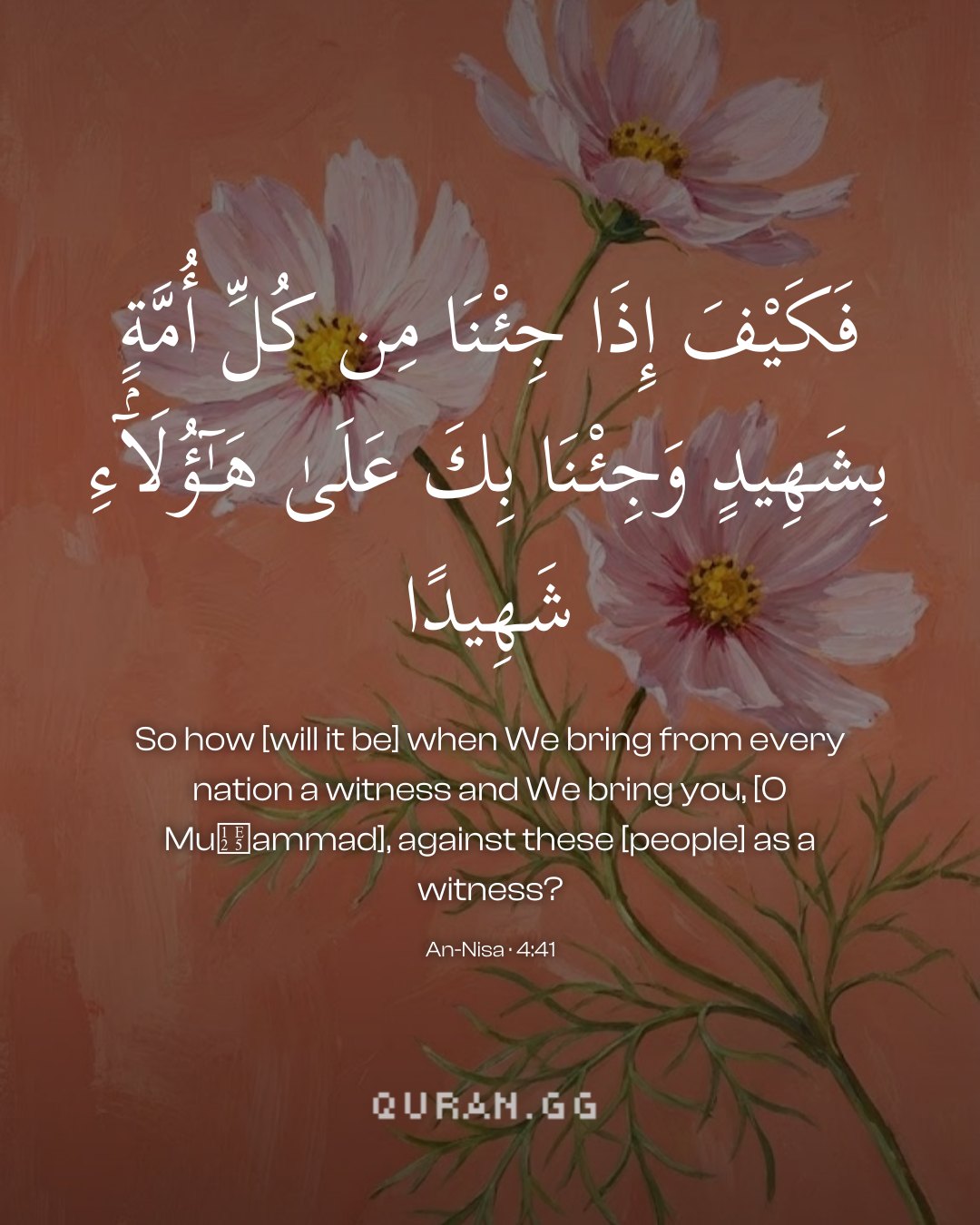
In the verse (41) beginning with: فَكَيْفَ إِذَا جِئْنَا مِن كُلِّ أُمَّةٍ , there is an invitation to visualize, in range and depth, the gravity of what will happen on the site of the Last Day. Also intended is an admonition to the disbelievers from the tribe of Quraysh. Their anxiety would know no bounds when every prophet of every community would appear as a witness to the good or bad deeds of his respective community on the Last Day - and Muhammad ﷺ too, the last of the prophets, will appear as a witness over his community - and he would give witness in the Divine Court particularly about such disbelievers and polytheists declaring that these people saw open signs and miracles, yet they belied and rejected them and ultimately refused to believe in 'The Divinity and my Prophethood'.
According to a narration in al-Bukhari, the Holy Prophet ﷺ asked
Sayyidna ` Abdullah ibn Masud ؓ to recite the Qur'an to him. Sayyidna ` Abdullah ؓ said : 'You want to hear it from me, although the Qur'an was revealed to you?' He ﷺ said: 'Yes. Recite.' Sayyidna ` Abdullah ibn Masud ؓ says: 'I started reciting Suratun-Nisa' and when I reached the verse: فَكَيْفَ إِذَا جِئْنَا مِن كُلِّ أُمَّةٍ بِشَهِيدٍ (41), he said: "Enough for now;" and when I raised my eyes to look at him, I saw tears trickling from his blessed eyes.'
` Allama al-Qastalani (رح) writes: This verse caused a full view of the Akhirah to be present before his eyes and he thought about the people of his community who were short on or lacking in good deeds and that was why tears started flowing from his eyes.
Special Note:
Some commentators, have said that the word, هَـٰؤُلَاءِ (them), in this verse (41) points to the disbelievers and hypocrites present during the age of prophethood. Some others say that it refers to the entire community right through the Day of Doom. This is so because, as indicated in some hadith narrations, the deeds of his community are being continuously presented before him. Nevertheless, from here we know that the prophets of past communities will appear as witnesses over their respective communities and that the Holy Prophet ﷺ too will testify to the deeds of his community. This textual style of the noble Qur'an tells us that there is to be no prophet after him who could appear as a witness over a possible community of his - otherwise, the Qur'an would have mentioned him and his community and the testimony he would give. Seen from this angle, this verse is a proof of the finality of prophethood as well.
Tazkirul Quran
Maulana Wahiduddin KhanOn ayahs 40–41
Those who become proud instead of humble after receiving the bounties of God and those who spend their God-given wealth on making selfish investments instead of on good causes as approved by God, are fellow travellers of Satan. Having been lured by the fleeting gains of this life, they lose interest in the eternal gain promised by God. For such persons, there shall be nothing but severe punishment in the Hereafter. Man declares unimportant that which he does not practice. This is self-centred theorizing and an effort at self-justification. All such endeavours are futile and worthless in the eyes of God.
Uthmani text of the Madinah mushaf (King Fahd Complex). Translation: Saheeh International. Tafsir via Quran.com.