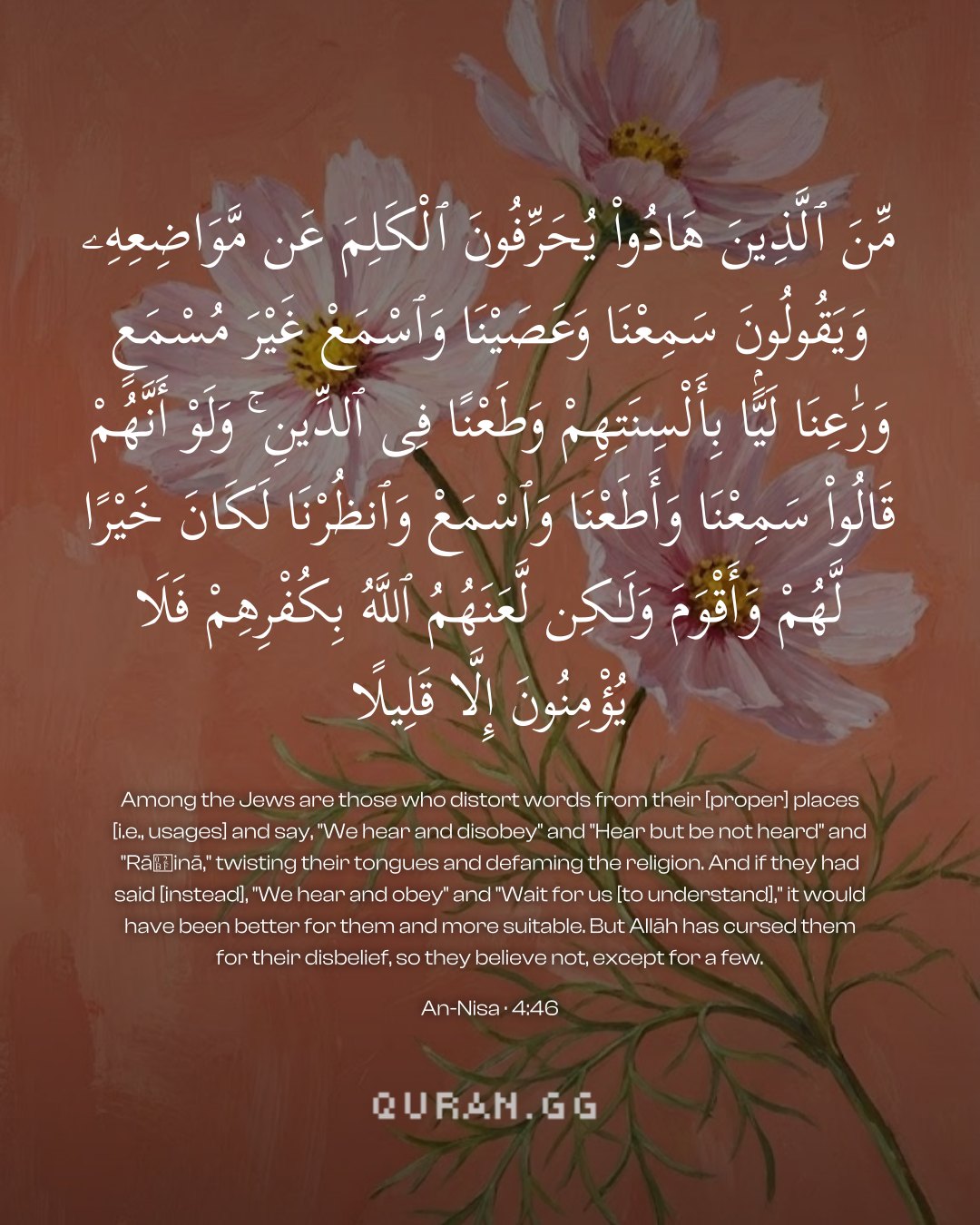
Among the Jews are those who distort words from their [proper] places [i.e., usages] and say, "We hear and disobey" and "Hear but be not heard" and "Rāʿinā," twisting their tongues and defaming the religion. And if they had said [instead], "We hear and obey" and "Wait for us [to understand]," it would have been better for them and more suitable. But Allāh has cursed them for their disbelief, so they believe not, except for a few.
Chastising the Jews for Choosing Misguidance, Altering Allah's Words, and Mocking Islam
Allah states that the Jews, may Allah's continued curse fall on them until the Day of Resurrection, have purchased the wrong path instead of guidance, and ignored what Allah sent down to His Messenger Muhammad . They also ignored the knowledge that they inherited from previous Prophets, about the description of Muhammad ﷺ, so that they may have a small amount of the delights of this life.
وَيُرِيدُونَ أَن تَضِلُّواْ السَّبِيلَ
(and wishing that you should go astray from the right path.) for they would like that you disbelieve in what was sent down to you, O believers, and that you abandon the guidance and beneficial knowledge that you have.
The present verses take up the matter of dealings with enemies. It brings into sharp focus the wicked tricks, in word and deed, as practiced by the Jews, and then gives a view of what is true and correct. This last aspect is in a way an exhortation to Muslims that they should be careful in choosing the words they use to say what they have to say, for mincing words is not their style.
In the previous verse (46), there was a description of the Jewish stance against Islam which ranged from flat denial to laboured falsification, something born out of the desire to misrepresent, alter and ridicule. The present verse addresses them directly and commands them to believe in the final revelation and demonstrate their confirmation. Should they continue ignoring the warning and remain hostile, they should really be concerned with the chilling prospects of what their fate would be as a consequence of their ill choice.
Tazkirul Quran
Maulana Wahiduddin KhanOn ayahs 46–51
The book of God is given to a community so that it may rectify the thinking and conduct of its people. But when the bearers of the Divine Book, like the Jews, suffer from decline, they begin to take misguidance in place of guidance from it. The commands of God become the subject of futile hair-splitting discussions; concocted philosophies are produced in the name of theology, and wrongdoers alter the divine book to justify the religious validity of their actions. They detach the words of God from their context and interpret them on the basis of their own assumptions. The Jews having received a portion of the Book means that they were able to read the words of the Book, but could not mould their actions according to those words, thereby defeating the real purpose of the Scriptures. They remained the bearers of the Book so far as its words were concerned, but in the matter of practice they adopted the ways of other worldly communities. Moreover, while the others practised worldliness in the name of worldliness, the Jews adopted the same worldly ways but had the audacity to try to justify their practices by misquoting the Divine Book.
Uthmani text of the Madinah mushaf (King Fahd Complex). Translation: Saheeh International. Tafsir via Quran.com.