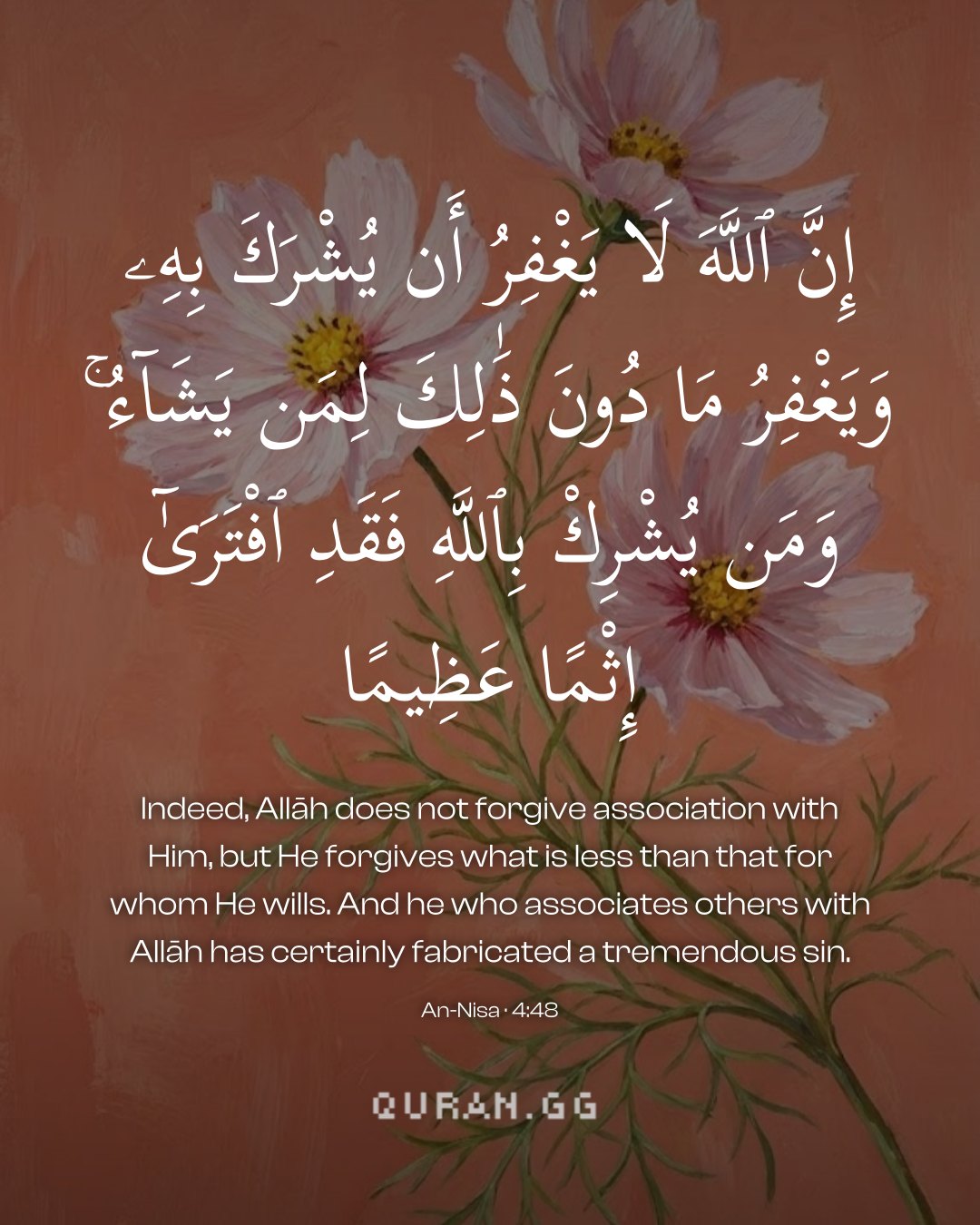
Indeed, Allāh does not forgive association with Him, but He forgives what is less than that for whom He wills. And he who associates others with Allāh has certainly fabricated a tremendous sin.
Calling the People of the Book to Embrace the Faith, Warning them Against Doing Otherwise
Allah commands the People of the Scriptures to believe in what He has sent down to His servant and Messenger, Muhammad ﷺ , the Glorious Book that conforms to the good news that they already have about Muhammad ﷺ. He also warns them,
(before We efface faces and turn them backwards) Al-`Awfi said that Ibn `Abbas said that `effacing' here refers to blindness,
فَنَرُدَّهَا عَلَى أَدْبَـرِهَآ
(and turn them backwards) meaning, We put their faces on their backs, and make them walk backwards, since their eyes will be in their backs. Similar was said by Qatadah and `Atiyah Al-`Awfi. This makes the punishment even more severe, and it is a parable that Allah set for ignoring the truth, preferring the wrong way and turning away from the plain path for the paths of misguidance. Therefore, such people walk backwards. Similarly, some said that Allah's statement,
The previous verse carried an admonition for those who refused to believe. But, from among those to whom this admonition has been addressed, some could finally be forgiven, which admits of the probability that all these other addressees may, perhaps, be also forgiven. Therefore, the text goes on to explain that this group of people will not be forgiven because of their kufr or disbelief. This also refutes the Jewish claim that they shall be forgiven.
Commentary
Shirk: A definition, and some forms
The words of the Qur'anic text in إِنَّ اللَّـهَ لَا يَغْفِرُ أَن يُشْرَكَ بِهِ (Surely, Allah does not forgive the ascribing of a partner to Him) demonstrate that the set articles of faith relating to the Being and Attributes of Allah Almighty are the sine qua non of religion and holding any belief similar to these in favour of whoever and whatever He has created is shirk. Some of the forms it takes are as follows:
Shirk in Knowledge: This is the ascribing of a partner to Allah in matters of knowledge ( ‘ilm), for example believing that a certain pious person or a spiritual master or the head of a mystical order knows about everything in this universe all the time. Other forms could be asking an astrologer or a fortune-teller or a diviner about things that are going to take place in a person's life, things which belong to the unseen world, an exclusive domain of Allah; or, to take omen (fal) فال from the words written by a pious person and believing that it has got to happen; or, calling someone from a considerable distance and believing that the person has become all aware of the call; or, keeping a fast dedicated to someone other than Allah.
Shirk in Power: This is ascribing to others the powers and rights which are the exclusive domain of Allah as for example, taking someone to have the power and authority to provide gain or inflict loss. It includes things like asking someone to grant wishes or to ask for sustenance, and children.
Shirk in ` Ibidah: This means the ascribing of a partner to Allah in acts of worship (` Ibadah) which is the sole due of Allah. Some of the forms it could take are to go down in sajdah (prostration) for anyone, to release an animal dedicated in the name of somebody, making cere-monious offering for a person or thing, living or dead, to make a vow (mannat, nadhr) in someone's name; to make tawaf (rounds, circumambulation) of someone's grave or house; to give preference to someone else's word, or custom, as against God's own command; to make bows before anyone in the manner of a ruku`, the bowing position peculiar to Muslim prayer; to slaughter an animal in the name of someone; to take the affairs of the mortal world as subservient to the effect and influence of stars; to regard some month as ill-omened, wretched; and things like that.
Tazkirul Quran
Maulana Wahiduddin KhanOn ayahs 46–51
The book of God is given to a community so that it may rectify the thinking and conduct of its people. But when the bearers of the Divine Book, like the Jews, suffer from decline, they begin to take misguidance in place of guidance from it. The commands of God become the subject of futile hair-splitting discussions; concocted philosophies are produced in the name of theology, and wrongdoers alter the divine book to justify the religious validity of their actions. They detach the words of God from their context and interpret them on the basis of their own assumptions. The Jews having received a portion of the Book means that they were able to read the words of the Book, but could not mould their actions according to those words, thereby defeating the real purpose of the Scriptures. They remained the bearers of the Book so far as its words were concerned, but in the matter of practice they adopted the ways of other worldly communities. Moreover, while the others practised worldliness in the name of worldliness, the Jews adopted the same worldly ways but had the audacity to try to justify their practices by misquoting the Divine Book.
Uthmani text of the Madinah mushaf (King Fahd Complex). Translation: Saheeh International. Tafsir via Quran.com.