The Envy and Miserly Conduct of the Jews
Allah asked the Jews if they have a share in the dominion. That is merely a statement of rebuke, since they do not have any share in the dominion. Allah then described them as misers,
فَإِذاً لاَّ يُؤْتُونَ النَّاسَ نَقِيراً
(Then in that case they would not give mankind even a Naqir.) Meaning, if they had a share in the sovereignty and dominion, they would not give anyone anything, especially Muhammad , even if it was the speck on the back of a date-stone, which is the meaning of Naqir according to Ibn `Abbas and the majority of the scholars. This Ayah is similar to another of Allah's statements,
Continue reading the tafsir of ayahs 53–55 Commentary
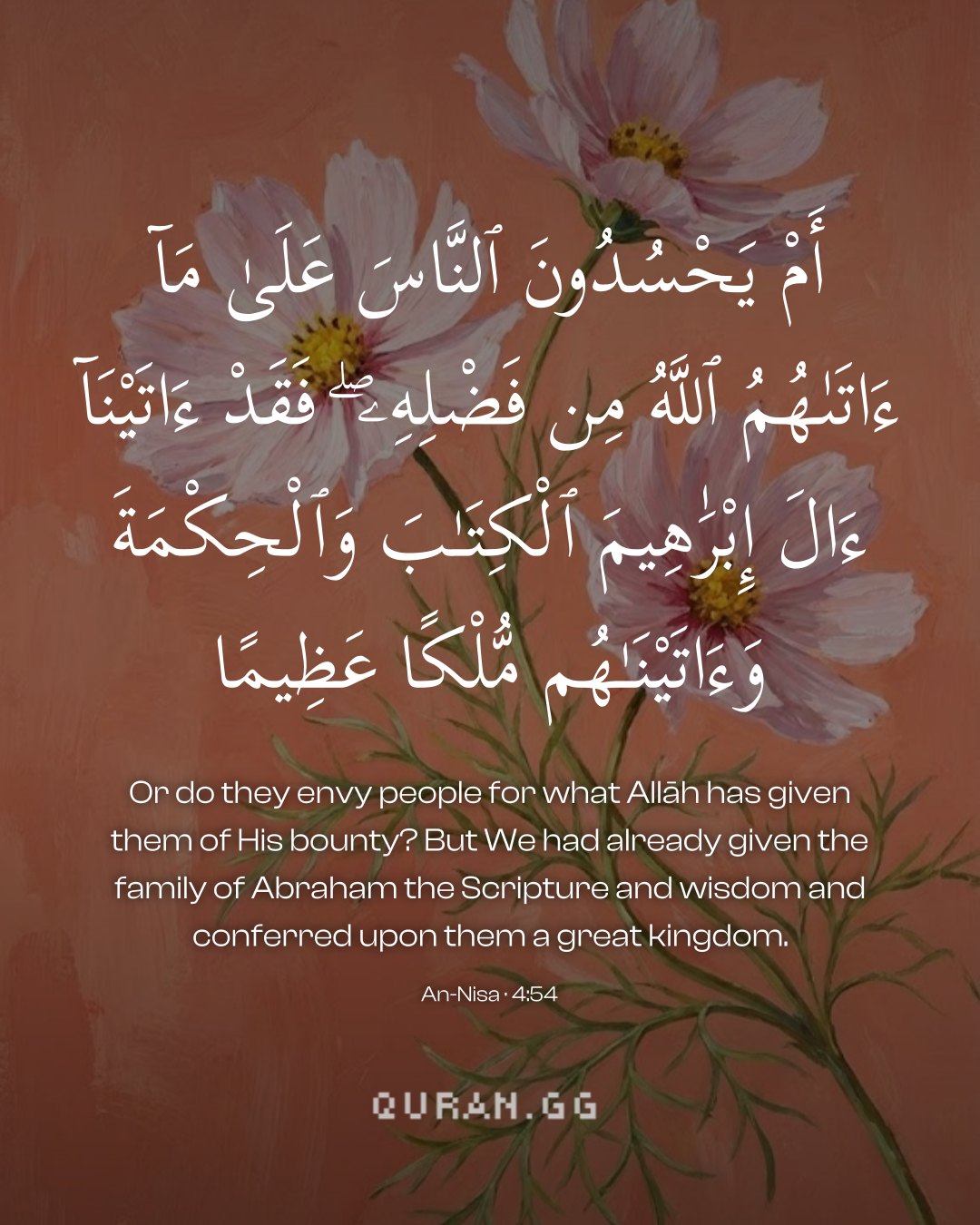
Admonishing Jews for being unreasonably envious
The knowledge, the grace, the high rank and the grandeur of mission given by Allah Almighty to the Noble Prophet ﷺ made Jews all too jealous. Verses 53 and 54 strongly admonish this attitude of theirs, giving two reasons why their envy was unreasonable. The first reason appears in verse 53, while the second, in verse 54. But, the outcome of both is the same. The drift of the argument is: 'What is the basis of your envy? If this is because you think you are the real inheritors of the kingdom and what he has been blessed with is actually yours, obviously then, this is all wrong. As it is, right now you have no kingdom. Even if you came to have some of it, you are not the kind to give anything to anybody. If your envy is based on the realization that the kingdom, no doubt, did not pass from you onto him, still, the question remains, why did it have to go to him at all. What relevance does he have with having a kingdom? The answer given was: He too comes from the family of prophets who have ruled over kingdoms before him. So, the kingdom has really not come to a stranger. Your envy, therefore, is unreasonable.'
The definition and rules of envy
` Allamah al-Nawawi, the Commentator of Muslim, defines Hasad as : اَلحَسَدُ تَمَیّ زَوَّالِ النِّعمَۃ (Muslim, v.2). It means that Hasad (envy) is a desire to see the other person's blessing somehow disappear, and this is harm (forbidden).
The Holy Prophet ﷺ has said:
لا تباڈضواولا تحاسدوا ولا تدابروا ، وکونوا عباد اللہ اخواناً ، ولا یحل لمسلم ان یھجر اخاہ فوق ثلاث
"Do not hate and do not envy and do not turn your backs on each other. Instead, become servants of Allah, as brothers. And it is not lawful for a Muslim that he abandons his brother for more than three days." (Muslim, v.2)
In another hadith, he has said:
اِیاکم والحسد، فإن الحسد یأکل الحسنات کما تاکل النار الحطب
"Beware of envy, for envy eats up good deeds as the fire eats up wood." (Abu Dwud, cited by Mishkat)
Sayyidna Zubayr ؓ ، narrates that the Holy Prophet ﷺ said:
عن الزبیر ؓ قال : قال رسول اللہ ﷺ : دب الیکم داء الامم قبلکم، الحسد والبغضاء ھی لحالقۃ، لا إقول تحلق الشعر، ولکن تحلق الدین
"Stealthily creeping into you is the disease of earlier peoples - envy; and hatred, which is a shaver. I do not say that it shaves hair, but it does shave the religion off." (Ahmad and Tirmidhi, cited by Mishkat)
Envy, whether it be on account of someone's worldly, or spiritual excellence, is harem (forbidden) on both counts, as the words أَمْ لَهُمْ نَصِيبٌ مِّنَ الْمُلْكِ (Is it that they have a share in the kingdom?) seem to point out towards worldly excellence, while the words الْكِتَابَ وَالْحِكْمَةَ (54) (the Book and the wisdom) are indicative of spiritual excellence.
The Jews, thinking that they belonged to the race of prophets, projected their community as a sacred one. In consequence, they laid claim to honour and privilege which they justified by the invention of numerous stories and parables. By their own lights, everyone who was Jewish by faith was destined for deliverance and would not be consigned to the fire of Hell. Clearly, their lives were dominated by wishful thinking. The Quranic statement that ‘it is indeed God who purifies whoever He pleases’ rejects such notion that ‘those who consider themselves pure’ are actually and necessarily so. It clarifies that no one may have honour and privilege on the basis of his links with a race or community; these things depend on the divine law of justice. One who, adhering to the divine law, proves himself deserving of honour, will have honour confered upon him, but one who, by his actions, fails to do so, will never be honoured—no matter which race or community he belongs to. The belief in community-based salvation, whether created by the Jews or any other group, is totally without foundation. To invent such a belief and associate it with God is an attempt to associate falsehood with Him. He has never imparted such teaching. God does not discriminate between people on the basis of group, community or race. Such discrimination is a great injustice, whereas God dispenses absolute justice: He does not deal unjustly with anyone. When decadence sets in among the People of the Book, its adherents begin to live a life of wishful thinking instead of following the commands of God. This leads to superstition gaining ground. What can be achieved only through the performance of good deeds, they attempt to gain through sorcery, false beliefs and communion with evil spirits. Such deviators consider religion as a matter of ‘sacred words’ and ‘special relations with saintly personages,’ which may bring miraculous results merely by pronouncing those words or practising the relevant rituals. They continue to pay lip service to religion, but in practice, they follow the path of Satan.
Continue reading the tafsir of ayahs 53–56 Uthmani text of the Madinah mushaf (King Fahd Complex). Translation: Saheeh International. Tafsir via Quran.com.