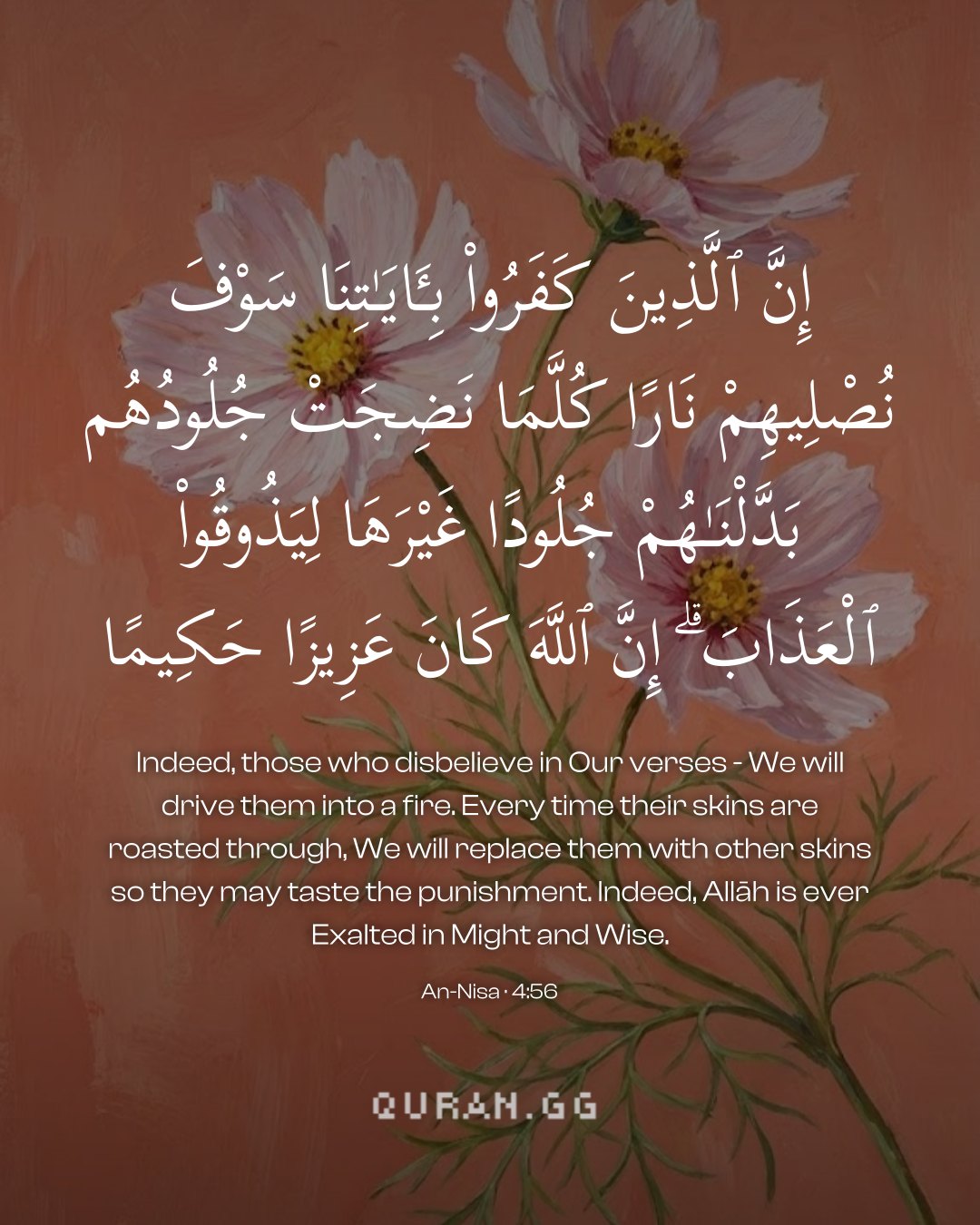
Indeed, those who disbelieve in Our verses - We will drive them into a fire. Every time their skins are roasted through, We will replace them with other skins so they may taste the punishment. Indeed, Allāh is ever Exalted in Might and Wise.
The Punishment of Those Who Disbelieve in Allah's Books and Messengers
Allah describes the torment in the Fire of Jahannam for those who disbelieve in His Ayat and hinder from the path of His Messengers. Allah said,
إِنَّ الَّذِينَ كَفَرُواْ بِـَايَـتِنَا
(Surely, those who disbelieved in Our Ayat ,) meaning, We will place them in the Fire which will encompass every part of their bodies. Allah then states that their punishment and torment are everlasting,
(We shall burn them in Fire. As often as their skins are roasted through, We shall change them for other skins that they may taste the punishment). Al-A`mash said that Ibn `Umar said, "When their skin are burned, they will be given another skin in replacement, and this skin will be as white as paper." This was collected by Ibn Abi Hatim, who also recorded that Al-Hasan said,
كُلَّمَا نَضِجَتْ جُلُودُهُمْ
(As often as their skins are roasted through,) "Their skin will be roasted through, seventy thousand times every day." Husayn said; Fudayl added that Hisham said that Al-Hasan also said that,
كُلَّمَا نَضِجَتْ جُلُودُهُمْ
(As often as their skins are roasted through, ) means, "Whenever the Fire has roasted them through and consumed their flesh, they will be told, `Go back as you were before,' and they will."
(But those who believe and do deeds of righteousness, We shall admit them to Gardens under which rivers flow (Paradise), abiding therein forever.) describing the destination of the happy ones in the gardens of Eden, beneath which rivers flow in all of its areas, spaces and corners, wherever they desire and wish. They will reside in it for eternity, and they will not be transferred or removed from it, nor would they want to move from it. Allah said,
لَّهُمْ فِيهَآ أَزْوَجٌ مُّطَهَّرَةٌ
(Therein they shall have Azwajun Mutahharatun (purified mates),) free of menstruation, postnatal bleeding, filth, bad manners and shortcomings. Ibn `Abbas said that the Ayah means, "They are purified of filth and foul things." Similar was said by `Ata', Al-Hasan, Ad-Dahhak, An-Nakha`i, Abu Salih, `Atiyah, and As-Suddi. Mujahid said that they are, free of urine, menstruation, spit, mucous and pregnancies." Allah's statement,
وَنُدْخِلُهُمْ ظِـلاًّ ظَلِيلاً
(And We shall admit them to shades, wide and ever deepening (Paradise).) means, wide, extensive, pure and elegant shade. Ibn Jarir recorded that Abu Hurayrah said that the Prophet said,
(There is a tree in Paradise, that if a rider travels under its shade for a hundred years, he will not cross it. It is the Tree of Everlasting Life.)
Ma'arif al-Qur'an
Mufti Muhammad ShafiOn ayahs 56–57
Particular believers and disbelievers were mentioned in the previous verses. Stated now is the reward and punishment of a believer and a disbeliever as a universal rule.
Commentary
Explaining the highly apocalyptic statement كُلَّمَا نَضِجَتْ جُلُودُهُم بَدَّلْنَاهُمْ in verse 56, Sayyidna Mu` adh ؓ says that as soon as their skin is burnt out it will be replaced - and this will be with such speed that the skin will be replaced a hundred times in one moment.
Sayyidna Hasan al-Basri (رح) says:
تاکل النار کلّ یوم سبعین الف مرّۃ کلما اکلتھم قیل لھم : عودوا فیعودون کما کانوا (اخرج البیھقی عین الحسن بحوالہ مظھری ج 2)
"The fire will eat them everyday seventy thousand times. When it would have eaten them up, they will be commanded: 'Return’. So, they shall return to be as they were." (al-Baihaqi, as quoted by Mazhari)
According to a narration in al-Bukhari and Muslim, the Holy Prophet ﷺ said: عن انبی ﷺ قال : ان اھون اھل النار عذابا رجل فی اخمص قدمیہ جمرتان یغلی منھما دماحہ کما یغلی الرجل بالقمقم (رواہ البخاری و مسلم ، بحوالہ الترغیب و الترھیب ج 4 ص 239)
"Lightest in punishment among the people of fire will be the man in the sole of whose feet there will be two smoldering embers the heat from which will keep his brain boiling like a cauldron boiling to the brim." (Almundhiri, al-Targhib v.4, p.239)
An explanation of 'purified wives'
According to Hakim, Sayyidna Abu Said al-Khudri ؓ narrated that the Holy Prophet ﷺ said: The women of Jannah will be pure, that is, pure from menstruation, defecation, urination and nasal mucus.
Mujahid adds to the above by saying: They shall also be 'pure and free from procreation and seminal impurity.' (Mazhari)
Let us now look at the last two words: ظِلًّا ظَلِيلًا in verse 57. Here, by mentioning ظلیل after ظل it has been mentioned that the shade in Jannah will be dense and ever-present. This is like saying: شَمسُ شَامِسُ or لیللُ لِیٔیلُ which indicate that the blessings of Paradise will last forever.
Sayyidna Abu Hurairah narrates that the Holy Prophet ﷺ said: اِن فی الجنۃ الشجرۃ یسیر الراکب فی ظلھا مأۃ عام ما یقطعھا، اقروا إن شٔتم و ظل ممدود
"There is a tree in Paradise. If a rider were to ride under its shade for a hundred years, he will still not cross it. Read, if you wish, وَظِلٍّ مَّمْدُودٍ (A shade, ever-extended, ever-stretched)."
Explaining ظِلًّا ظَلِيلًا ، Rabi' ibn Anas said:
ھو ظل العرش الذی لا یزول
"That is the shade of the Throne (al-'arsh) which will never decline."
Tazkirul Quran
Maulana Wahiduddin KhanOn ayahs 53–56
The Jews, thinking that they belonged to the race of prophets, projected their community as a sacred one. In consequence, they laid claim to honour and privilege which they justified by the invention of numerous stories and parables. By their own lights, everyone who was Jewish by faith was destined for deliverance and would not be consigned to the fire of Hell. Clearly, their lives were dominated by wishful thinking. The Quranic statement that ‘it is indeed God who purifies whoever He pleases’ rejects such notion that ‘those who consider themselves pure’ are actually and necessarily so. It clarifies that no one may have honour and privilege on the basis of his links with a race or community; these things depend on the divine law of justice. One who, adhering to the divine law, proves himself deserving of honour, will have honour confered upon him, but one who, by his actions, fails to do so, will never be honoured—no matter which race or community he belongs to. The belief in community-based salvation, whether created by the Jews or any other group, is totally without foundation. To invent such a belief and associate it with God is an attempt to associate falsehood with Him. He has never imparted such teaching. God does not discriminate between people on the basis of group, community or race. Such discrimination is a great injustice, whereas God dispenses absolute justice: He does not deal unjustly with anyone. When decadence sets in among the People of the Book, its adherents begin to live a life of wishful thinking instead of following the commands of God. This leads to superstition gaining ground. What can be achieved only through the performance of good deeds, they attempt to gain through sorcery, false beliefs and communion with evil spirits. Such deviators consider religion as a matter of ‘sacred words’ and ‘special relations with saintly personages,’ which may bring miraculous results merely by pronouncing those words or practising the relevant rituals. They continue to pay lip service to religion, but in practice, they follow the path of Satan.