Ma'arif al-Qur'an
Mufti Muhammad Shafi
The injunction to test the ability and understanding of minors
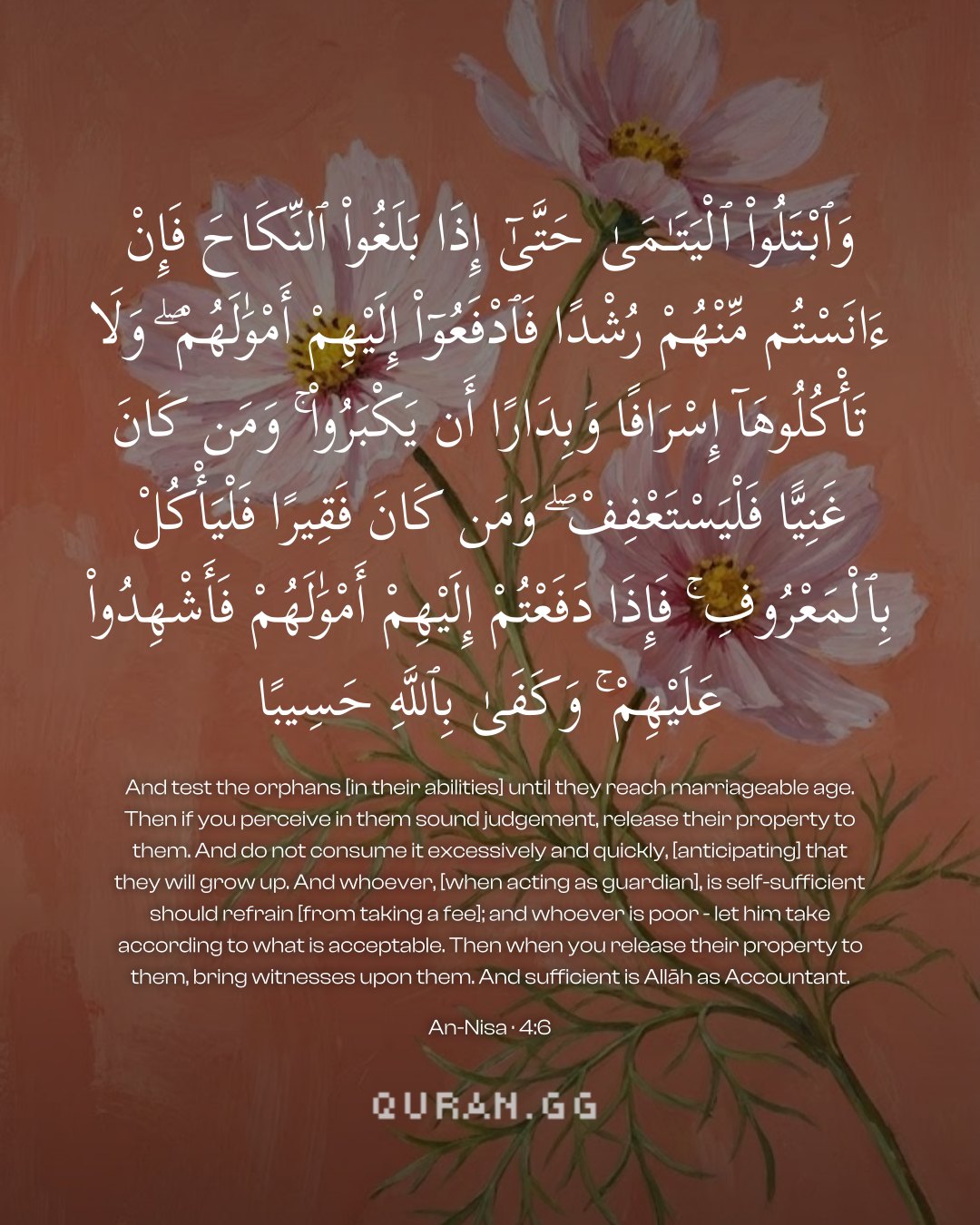
Once we know from verse 5 that minors should not be entrusted with properties until such time that their ability to discern and decide stands proved, the injunctions to educate and test such children to determine their ability follow in the next verse (6) Verse 6: وَابْتَلُوا الْيَتَامَىٰ حَتَّىٰ إِذَا بَلَغُوا النِّكَاحَ translated as 'and test the orphans until they reach marriageable age;' means that children, well before they become pubert and marriageable, should be tested through small assignments of buying and selling in order to determine their ability to conduct themselves in transactions on their own. This process of practical experimentation should continue right through upto the age of marriage-ability, that is, when they become pubert and mature. This is the time of special assessment. Now it should be determined if they have become smart and self-reliant in their affairs. Once this is sensed as 'dependable', it is time to hand over their property to them.
In short, given the nature of children and the factors involved in the growth of reason and intelligence among them, they have been divided in three stages. One: minority (before puberty). Two: After puberty. Three: After self-reliance, and discretion in conducting personal affairs (Rushd as opposed to Safahah). During the first stage, the guardians of children have been instructed to educate and train them by providing for them hands-on experience, that is, let them become smarter by conducting small dealings in buying and selling on their own. The expression: وَابْتَلُوا الْيَتَامَىٰ (and test the orphans) in this verse means exactly this. It is from here that Imam Abu Hanifah (رح) has deduced the ruling that the transactions of buying and selling entered into by minor children with the permission of their guardian are sound, valid and operative.
In accordance with the other injunction, when children become mature, pubert and marriageable, the guardian should check up their state of growth at that stage in terms of experience, intelligence and dealings, and once it becomes clear that they understand their profit and loss and handle their affairs and dealings in a satisfactory manner, their property should be handed over to them.
The Age of Maturity
Along with the injunction of maturity (بلوغ bulugh) in this verse, the Holy Qur'an has also answered the question as to the 'age' when a child would be taken as mature ( بالغ baligh) by saying: إِذَا بَلَغُوا النِّكَاحَ translated as 'until they reach marriage-ability'. Here, it has been indicated that real maturity is not tied up with any particular count of years. Rather, it depends on particular indicators and signs experienced by adults entering the threshold of adulthood. When, in terms of these indicators and signs, they would be regarded fit to marry, they would be considered mature, even if their age does not exceed thirteen or fourteen years. But, should it be that such signs of maturity just do not show up in some child, he shall be considered mature in terms of age, a position in which Muslim jurists vary. Some fix eighteen years for boys and seventeen for girls; some others have fixed fifteen years for both. With the Hanafiyyah, the fatwa is on the position that the boy and the girl shall both be considered mature under the Islamic law after they have completed their fifteenth year, irrespective of whether or not signs of maturity are found.
The Perception of Proper Understanding : How to find it? An Explanation of آنَسْتُم مِّنْهُمْ رُشْدًا
The injunction of the Qur'an is: 'then, if you perceive in them proper understanding, hand over to them their property.' Now, what is the time of this 'proper understanding' (rushd)? The Holy Qur'an has not elaborated on this final limit of time. Therefore, some Muslim jurists leaned towards favouring the view that the properties of children should not be handed over to them until it has been determined that they do have full and proper understanding. Instead, these will stay under the safe custody of the guardian as usual, even if this state of affairs continues for the rest of life.
But, in accordance with the verification of the issue by Imam Abu Hanifah (رح) at this point the absence of 'proper understanding' refers to the state affected by childhood. Within ten years after maturity, the effect of childhood is gone. So, there are fifteen years as the age of maturity (بلوغ bulugh) and ten years as the age of proper understanding (rushd). Once these 25 years are reached, such proper understanding is most likely to be achieved; something which was not possible due to the barriers of childhood, and later, younger years. Then, it should be noted that the Holy Qur'an uses the word, ‘rushdan’ in its indefinite form whereby it is suggesting that full understanding and perfect sense are not absolute conditions. A reasonable measure of understanding is also sufficient for this purpose on the basis of which their properties could be given to them. Therefore, even if perfect understanding has not been achieved despite the long wait of twenty five years, even then, their properties will be handed over to them. As far as perfect understanding and wisdom is concerned, there are people who do not get to achieve these throughout their entire lives. They always remain simple, innocent and rather shy and slow in conducting their practical dealings. They will not be deprived of their properties because of this. However, should there be someone totally insane, he will be governed by a separate rule since such a person always remains in the category of immature children. His property will never be handed over to him until his insanity disappears, even if his entire life were to pass in insanity.
The Prohibition of Undue Spending from the Property of Orphans
As we know, the verse instructs that the property of the orphans should not be handed over to them until a certain degree of under-standing and experience is perceived in them. Naturally, for this purpose, one will have to wait for some more time. In that case, it was probable that the guardian of the orphan could commit an excess against the interests of the orphan. So, the verse goes on to say:
وَلَا تَأْكُلُوهَا إِسْرَافًا وَبِدَارًا أَن يَكْبَرُوا
And do not consume it extravagantly and hastily lest they should grow up.
Here, the guardians of the orphans have been prevented from two things: Firstly, from spending out of their property extravagantly, that is, from spending over and above normal needs; and secondly, from starting to spend out from their property way before the need to do so, as if in a hurry, thinking of the near future when their wards would grow up and their property would have to be given to them and the guardian's control will be all over.
The orphan's guardian, if needy, can take out some of his expenses from the orphan's property
Does a person, who spends his time and labour in the upbringing of an orphan and is devoted to the protection of his property, have the right to take an honorarium for his services from the property of the orphan? The rule is given towards the later part of the verse when it is said: وَمَن كَانَ غَنِيًّا فَلْيَسْتَعْفِفْ (And whoever is rich he should abstain). It means that a person who is need-free as he can take care of his needs through some other means, then, he should not take any payment for his services from the property of the orphan, because this service is an obligation on him. Receiving payment for it is not permissible. Then, it was said: وَمَن كَانَ فَقِيرًا فَلْيَأْكُلْ بِالْمَعْرُوفِ (and whoever is poor he should consume in fairness). It means that the guardian of an orphan who is poor and needy and has no other source of earning his livelihood, he can consume a reasonable amount from the property of the orphans for his sustenance in a measure that is just about right to cover his basic needs.
Having witnesses while handing over property
The verse concludes with فَإِذَا دَفَعْتُمْ إِلَيْهِمْ أَمْوَالَهُمْ فَأَشْهِدُوا عَلَيْهِمْ وَكَفَىٰ بِاللَّـهِ حَسِيبًا : It means: 'when you hand over to them their property (after having gone through the period of test and trial), have (some reliable and pious people as) witnesses upon them (so that there is no dispute later). And (remember that) Allah is sufficient for reckoning (for He has a count of everything within His sight).
Payment for services rendered to country, community and Awqaf
The contextual extension of the verse yields an important juristic rule and principle. It concerns people who supervise Awqaf (religious endowments, trusts and estates) or manage mosques and religious schools or head institutions of Muslim states or hold charge of similar other services rendered for the country and community, services the rendering of which is known in Islamic terminology as فرض علی الکفایہ fard 'alal 'kifayah (an obligation which, if discharged by some, will absolve others). For these gentlemen too, the superior and more meritorious conduct is - of course, if they have sufficient assets to take care of the necessary expenses needed to maintain their family - that they should not take anything from these institutions or from the public exchequer of the government. But, should it be that they do not have funds of their own to sustain themselves and they devote their earning time to such service-oriented activities, then, they have the right to take such funds from these institutions in proportion to their need. Please do notice the condition which is: 'in proportion to need'. A lot of people fix an insignificant monthly emolument shown on paper to satisfy legal requirements but they go on spending by various other means on their person and on their family recklessly, much much beyond it. There is just no remedy for this lack of caution except the fear of Allah. The last words of the verse: وَكَفَىٰ بِاللَّـهِ حَسِيبًا and Allah is sufficient for reckoning) invite everyone, masses or classes, to realize that the man who stays untouched by unlawful acquisitions will be the man who fears the final accounting by Allah. وباللہ التوفیق :And the ability to do so comes from Allah.
Uthmani text of the Madinah mushaf (King Fahd Complex). Translation: Saheeh International. Tafsir via Quran.com.