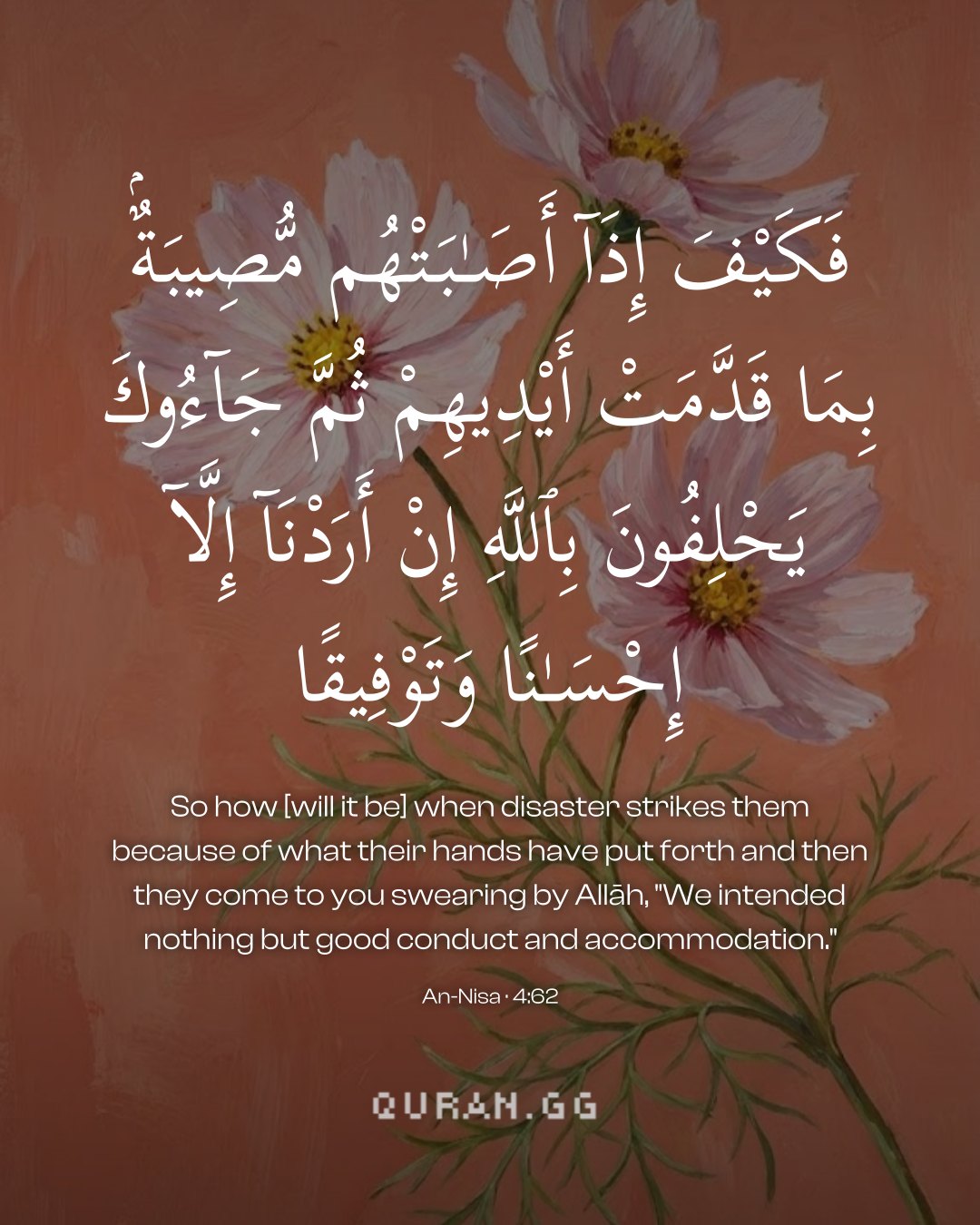
So how [will it be] when disaster strikes them because of what their hands have put forth and then they come to you swearing by Allāh, "We intended nothing but good conduct and accommodation."
Referring to Other than the Qur'an and Sunnah for Judgment is Characteristic of Non-Muslims
Allah chastises those who claim to believe in what Allah has sent down to His Messenger and to the earlier Prophets, yet they refer to other than the Book of Allah and the Sunnah of His Messenger for judgment in various disputes. It was reported that the reason behind revealing this Ayah was that a man from the Ansar and a Jew had a dispute, and the Jew said, "Let us refer to Muhammad to judge between us." However, the Muslim man said, "Let us refer to Ka`b bin Al-Ashraf (a Jew) to judge between us." It was also reported that the Ayah was revealed about some hypocrites who pretended to be Muslims, yet they sought to refer to the judgment of Jahiliyyah. Other reasons were also reported behind the revelation of the Ayah. However, the Ayah has a general meaning, as it chastises all those who refrain from referring to the Qur'an and Sunnah for judgment and prefer the judgment of whatever they chose of falsehood, which befits the description of Taghut here. This is why Allah said,
The third verse (62) exposes as false all interpretations advanced by those who bypassed decisions given under God-given laws only to turn to decisions which were contrary to it. Their plea, in gist, was that they did not bypass the Messenger of Allah for any reason of lack of belief in the truth of his station and mission and that they did not prefer the decision of others over his decisions as if it was the ultimate Truth. Rather, they claimed, there were expedient considerations which led them to taking this course of action. For instance, one such expedient consideration was that, a case going to the Messenger of Allah would have meant that the decision would have been strictly legal, true and just - devoid of any options of mutual patch-up and tolerance (of 'other' factors not necessarily just): Naturally, articulating deceptively, they said they took the case somewhere else so that something good shows up for both parties through a mutual conciliation.
As evident, they came up with all these interpretations only when their secret was revealed and their wickedness and hypocrisy came out in the open and their man was killed at the hands of Sayyidna ` Umar ؓ .
In short, it was a consequence of their evil deed which brought upon them the disgrace or disaster of an accomplice killed, following which they started making statements on oath with all sorts of excuses and interpretations. Allah Almighty, in this verse, makes it very clear that these people are liars in their oaths and interpretations and that everything they have done, they have done because of their disbelief and hypocrisy. Their pattern of behaviour is that, when called to come to the Book of Allah and to His Messenger, they would turn away, all averse - which is no hallmark of a true Muslim. But they, as the verse says, would become all alert once they get into trouble as a result of their own evil deeds - like when the exposure of their breach of trust or hypocrisy brings shame on them, or when it leads to the killing of their man - then, they come to the Messenger swearing by Allah that they meant nothing but good. That they took their case to somebody else was not because they did not believe in the Prophet, or that they doubted the veracity of his judgment, but that their aim was to promote good and. bring about harmony between the disputing parties.
Tazkirul Quran
Maulana Wahiduddin KhanOn ayahs 60–62
Every responsibility is a trust which must be properly discharged. Our dealings with everyone should be just and fair, no matter whether they be friend or foe. Even if the way of trustworthiness and justice appears to run counter to one’s interests and worldly considerations, one has to adhere to the path of justice and truth. Our gain lies in following not the dictates of the self, but the directives of God. If there are opportunities of forming the government, the Muslims must establish a proper Islamic government, but if such opportunities do not exist, they should concentrate on leading a religious life under the guidance of reliable persons selected from among themselves. Any differences between them should be resolved in the light of instructions given by God and the Prophet. Everyone does have the right to differ, but no one is permitted to defy a collective decision. Societal order and system are the primary needs of Muslim society.
Uthmani text of the Madinah mushaf (King Fahd Complex). Translation: Saheeh International. Tafsir via Quran.com.