The Wish that the Order for Jihad be Delayed
In the beginning of Islam, Muslims in Makkah were commanded to perform the prayer and pay some charity, so as to comfort the poor among them. They were also commanded to be forgiving and forbearing with the idolators and to observe patience with them at the time. However, they were eager and anticipating the time when they would be allowed to fight, so that they could punish their enemies. The situation at that time did not permit armed conflict for many reasons. For instance, Muslims were few at the time, compared to their numerous enemies. The Muslims' city was a sacred one and the most honored area on the earth, and this is why the command to fight was not revealed in Makkah. Later on when the Muslims controlled a town of their own, Al-Madinah, and had strength, power and support, Jihad was then legislated. Yet, when the command to fight was revealed, just as Muslims wished, some of them became weary and were very fearful of facing the idolators in battle.
Continue reading the tafsir of ayahs 77–79Ma'arif al-Qur'an
Mufti Muhammad Shafi
There is no escape from death:
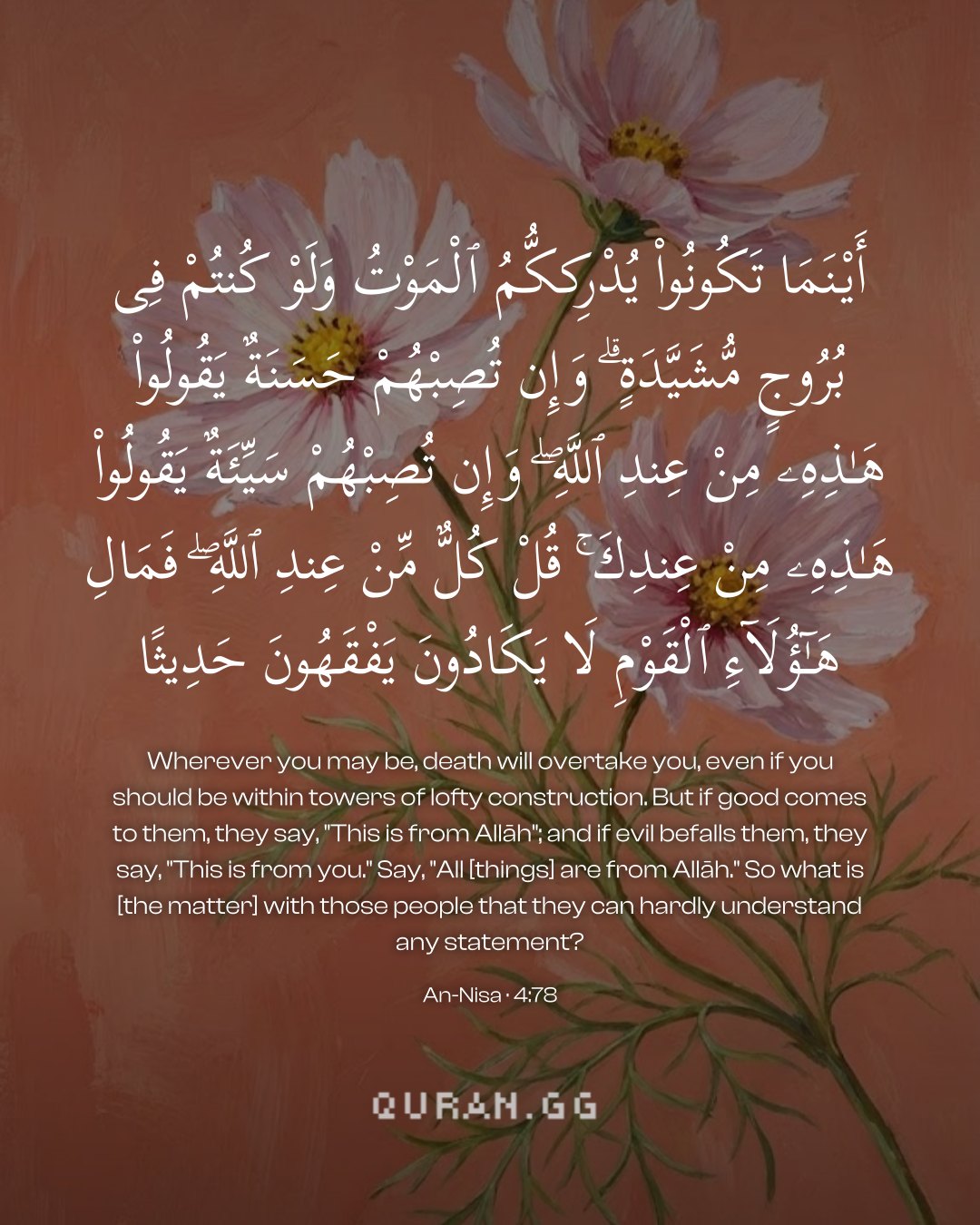
In أَيْنَمَا تَكُونُوا يُدْرِككُّمُ الْمَوْتُ (verse 78) (Wherever you will be death will over-take you), Allah Almighty removes any doubts the deserters from Jihad may entertain. They think that, perhaps by dodging Jihad, they can also dodge death. Therefore, it was said that there will be a day of death, a day when it, must come, no matter where you are; it will come exactly where you are. When this is settled, there is no sense in backing out from Jihad.
Hafiz Ibn Kathir (رح) ، the famous commentator, while discussing this verse, has reported a lesson-filled event on the authority of Mujahid as narrated by Ibn Jarir and Ibn Abi Hatim ؓ . He recounts the event concerning a woman from an earlier community. Soon after her pregnancy matured, she gave birth to a child and sent her servant out to fetch some fire. As soon as the servant stepped out of the door of the house, he saw a man appear suddenly before him. He asked: 'What baby this woman has given birth to?' The servant told him that it was a baby girl. Thereupon, the man said: You must remember that this girl will sleep with a hundred men and will finally die through a spider.' Hearing this, the servant returned immediate with a knife and slit the abdomen of that girl open. Taking her to be dead, he ran away from the house. But, a little later, the mother of the girl stitched up the skin of the abdomen slit by the servant. Then came the day when this girl grew to be young and beautiful, so beautiful that she was considered to be the jewel of the city.
As for the servant, he escaped overseas where he stayed for a long time and, in the meantime, assembled a fortune for himself. When he planned to get married, he returned to his old city. There he met an old woman. He told her that he was looking for a bride, but that he was eager to marry the most beautiful' woman in town. The old woman told him about a certain girl whose beauty was unmatched in the whole city and insisted that he should marry her. The servant, now a rich man, made efforts and finally got married to that girl. While getting to know each other, the girl asked him as to who he was and where did he live. He told her: 'Actually, I belong to this very city, but I had to run away because I had slit the abdomen of a girl open.' Then he narrated the whole event. Hearing this, she said: 'I am that girl.' She showed him her abdomen. The cut mark was still there. Seeing this, the man said: 'If you are the same woman, I disclose two things about you. The first one is that you will sleep , with a hundred men.' Thereupon, the woman confessed that she has done that, but she could not remember the number. The man said: 'The number is hundred. And the second one is that you will die through a spider.'
The man who was now rich had a grand palace built for her which was absolutely free of any spider webs. On a certain day, while they were resting in their room in the palace, they noticed a spider on the wall. The woman said: 'Is this the spider you scare me of?' The man said: 'Yes.' Thereupon, she sprang up from the bed saying: 'Then, this one I am going to kill right now.' Having said that, she downed the spider on the floor and trampled her dead under her feet.
The spider died all right but the poison from her infected her feet and nails and the message of death became all too clear for her. (Ibn Kathir)
Here was a woman living in a palace, new and very clean, but she died through a spider all of a sudden. Compare her case with many others who spent a life-time in fighting battles yet death did not come to them there. Think of Sayyidna Khalid ibn Walid ؓ ، the famous soldier and general of Islam known by his oft-repeated title, Saifullah - the Sword of Allah. He had a burning desire to die as martyr in the way of Allah. So, he kept fighting all his life, engaging in one Jihad after another and longing to become a Shahid. He killed thousands of disbelievers on the battlefields, living dangerously and daringly against many a trial, always praying and pleading that he be saved from the fate of dying in bed like women and praying and pleading that Allah favour him with the death of a fearless soldier in the heat of some Jihad. But, as. decreed by Allah, he finally died nowhere else but on his own bed in the house.
The lesson is that the arrangement of life and death stays in the hands of our creator whose decisions are final. There is nothing we can do about it. It is He who can, if He wills, give us death on a luxury bed at the hands of a spider; or, if He elects to save us, he can keep us alive amid swinging swords or zooming fires.
The opponents of Islam in Makkah used to persecute Muslims before the Migration. They resorted to all kinds of aggression and injustice against the Muslims, such as assault, destruction of their means of livelihood, stopping them from praying in the Kabah, not permitting them to spread the word of God, compelling them to leave their homes, etc. Whoever accepted Islam was subjected to all types of pressures to abandon his new faith and return to his ancestral religion. This unjust and aggressive stance of the opponents of Islam had, in principle, made it basically legitimate for the Muslims to take up arms against them; and therefore, the oppressed Muslims approached the Prophet repeatedly to seek his permission to fight. But the Prophet always restrained them, saying that he had not been given permission for armed confrontation. Instead, he advised the Muslims to be patient, say their prayers (salat) and pay the obligatory alms (zakat). The reason for this restraint was that premature and untimely action is not the way of Islam. The Muslims were not powerful enough in Makkah to take decisive action against their enemies. An armed confrontation at that time would have intensified their affliction. It would have amounted to giving the Makkans justification to declare open war against the Muslims, instead of there being just stray incidents of tyranny at the individual level. A practical step may be taken only when the necessary preparations have been made for it. Before reaching this stage, the faithful are required only to fulfil their personal obligations, which must be attended to under all circumstances. These obligations are to seek closeness with God, pay others their rightful dues and endure the difficulties encountered in the path of religion.
Continue reading the tafsir of ayahs 77–78 Uthmani text of the Madinah mushaf (King Fahd Complex). Translation: Saheeh International. Tafsir via Quran.com.