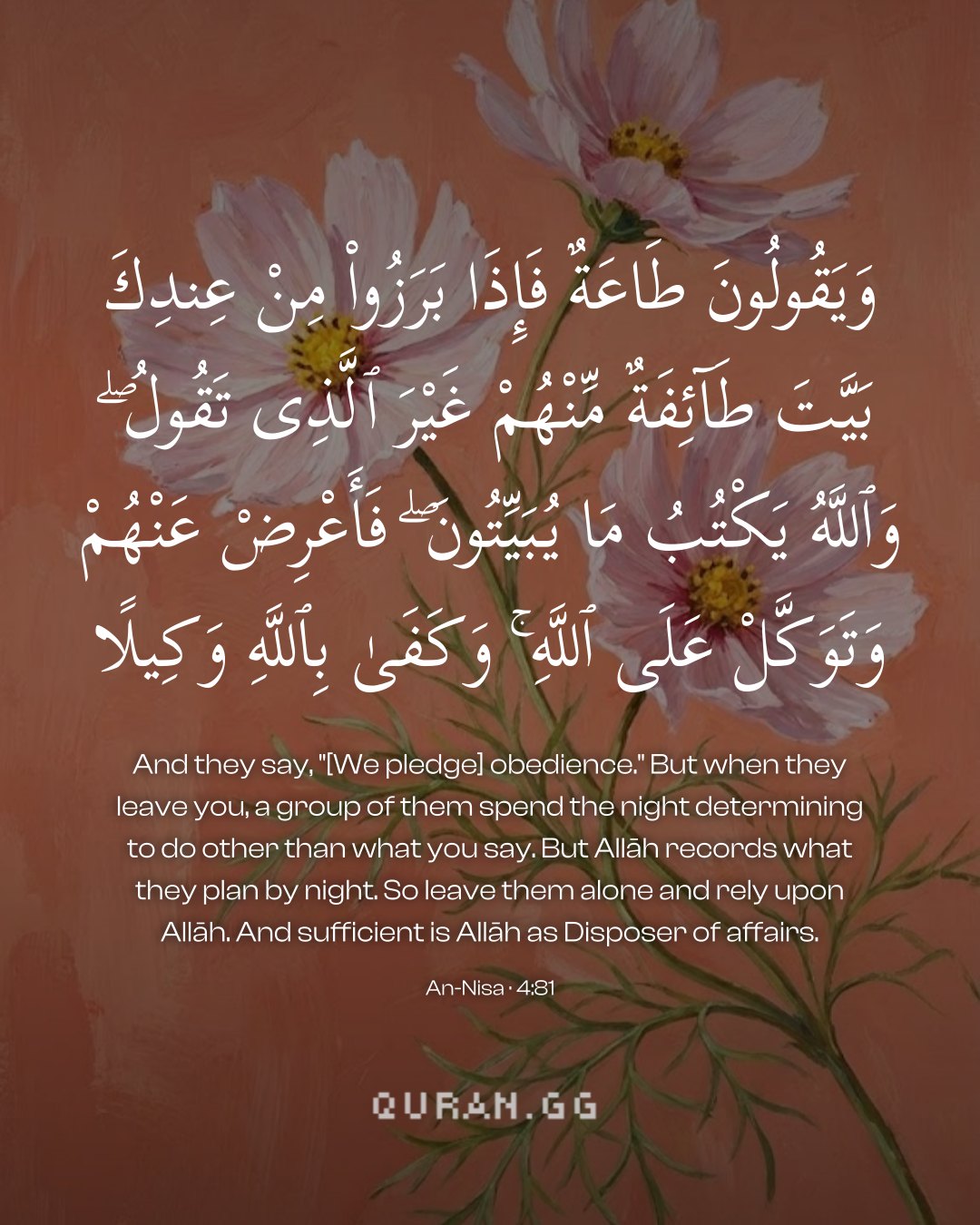
And they say, "[We pledge] obedience." But when they leave you, a group of them spend the night determining to do other than what you say. But Allāh records what they plan by night. So leave them alone and rely upon Allāh. And sufficient is Allāh as Disposer of affairs.
Allah states that whoever obeys His servant and Messenger, Muhammad ﷺ , obeys Allah; and whoever disobeys him, disobeys Allah. Verily, whatever the Messenger ﷺ utters is not of his own desire, but a revelation inspired to him. Ibn Abi Hatim recorded that Abu Hurayrah said that the Messenger of Allah ﷺ said,
(Whoever obeys me, obeys Allah; and whoever disobeys me, disobeys Allah. Whoever obeys the Amir (leader, ruler), obeys me; and whoever disobeys the Amir, disobeys me.) This Hadith was recorded in the Two Sahihs. Allah's statement,
That obedience to the Holy Prophet ﷺ is obligatory was the subject of verse 80. Here, the Prophet ﷺ was comforted in case the disbelievers rejected his message. Now comes a mention of some hypocrites who used to wriggle out of this obligation.
Commentary
The first verse (81) which begins with the words: وَيَقُولُونَ طَاعَةٌ فَإِذَا بَرَزُوا مِنْ عِندِكَ بَيَّتَ طَائِفَةٌ مِّنْهُمْ غَيْرَ الَّذِي تَقُولُ (And they say, "Obedience (we observe)..." condemns those who practice a policy of double-dealing. They will say something verbally and have something else hidden in their hearts. Once this is established, what should be the attitude of the Messenger of Allah towards such a set of people? The latter part of the verse carries a special instruction about it.
An important instruction for a leader
The verse: فَأَعْرِضْ عَنْهُمْ وَتَوَكَّلْ عَلَى اللَّـهِ ۚ وَكَفَىٰ بِاللَّـهِ وَكِيلًا refers to the hypocrites who, when they came face to face with the Holy Prophet ﷺ said that they were quite obedient to him and had accepted what he had commanded them with. But, when they left his company, they got together and conspired as to how they could disobey him. This duplicity of theirs caused great pain to him. Thereupon, Allah Almighty instructed him to ignore them and continue with his mission placing his trust in Allah because Allah is all-sufficient for him.
From here we know that one who leads people has to go through all sorts of hardships. People tend to level absurd allegations against him. Then, there are enemies in the garb of friendship and trust around him. Despite the presence of all such obstacles, this leader must display determination and steadfastness and devote to his mission with full trust in Allah. If his objective and orientation is right, he will, Insha’ Allah, succeed.
Tazkirul Quran
Maulana Wahiduddin Khan
The acknowledgment of the dayee is to accept ‘a human being like oneself’. This is why people may accept God, but do not extend their acceptance to God’s dayee. The real test, however, is to acknowledge and accept the dayee and stand by his side. Unless one takes him to be truly a messenger of God, one cannot be serious towards him. Then is no point in agreeing to lend support to the dayee to his face, and then continue to go one’s own way afterwards, or going to the extent of spreading irresponsible rumours about him. Those who behave so carelessly towards him cannot expect to be exonerated in the Hereafter by pleading ignorance. The veracity of the dayee, if one ponders upon it, is self-evident in his utterances, which are God-inspired.
Uthmani text of the Madinah mushaf (King Fahd Complex). Translation: Saheeh International. Tafsir via Quran.com.