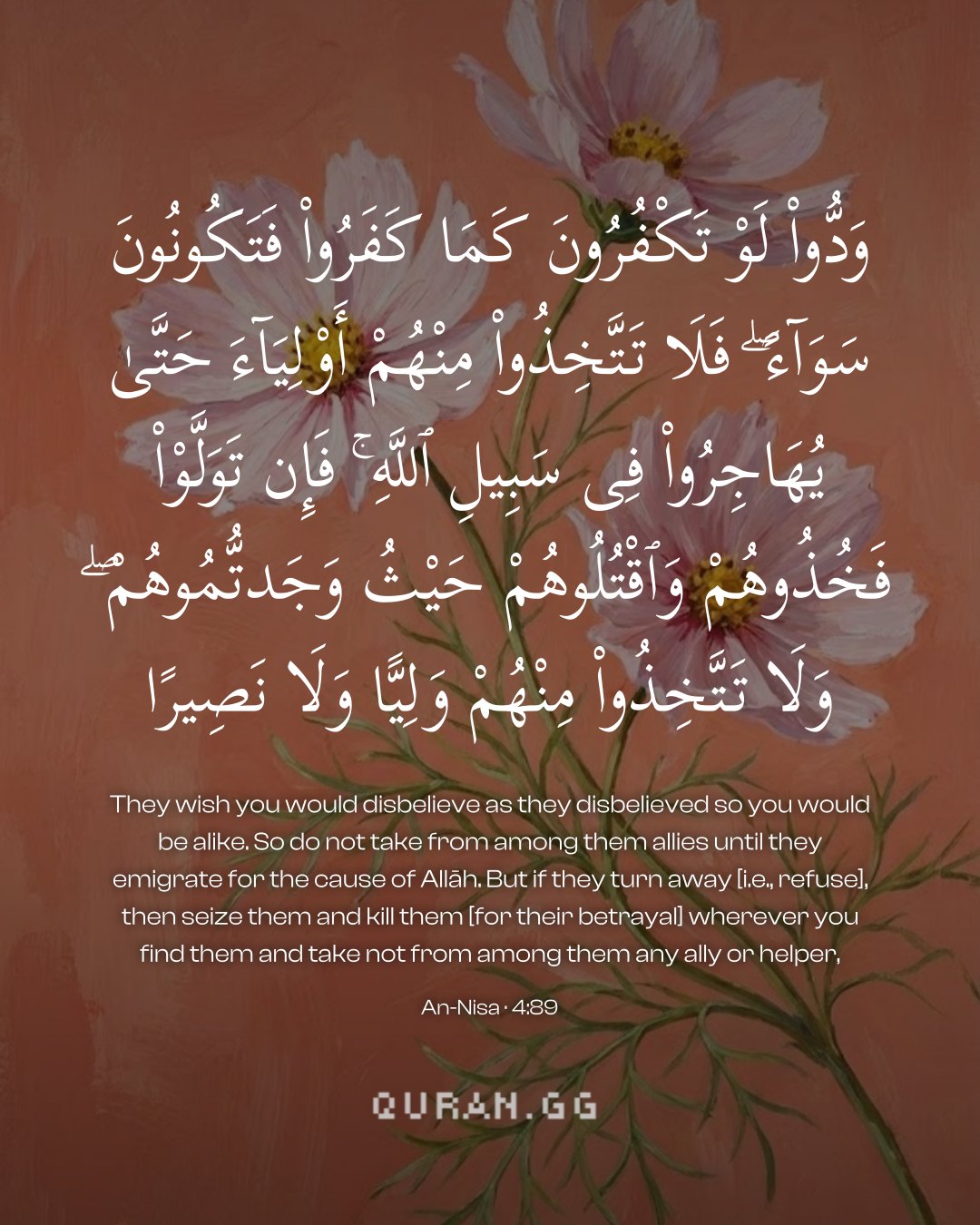
Censuring the Companions for Disagreeing over the Hypocrites who Returned to Al-Madinah Before Uhud
Allah criticizes the believers for disagreeing over the hypocrites. There are conflicting opinions over the reason behind revealing this Ayah. Imam Ahmad recorded that Zayd bin Thabit said that Messenger of Allah ﷺ marched towards Uhud. However, some people who accompanied him went back to Al-Madinah, and the Companions of the Messenger of Allah ﷺ divided into two groups concerning them, one saying they should be killed and the other objecting. Allah sent down,
فَمَا لَكُمْ فِى الْمُنَـفِقِينَ فِئَتَيْنِ
(Then what is the matter with you that you are divided into two parties about the hypocrites) The Messenger of Allah ﷺ said,
Continue reading the tafsir of ayahs 88–91 Different forms of Emigration and their Rules
Hijrah (Emigration) mentioned in verse 89 has been taken up in detail under the commentary on verse 100 of Surah al-Nis-a' which appears a little later. At this point, it is sufficient to know that Emigration from the homeland of Disbelief (Darul-kufr) was enjoined on all Muslims during the early period of Islam. It is for this reason that Allah Almighty has prohibited treating those who fail to carry out this obligation as Muslims. Consequently, when Makkah was conquered, the Holy Prophet declared: ھِجرَۃَ بَعدَ الفَتح لَا (There is no Hijrah after the Victory). It means: ‘Now that the Conquest of Makkah has made it the Abode of Islam, emigration from there was no more obligatory.' This rule related to the period of time when Emigration was considered to be a pre-condition of anyone's faith. During those days, anyone who did not emigrate despite having the ability to do so was not taken to be a Muslim. But, later on, this injunction was abrogated1 and now this mode of Emigration has ceased to exist.
1. It means that emigration no longer remained a pre-requisite for his being Muslim. However, if a Muslim lives in a non-Muslim country where he cannot fulfill his religious obligations, it is incumbent on him to emigrate if he has the means to do so. (Muhammad Taqi Usmani)
There remains, however, another form of Hijrah which has been identified in a hadith of Sahib al-Bukhari where it was said: لَا تَنقَطِعُ الھِجرَۃُ حَتَّی تَنقَطِعَ التَوبَۃ . It means that Hijrah (not in the sense of abandoning one's homeland, but in the sense of abandoning one's sins) will continue to exist until there remains the time to repent.
` Allamah ` Ayni, the commentator of al-Bukhari has said about this Hijrah: اَنَ المرَادَ بِالھجِرَۃِ البَاقِیۃِ ھِیَ ھَجرُ اَلسَّیِّاتِ (This later Hijrah means the abandonment of sins). This subject also finds elucidation in a hadith of the Holy Prophet ﷺ where he is reported to have said: اَلمُھَجرُ مَن ھَجَرَمَا نَھَی اللہُ عَنہُ. It means that a Muhajir (Emigrant) is one who emigrates ('hajara': abandon, leave) from everything prohibited by Allah Almighty (al-Mirqat, v.1)
The discussion appearing above tells us that, technically, the word, Hijrah is applied in a dual sense:
1. To leave one's homeland in order to save one's faith as was done by the Companions, may Allah be pleased with them all - they left their homeland of Makkah and emigrated to Madinah and Ethiopia.
2. To leave one's sins.
The words of the verse 89: وَلَا تَتَّخِذُوا مِنْهُمْ وَلِيًّا وَلَا نَصِيرًا (and do not take from them a friend or a helper) tell us that seeking help from disbelievers is forbidden (Haram). Pursuant to this, it appears in a narration that the Ansars of Madinah sought the permission of the Holy Prophet $ to seek help from the Jews to offset disbelievers whereupon
he said: v 'I (The bad ones! We do not need them). (Mazhari, v.2
During difficult times the only guarantee of keeping alive the message of the Truth is for the dayee, despite trying conditions, to remain firm in his commitment and carry on his mission, even if there happens to be no one to support him. In such circumstances, the determination of the dayee makes him eligible for God’s special reward. During the second expedition of Badr, which took place only one month after the battle of Uhud, the state of affairs in Madinah was so gloomy that only seventy men came forward to fight along with the Prophet. This small troop, however, received special succour from God, filling the Makkans with awe, making them retreat without fighting, thus averting what could have been a disastrous encounter. God’s resolve is to weaken the non-believers, but this resolve is expressed only when the standard bearers of His own religion, though deprived of means and support, step forward to counter the enemy onslaught.
Uthmani text of the Madinah mushaf (King Fahd Complex). Translation: Saheeh International. Tafsir via Quran.com.