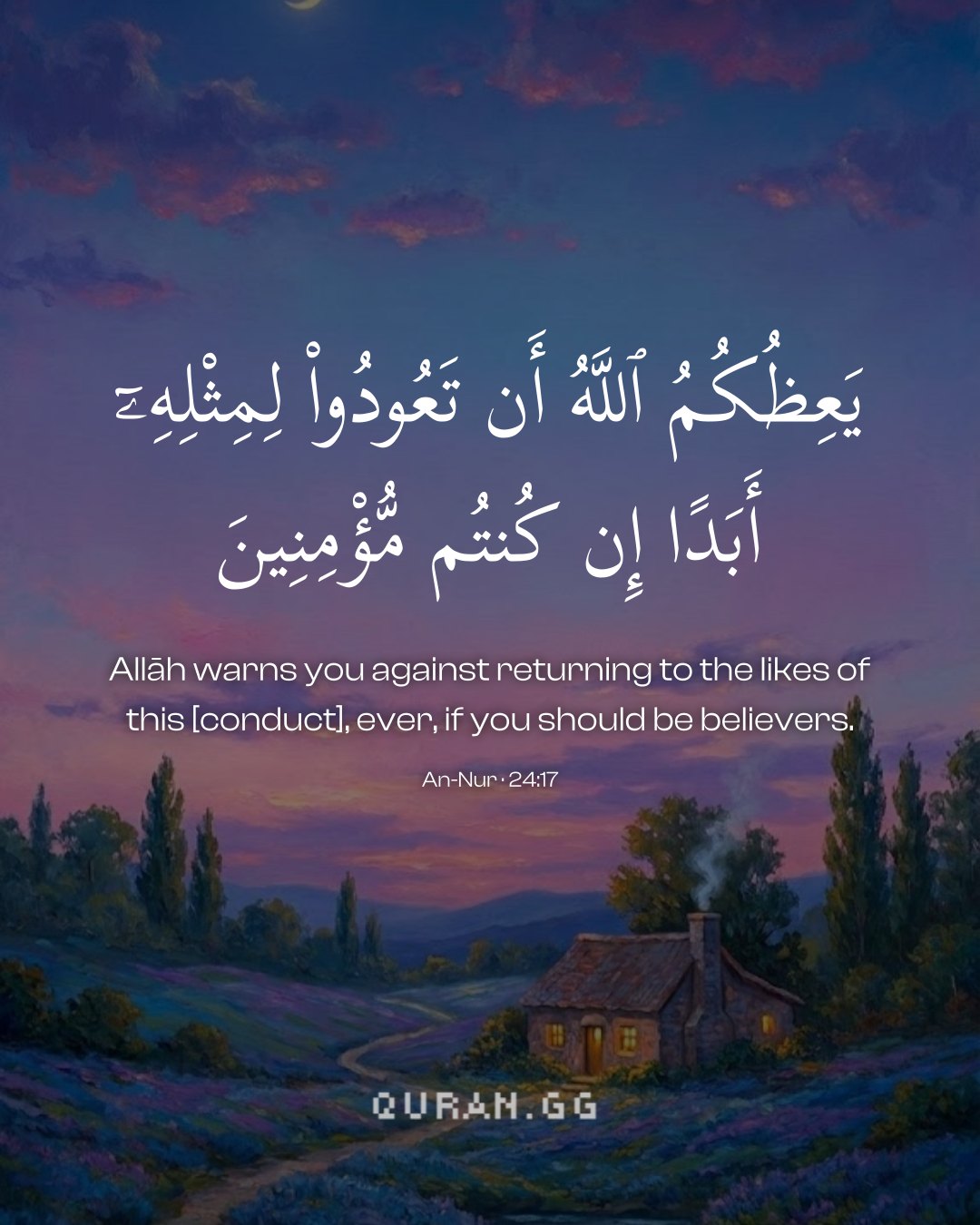
This is further discipline, in addition to the command to think well of people, i.e., if something unbefitting is mentioned about good people, then one should think well of them, and not feel towards them anything but good. Then if a person has any unsuitable thoughts about them, insinuated into his mind and imagination by Shaytan, he should not speak about that, for the Prophet said:
(Allah will excuse my Ummah for anything that occurs to their minds, so long as they do not speak about it or act upon it.) This was reported in the Two Sahihs. Allah's saying:
And why, when you heard of it, did you not say, It is not for us to speak about this. Pure are You (0 Allah). This is a terrible calumny.' - 24:16.
In this verse the same advice is repeated which was imparted in an earlier verse, with further elaboration as to what should the Muslims do in such a situation when they hear a rumor. The advice is that they should say in categorical terms that they are not allowed even to mention such a thing for which there is no proof. It is a very grave accusation.
A doubt and its answer
If someone has a doubt that just as the truth of an event cannot be verified without a proof, and hence it is unlawful to mention it and spread it, likewise, the report of that event should not be believed to be a lie and a 'terrible calumny' without a proof of its being a lie. The answer to this doubt is that it is the integral spirit of Islam to consider every Muslim as free from sins, and this is based on reasoning. Anything contrary to this proven reality is a lie if put forward without a proof, and no further proof is required to prove this assertion a lie. This is enough to call it a slander if a believer Muslim is blamed for a crime without proof.
Tazkirul Quran
Maulana Wahiduddin KhanOn ayahs 16–18
The role of the Prophet Muhammad was that of a preacher of Truth. The position of a preacher, or da‘i, is always extremely delicate. Even a slight mistake on his part can damage his entire mission. Those who lent an ear to baseless slander concerning a Muslim lady, namely ‘A’ishah, and started spreading it all around, were thus acting in a highly irresponsible manner. Had it not been for the timely refutation of the allegations—by direct intervention of God—this would have caused irreparable loss to Islam. Muslims would then have been divided into two groups and would have started fighting against each other. The community, which, according to God’s plan, was to serve as a means of eliminating the prevalence of polytheism from the world, would have destroyed itself in an internecine war.
Uthmani text of the Madinah mushaf (King Fahd Complex). Translation: Saheeh International. Tafsir via Quran.com.