The Virtues of the Masjids, the Correct Etiquette, and the Virtues of Those who take care of them
Having likened the heart of the believer and what it contains of guidance and knowledge to a lamp lit with good oil shining in a clear glass, Allah then states where it belongs, which is in the Masjids, the places on earth that are most beloved to Allah. The Masjids are His houses where He Alone is worshipped. So Allah says:
فِى بُيُوتٍ أَذِنَ اللَّهُ أَن تُرْفَعَ
(In houses which Allah has ordered to be raised,) meaning, Allah has commanded that they be established and that they be kept clean of any filth, idle talk or words or deeds that are inappropriate. `Ali bin Abi Talhah reported from Ibn `Abbas concerning this Ayah:
Continue reading the tafsir of ayahs 36–38Ma'arif al-Qur'an
Mufti Muhammad Shafi
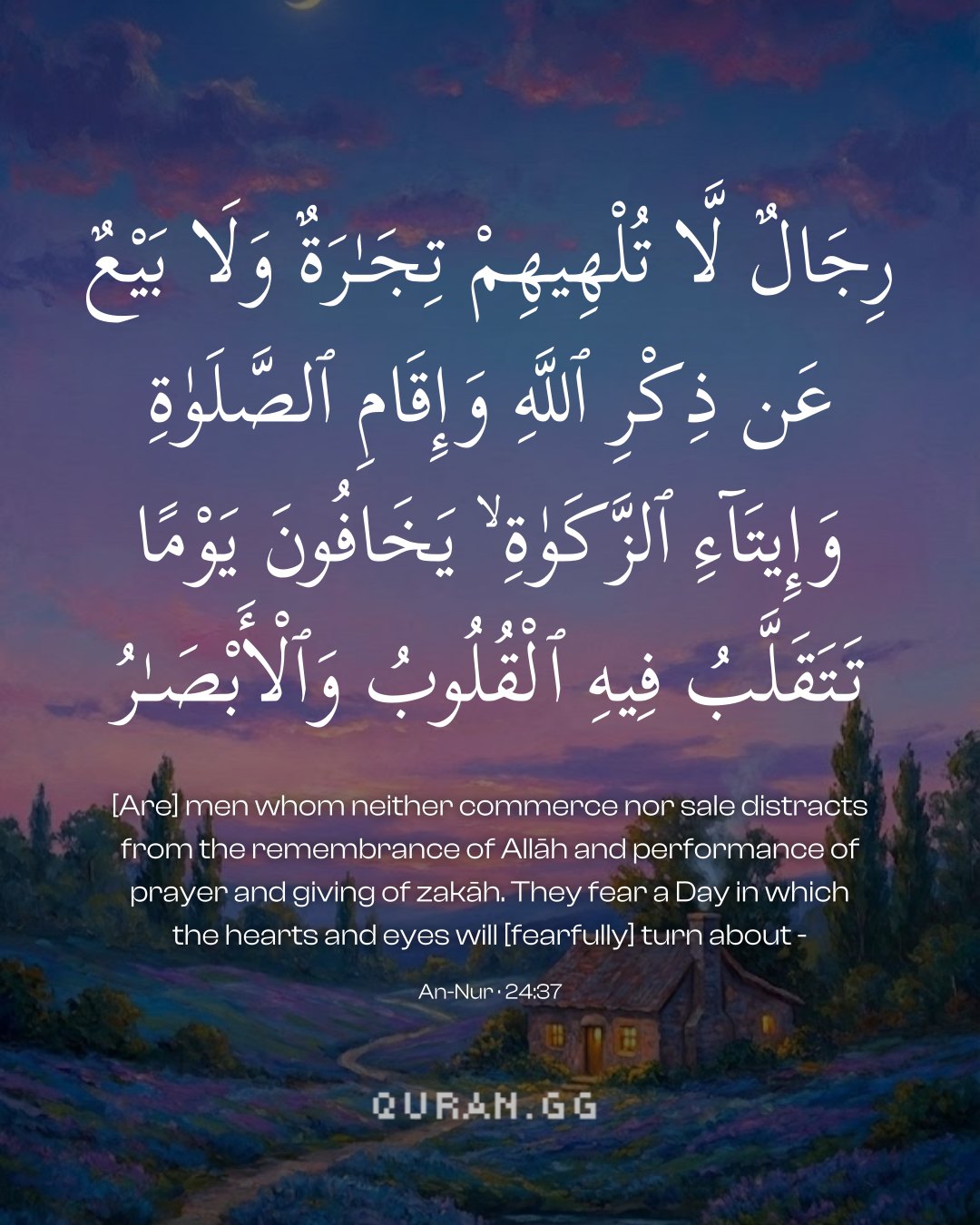
رِجَالٌ لَّا تُلْهِيهِمْ تِجَارَةٌ وَلَا بَيْعٌ عَن ذِكْرِ اللَّـهِ
By men whom no trade or sale makes neglectful of the remembrance of Allah - 37.
This verse describes special attributes of those believers who are the distinguished recipients of the Nur of guidance and remain in the mosques. By the use of word Rijal رِجَالٌ (men) there is a hint that only men's presence is required in the mosques. For women it is better that they offer their prayers at homes.
Musnad of Ahmad and Baihaqi have related a hadith of Sayyidah Umm Salmah ؓ that the Holy Prophet ﷺ once said خیر المساجد النساء قعر بیوتھنّ . ` The best mosques for women are the secluded corners of their homes'.
This verse describes that the involvement in trade and sales does not stop the righteous believers from the remembrance of Allah. Since 'sale' is included in the word 'trade', some commentators have preferred to assume trade for purchase only for the sake of comparison, while others have taken the trade in its common sense, that is transactions of sale and purchase, and have explained the wisdom of using the word 'sale' separately for the reason that trade transactions have a wide scope where profits and benefits are received after a long time. On the other hand by selling something one receives the money with profit immediately in cash. Hence, it is mentioned separately to stress that they do not bring into consideration even the most lucrative mundane benefit as against the prayers and remembrance of Allah Ta’ ala.
Sayyidna ` Abdullah Ibn ` Umar ؓ has said that this verse was revealed in connection with the market people, and his son, Sayyidna Salim, has related that one day his father was passing through the market and the time for prayers had come. Then he noticed that people started closing their shops and set out to go towards the mosque. On that Sayyidna ` Abdullah Ibn ` Umar ؓ said that it is for these persons that the Qur'an has said رِجَالٌ لَّا تُلْهِيهِمْ تِجَارَةٌ وَلَا بَيْعٌ عَن ذِكْرِ اللَّـهِ.
There were two companions of the Holy Prophet ﷺ during his time, one was a general trader and the other a blacksmith who used to produce swords and sell them. It was the habit of the trader that when he would hear the call of the prayer while weighing something, he would leave everything there and get up to go to the mosque for prayers. The other one who was the blacksmith, when he was busy hammering the hot iron and would hear the call of the prayer, he would stop his hand wherever it was and throw the hammer out of his hand to rush to the mosque for prayers, without even bothering to strike the raised hammer. This verse was revealed in their praise. (Qurtubi)
Most of the companions were traders
This verse also points out that most of the companions were either traders or manufacturers, that is in the professions involved with the market, because the quality mentioned in the verse can be attributed only to those who are in the profession of trade and sales and do not let their profession interfere in the remembrance of Allah Ta’ ala. Otherwise it is irrelevant. (Ruh)
يَخَافُونَ يَوْمًا تَتَقَلَّبُ فِيهِ الْقُلُوبُ وَالْأَبْصَارُ
They are fearful of a day in which the hearts and the eyes will be overturned - 37.
The last quality of those believers who are mentioned in the above verse is that despite being busy in Allah's obedience, remembrance and worshiping all the time, they do not become careless or free themselves from Allah's fear. Instead the fear of reckoning on the Day of Judgment is constantly in their mind, which is the fruit of Nur of guidance granted to them by Allah Ta ala, mentioned in the earlier verse يَهْدِي اللَّـهُ لِنُورِهِ مَن يَشَاءُ.
A mosque in an inhabited locality has the same importance as the heart in the human body. The heart of a human being is illuminated by faith, while mosques are illuminated by prayers. Mosques are constructed so that within their sacred precincts, devotees may concentrate their thoughts on God and spend some time in offering prayers to Him. In the spiritual atmosphere prevailing therein, they turn quite naturally towards their Maker. A human being, on whom God bestows the gift of divine guidance, learns to recognize the call of truth. His heart is filled with feelings of awe towards God and he decides to lead a God-oriented life. It is people such as these who become self-effacing and self-sacrificing God-worshippers. They are the ones who will receive the unlimited blessings of God.
Uthmani text of the Madinah mushaf (King Fahd Complex). Translation: Saheeh International. Tafsir via Quran.com.