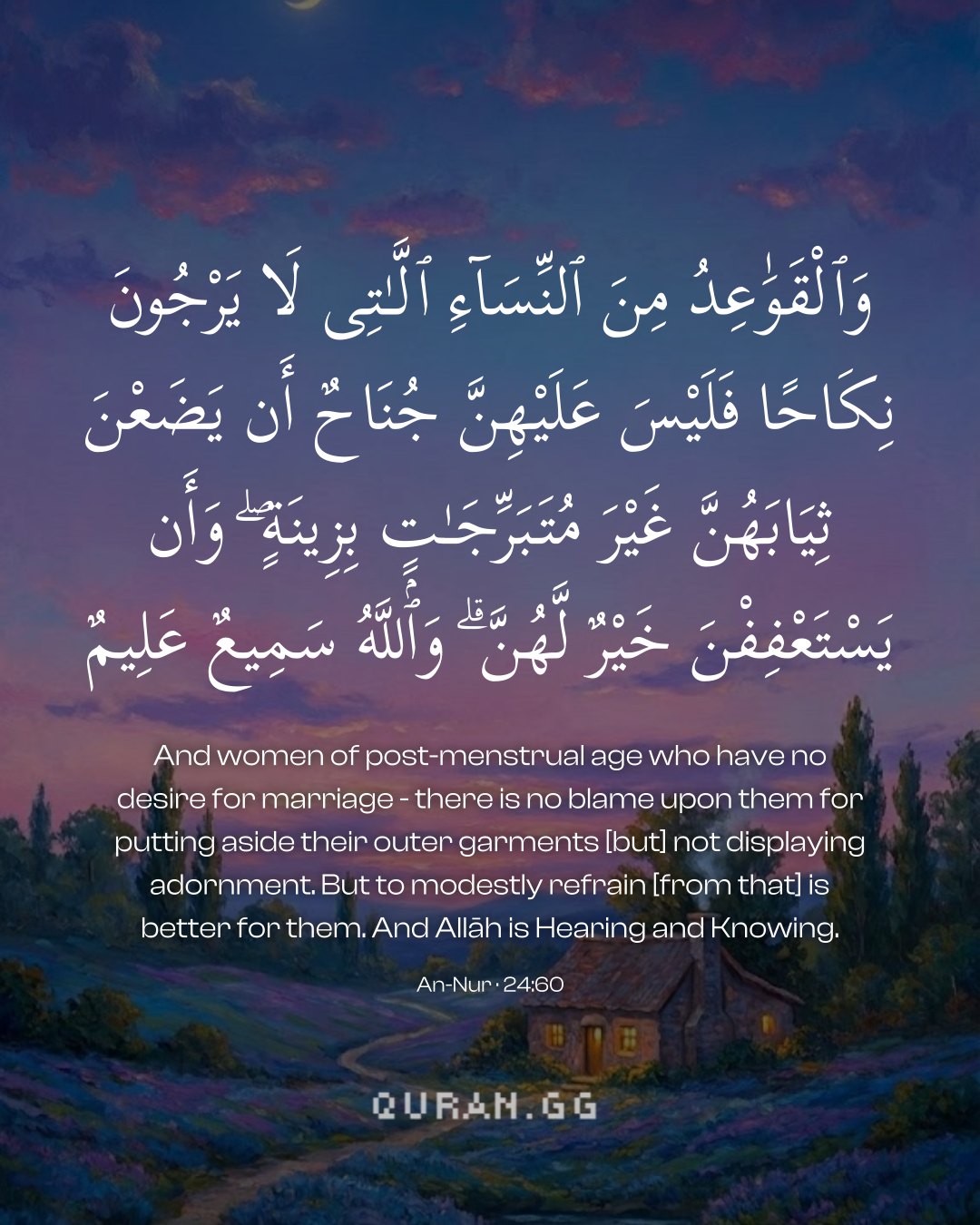
And women of post-menstrual age who have no desire for marriage - there is no blame upon them for putting aside their outer garments [but] not displaying adornment. But to modestly refrain [from that] is better for them. And Allāh is Hearing and Knowing.
The Times when Servants and Young Children should seek Permission to enter
These Ayat include a discussion of how people who are closely related should seek permission to enter upon one another. What was mentioned earlier in the Surah had to do with how unrelated people should seek permission to enter upon one another. Allah commanded the believers to ensure that their servants and their children who have not yet reached puberty should seek permission at three times: the first is before the Fajr prayer, because people are asleep in their beds at that time.
وَحِينَ تَضَعُونَ ثِيَـبَكُمْ مِّنَ الظَّهِيرَةِ
(and while you put off your clothes during the afternoon,) means, at the time of rest, because a man may be in a state of undress with his wife at that time.
The injunction on hijab for women has already appeared earlier in detail in two verses, and two exemptions were also mentioned there. One exemption relates to the one who is seeing, and the other to that who is seen. According to the first exemption, young children and the slave girls are exempt. As for the second exemption, the outward adornment is exempt from hijab, which includes outer clothing like veil or covering sheet. There is agreement of all on this, but according to some, women's face and palms are also included in this exemption.
In the next verse the third exemption is granted on the basis of a woman's personal situation. If a woman has grown so old that no one would have any (sexual) desire towards her, nor is she marriageable, for such a woman concession in hijab is allowed in that even strangers (non-Mahrams) are treated like mahrams for her. She is not required to cover those parts of her body before non-Mahrams which are not required to be covered before mahrams. Hence, it is said وَالْقَوَاعِدُ مِنَ النِّسَاءِ اللَّاتِي (And those old women who have no hope for marriage - 60). The explanation of this verse is already given above. Although very old women are allowed to uncover those parts of their body before non-Mahrams which are not required to be covered before mahrams, yet this exemption is allowed with the condition that they do so without applying any makeup or adornment. The other thing said in the last is وَأَن يَسْتَعْفِفْنَ خَيْرٌ لَّهُنَّ (60) that is, it is better for them if they avoid going before non-Mahrams altogether.
Tazkirul Quran
Maulana Wahiduddin Khan
In some of the preceding verses certain instructions regarding social behaviour are given. Now these verses were revealed, perhaps as a supplement to and an elaboration of them. For instance, one of the instructions given initially to women regarding the covering of the body was that they should cover their bosoms with scarves or sheets (verse 31). In verse 60 those old women who are past the marriageable age have been exempted from the general rule, and it is laid down that there is no harm in their not following it. These two sets of instructions could have been revealed at one and the same time, but there are four intervening paragraphs (ruku‘), in which different subjects have been dealt with. It is gathered from traditions that after the initial instructions had been revealed, some practical problems arose. Therefore, in clarification, these later verses were revealed. This shows that the Quran’s method is one of gradualness and not that of taking sudden steps. It was possible for God to have revealed all the instructions together at one time, but He chose to reveal them bit by bit, according to the circumstances.
Uthmani text of the Madinah mushaf (King Fahd Complex). Translation: Saheeh International. Tafsir via Quran.com.