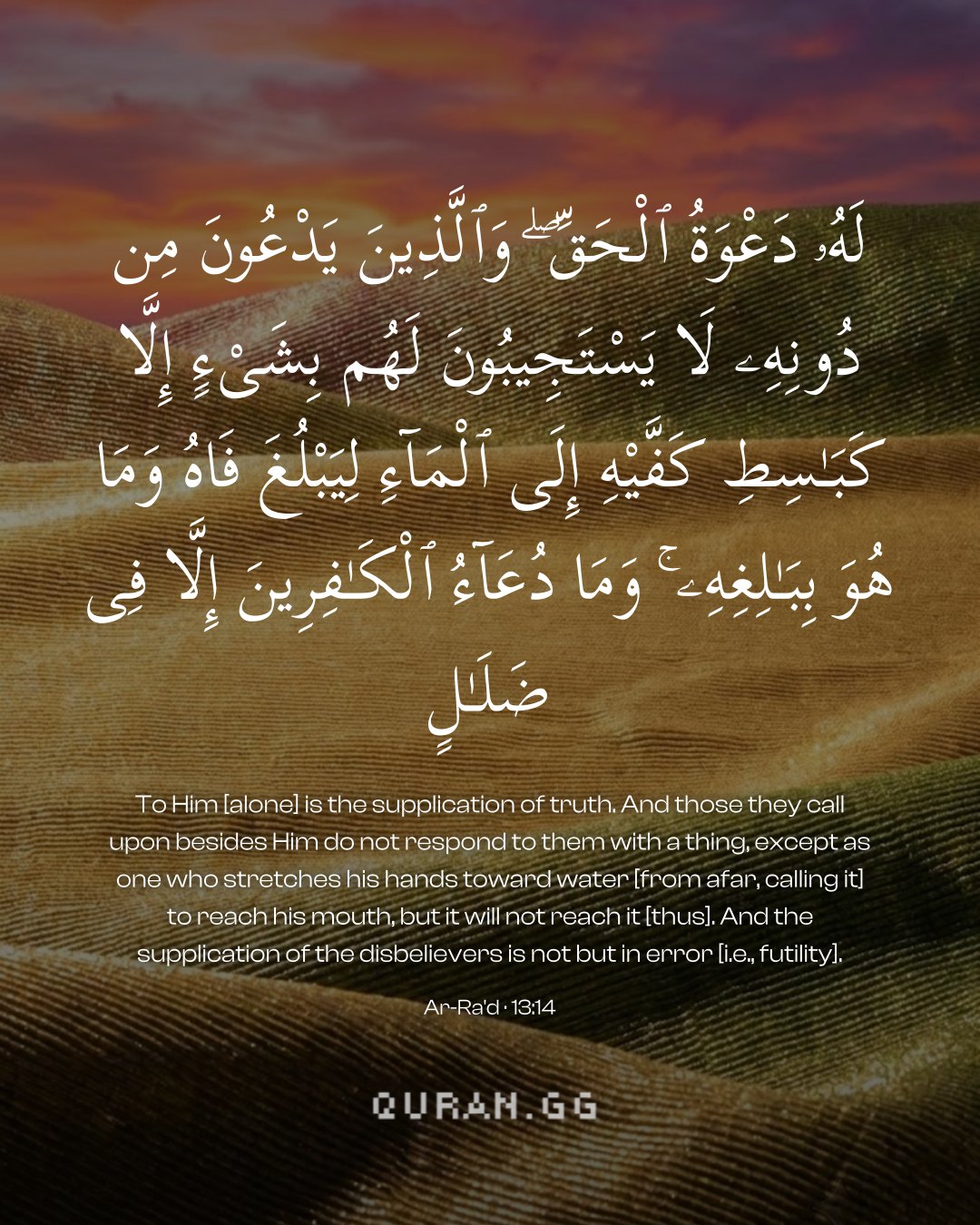
لَهُۥ دَعْوَةُ ٱلْحَقِّ ۖ وَٱلَّذِينَ يَدْعُونَ مِن دُونِهِۦ لَا يَسْتَجِيبُونَ لَهُم بِشَىْءٍ إِلَّا كَبَـٰسِطِ كَفَّيْهِ إِلَى ٱلْمَآءِ لِيَبْلُغَ فَاهُ وَمَا هُوَ بِبَـٰلِغِهِۦ ۚ وَمَا دُعَآءُ ٱلْكَـٰفِرِينَ إِلَّا فِى ضَلَـٰلٍ ١٤
To Him [alone] is the supplication of truth. And those they call upon besides Him do not respond to them with a thing, except as one who stretches his hands toward water [from afar, calling it] to reach his mouth, but it will not reach it [thus]. And the supplication of the disbelievers is not but in error [i.e., futility].
Tafsir Ibn Kathir (abridged)
Ismail ibn Kathir
A Parable for the Weakness of the False Gods of the Polytheists
`Ali bin Abi Talib said that Allah's statement,
لَهُ دَعْوَةُ الْحَقِّ
(For Him is the Word of Truth.) is in reference to Tawhid, according to Ibn Jarir At-Tabari. Ibn `Abbas, Qatadah, and Malik who narrated it from Muhammad bin Al-Munkadir, said that,
لَهُ دَعْوَةُ الْحَقِّ
(For Him is the Word of Truth.) means, "La ilaha illallah." Allah said next,
وَالَّذِينَ يَدْعُونَ مِن دُونِهِ
(And those whom they invoke besides Him...), meaning, the example of those who worship others besides Allah,
كَبَـسِطِ كَفَّيْهِ إِلَى الْمَآءِ لِيَبْلُغَ فَاهُ
(like one who stretches forth his hand for water to reach his mouth,) `Ali bin Abi Talib commented, "Like he who stretches his hand on the edge of a deep well to reach the water, even though his hands do not reach it; so how can the water reach his mouth" Mujahid said about,
كَبَـسِطِ كَفَّيْهِ
(like one who stretches forth his hand) "Calling the water with his words and pointing at it, but it will never come to him this way." The meaning of this Ayah is that he who stretches his hand to water from far away, to either collect some or draw some from far away, will not benefit from the water which will not reach his mouth, where water should be consumed. Likewise, those idolators who call another deity besides Allah, will never benefit from these deities in this life or the Hereafter, hence Allah's statement,
وَمَا دُعَآءُ الْكَـفِرِينَ إِلاَّ فِى ضَلَـلٍ
(and the invocation of the disbelievers is nothing but misguidance.)
In the next verse (13), it was said: وَيُسَبِّحُ الرَّعْدُ بِحَمْدِهِ وَالْمَلَائِكَةُ مِنْ خِيفَتِهِ (And the thunder proclaims His purity with His praise, and [ so do ] the angels, out of His awe). In Arabic usage, the word: الرَّعْدُ (Ar-Ra` d)refers to the sound of the clouds generated by their collision. The sense of (Tasbih: the glorification of Allah) mentioned here is that of the same Tasbih about which it has been said in another verse of the Qur’ an: وَإِن مِّن شَيْءٍ إِلَّا يُسَبِّحُ بِحَمْدِهِ وَلَـٰكِن لَّا تَفْقَهُونَ تَسْبِيحَهُمْ 'And there is nothing in the heavens and the earth which does not glorify Allah, but they do not understand their glorification' - (17:44).
Continue reading the tafsir of ayahs 13–15 When there is lightning, sometimes it carries the message of pleasant weather. But sometimes it falls on the earth like a thunderbolt and burns things down. Similarly, when the clouds gather, they sometimes shower beneficial rains upon the earth. But sometimes they are the forerunners of storms and floods. This means that in this world, one and the same thing can have the aspects of both fear and hope. The One who manages the affairs of the world sends His blessings to the people of the earth by means of various phenomena. He can turn an ostensibly beneficent thing into the most destructive punishment. This state of affairs warns man that he should never consider himself to be safe from God’s scourge. Heedless human beings always wait for some unique and magical sign. But those whose consciousness is alive are successful in finding every kind of sign—of an inestimable value—in the daily affairs happening around them. They feel their hearts beat faster with the roll of thunder and the flash of lightning and when they look at the raindrops, a flood of tears flows from their eyes. The condition which the angels face on seeing the power of God directly, are one and the same as those faced by true human beings, even when they have not seen the power of God directly.
Uthmani text of the Madinah mushaf (King Fahd Complex). Translation: Saheeh International. Tafsir via Quran.com.