Tafsir Ibn Kathir (abridged)
Ismail ibn Kathir
The Believer and the Disbeliever are never Equal
Allah says, `They could never be equal; those among people who know that what,
أَنزَلَ إِلَيْكَ
(has been revealed unto you), O Muhammad,
مِن رَبِّكَ
(from your Lord) is the truth about which there is no doubt and in which there is no confusion, vagueness or contradiction. Rather, they believe that all of it is the truth, each part of it testifying to another. They believe that none of its parts contradicts the others, that all its information is true and that all its commandments and prohibitions are just,
وَتَمَّتْ كَلِمَةُ رَبِّكَ صِدْقاً وَعَدْلاً
(And the Word of your Lord has been fulfilled in truth and in justice.) 6:15 It is accurate in its information and stories and just in what it orders. Therefore, the Ayah says, those who believe in the truth that you brought, O Muhammad, are not at all similar to those who are blind and cannot find guidance to what benefits them, which they cannot even comprehend. And even if they comprehend the guidance, they will not follow it, believe in it or abide by it.' Allah said in another Ayah,
لاَ يَسْتَوِى أَصْحَـبُ النَّارِ وَأَصْحَـبُ الْجَنَّةِ أَصْحَـبُ الْجَنَّةِ هُمُ الْفَآئِزُونَ
(Not equal are the dwellers of the Fire and the dwellers of the Paradise. It is the dwellers of Paradise that will be successful.) 59:20 Allah said in this honorable Ayah,
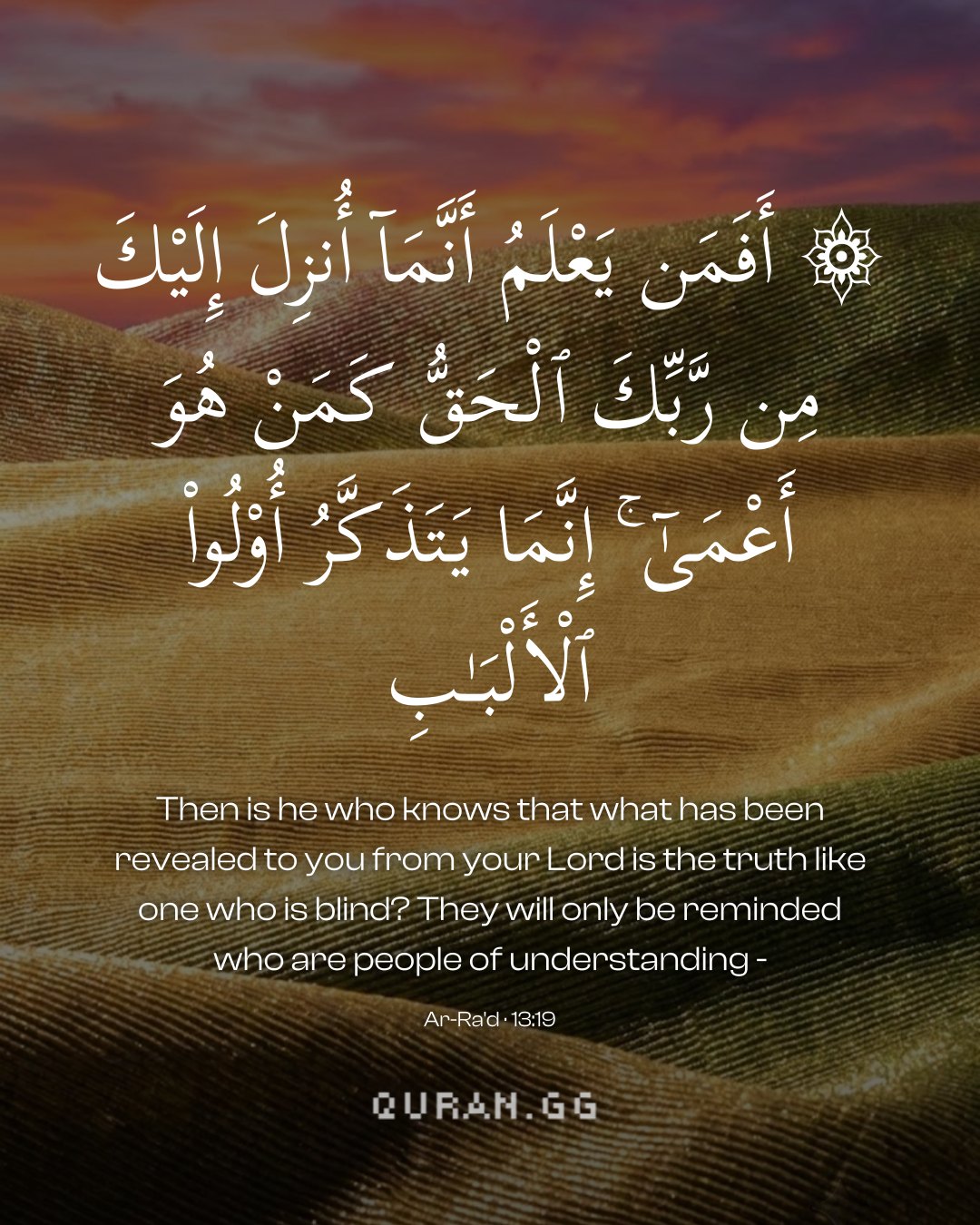
أَفَمَن يَعْلَمُ أَنَّمَآ أُنزِلَ إِلَيْكَ مِن رَبِّكَ الْحَقُّ كَمَنْ هُوَ أَعْمَى
(Shall he then who knows that what has been revealed unto you from your Lord is the truth, be like him who is blind) They are not equal. Allah said next,
إِنَّمَا يَتَذَكَّرُ أُوْلُواْ الأَلْبَـبِ
(But it is only the men of understanding that pay heed.) meaning, it is those who have sound minds who draw lessons, gain wisdom and understand. We ask Allah to make us among them.
Ma'arif al-Qur'an
Mufti Muhammad Shafi
Commentary
Truth and Falsehood were explained through parables in verses appearing previous to those cited above. Now, in the present verses, there is a description of the distinguishing marks and attributes of the people of Truth and the people of Falsehood, along with a description of their good and bad deeds, and their reward and punishment.
The first verse (18) carries a description of the good return reserved for those who obey Divine injunctions and act in accordance with them, and conversely, of the severe punishment for those who disobey them and act negatively.
In the second verse (19), the two groups have been identified as the sighted and the blind through a parable and, at the end, it was said: إِنَّمَا يَتَذَكَّرُ أُولُو الْأَلْبَابِ that is, 'only the people of understanding respond to the advice.' It means what has been exemplified here is, though, fairly clear and obvious, yet it can only be understood and appreciated by those who have their essential reason intact with them. Those who have their faculty of reason all impaired by heedlessness and disobedience cannot understand a difference so great.
From the third verse (20) begins a description of particular deeds and marks which distinguish the two groups. Taken up first are the attributes of those who believe in and obey Divine injunctions. The initial at-tribute mentioned is:
It is the law of God in this world that dirt and foam may emerge and surface for some time, but finally what receives a place here is that which gives benefit. In the Hereafter also, the same is true of human beings. In the world some people may be prominent due to some skill but, in the Hereafter, only those who possess real qualities will receive a higher status. People do not respond to the call for the Truth in this world because they always feel that, by advancing towards unadulterated Truth, they will lose worldly benefits. The rewards for ignoring the Truth which such people receive are invariably honour, popularity and prosperity in this world. They appear to be occupying seats of high status by rejecting the Truth. In the Hereafter, all these people will have been thrown out as like fast disappearing foam. And only those people will figure as prominent who surrendered themselves to the Truth, ignoring timely benefits. People give so much importance to worldly status and worldly benefits that they ignore the truth. In the Hereafter these things will appear unimportant to them, so much so that they would want to give this whole world and one more world equal to it, to ransom themselves from divine punishment.
Uthmani text of the Madinah mushaf (King Fahd Complex). Translation: Saheeh International. Tafsir via Quran.com.