(Those who fulfill the covenant of Allah and break not the trust.) They are nothing like the hypocrites who when one of them makes a covenant, he breaks it; if he disputes, he is most quarrelsome; if he speaks, he lies; and if he is entrusted, he betrays his trust. Allah said next,
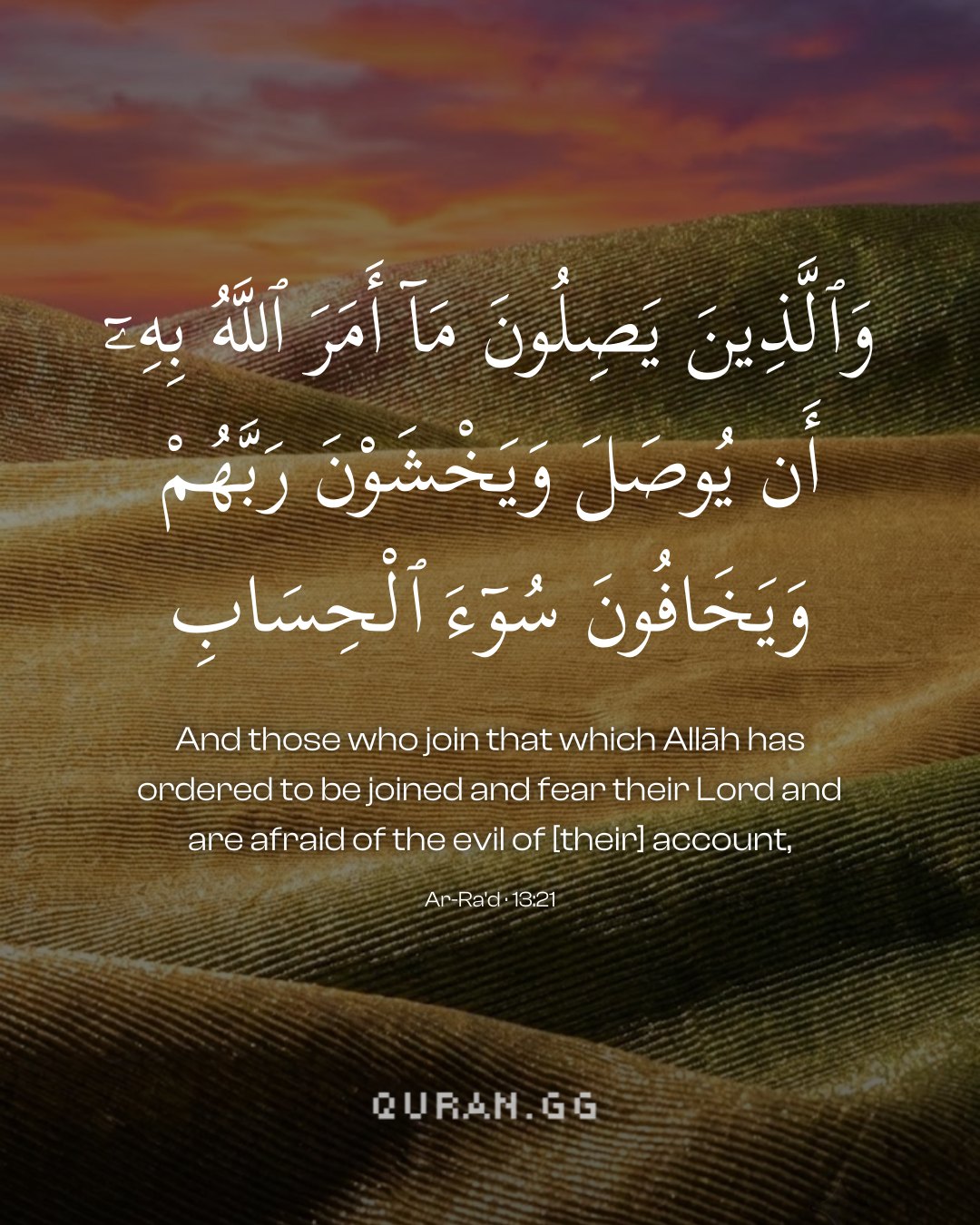
(And those who join that which Allah has commanded to be joined) they are good to their relatives and do not sever the bond of kinship. They are also kind to the poor and the needy and generous in nature,
The third attribute of the obedient servants of Allah Ta’ ala stated here is: وَالَّذِينَ يَصِلُونَ مَا أَمَرَ اللَّـهُ بِهِ أَن يُوصَلَ (and those who maintain the relations Allah has commanded to be maintained). According to the well-known explanation of this verse, it means that these people maintain relationships and keep doing what needs to be done in this matter as commanded by Allah Ta` ala. Some commentators have explained it by saying that these people conjoin righteous deeds with faith, or synchronize their initial faith in the Holy Prophet ﷺ and the Qur’ an with faith in
past prophets and their books.
The fourth attribute has been identified as: وَيَخْشَوْنَ رَبَّهُمْ (and fear their Lord). The use of the word: خَشیَہ (khashyah) rather than خَوف - (khawf) indicates that their 'fear' of Allah is not the kind of fear one naturally has when facing some beast or dangerous man. Instead of that, this fear is like the habitual fear children have of their parents, and students of their teacher, for that is no fear of being harmed or hurt by them. In-stead, such fear is grounded in love and esteem because of which one apprehends lest something said or done may become displeasing and repugnant in the sight of Allah Ta ala. Therefore, whenever the fear of Allah finds mention in an occasion of praise and glorification, generally the word used there is Khashyah because Khashyah is the name of the fear which emerges out of love and esteem. Therefore, in the next sentence, where the fear of strict reckoning has been mentioned, the word used is not Khashyah, instead the word used there is fear as such. It was said: وَيَخَافُونَ سُوءَ الْحِسَابِ (and they are frightful of evil reckoning). 'Evil reckoning' denotes reckoning which is strict and minute. Sayyidah A’ ishah ؓ has said: It is Divine Mercy alone which can bring salvation for human beings when things are forgone and forgiven summarily at the time the reckoning of deeds takes place. Otherwise, anyone who is made to account for everything said and done, cannot escape from punishment. It is virtually impossible because who is there to claim that he or she has never made a mistake or committed a sin? So, this fear of having to face strict reckoning of deeds is the fifth attribute of righteous and obedient people.
Tazkirul Quran
Maulana Wahiduddin KhanOn ayahs 18–21
It is the law of God in this world that dirt and foam may emerge and surface for some time, but finally what receives a place here is that which gives benefit. In the Hereafter also, the same is true of human beings. In the world some people may be prominent due to some skill but, in the Hereafter, only those who possess real qualities will receive a higher status. People do not respond to the call for the Truth in this world because they always feel that, by advancing towards unadulterated Truth, they will lose worldly benefits. The rewards for ignoring the Truth which such people receive are invariably honour, popularity and prosperity in this world. They appear to be occupying seats of high status by rejecting the Truth. In the Hereafter, all these people will have been thrown out as like fast disappearing foam. And only those people will figure as prominent who surrendered themselves to the Truth, ignoring timely benefits. People give so much importance to worldly status and worldly benefits that they ignore the truth. In the Hereafter these things will appear unimportant to them, so much so that they would want to give this whole world and one more world equal to it, to ransom themselves from divine punishment.
Uthmani text of the Madinah mushaf (King Fahd Complex). Translation: Saheeh International. Tafsir via Quran.com.