Here Allah glorifies Himself and commands His servants to glorify and praise Him at these times which come one after the other and are indicative of His might and power in the heavens. This is when the night comes with its darkness, then in the morning the day comes with its light. This glorification is followed by befitting praise, as Allah says:
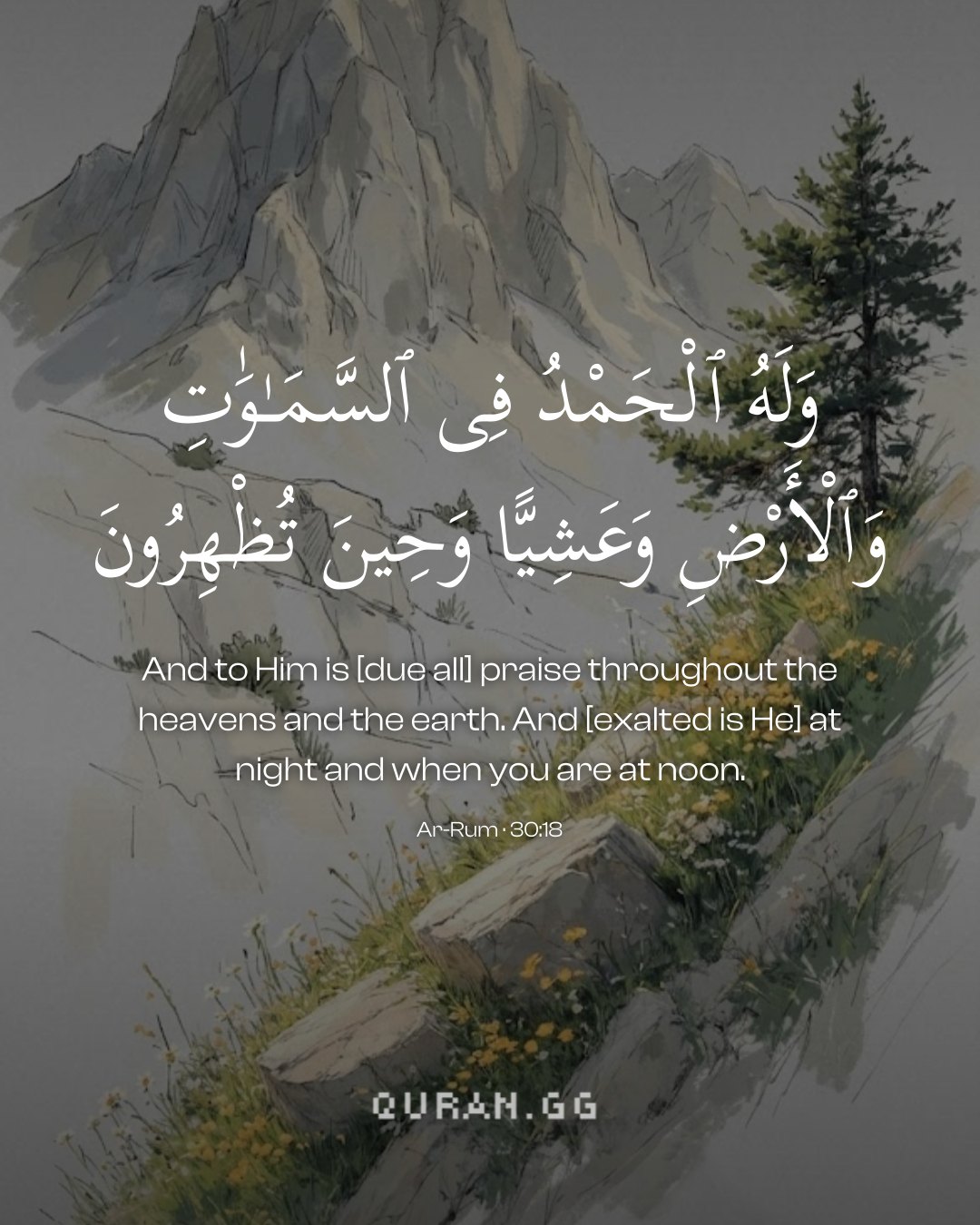
وَلَهُ الْحَمْدُ فِى السَّمَـوَتِ وَالاٌّرْضِ
(And His is all the praise in the heavens and the earth;) meaning, He is the One who is to be praised for what He has created in the heavens and on earth. Then Allah says:
وَعَشِيّاً وَحِينَ تُظْهِرُونَ
(and in `Ashiyya and when Tuzhirun.) -- the `Ashiyy is the time when the darkness is most intense, and Izhar is the brightest point of the day. Glory be to the One Who created both of them, the Cleaver of the daybreak and the One Who makes night a time of rest. Allah says:
So, proclaim Allah's purity when you see the evening and when you see the morning. And to Him be praise in the heavens and the earth, and in the afternoon and when you enter the time of Zuhr (soon after the decline of the sun towards West). (30:17-18)
The word 'subhan' (سُبْحَانَ ) is an infinitive which means 'to declare the purity of someone from defects'. The phrase 'subhanallah' (فَسُبْحَانَ اللَّـهِ ) is meant to proclaim Allah's purity from all defects. To recite this phrase with this intention is called 'tasbih'. But in general usage, the word 'tasbih' often includes all forms of worship and remembrance of Allah, like salah, dhikr, etc. In the present verse, a verb is understood before the infinitive 'subhan' which is meant to direct the addressees to make 'tasbih' which, in its general sense, includes all forms of remembrance of Allah, and salah in particular, as explained above. In the light of this explanation, the present verse, in its beginning, enjoins upon its followers that they should remember Allah in the morning and evening, and at the end of the verse, it is instructed that they should remember Him at the other two times, عَشِيًّا وَحِينَ تُظْهِرُونَ. One of these times is 'ashiyy' (عَشِیّ ) which is the name of the last part of the day, and here it refers to the time of ` Asr; and the other time is when the sun starts declining towards West, that is Zuhr.
The existence of a perfect and complete world is a definite proof of the First Creation. If the first creation was possible, why should the second creation not be possible? If one accepts the present world, but does not accept the Hereafter, it amounts to denying a natural corollary of a fact which one has oneself accepted as such. ‘The guilty’ refers to the influential people who led the campaign against the Truth, and who provided arguments in support of the denial of Truth. When the Doomsday explosion dislocates the system of the world, the guilty ones will suddenly realize that the supports of which they had been proud were without foundation. The words which, according to them, supplied uncontradictable arguments in favour of their stand, will all prove false. When they see conditions which are quite contrary to their expectations and which shatter their illusions, they will be dumbfounded. On the Day of Judgement, human beings will be divided into two groups—one consisting of those who glorify God and offer praises to Him, and the other consisting of those who do quite the reverse. The people of the first group are those who realize God to such a degree that He becomes the sole topic of their conversation. A definite manifestation of this glorification of God and offering praises is the prayers offered five times a day. In this verse, the offering of praises ‘in the morning’ means the fajr. The prayers of maghrib, and ‘isha are included in the words ‘in the evening’. Prayer at midday is called zuhr, while that of in the late afternoon is called ‘asr.
Uthmani text of the Madinah mushaf (King Fahd Complex). Translation: Saheeh International. Tafsir via Quran.com.