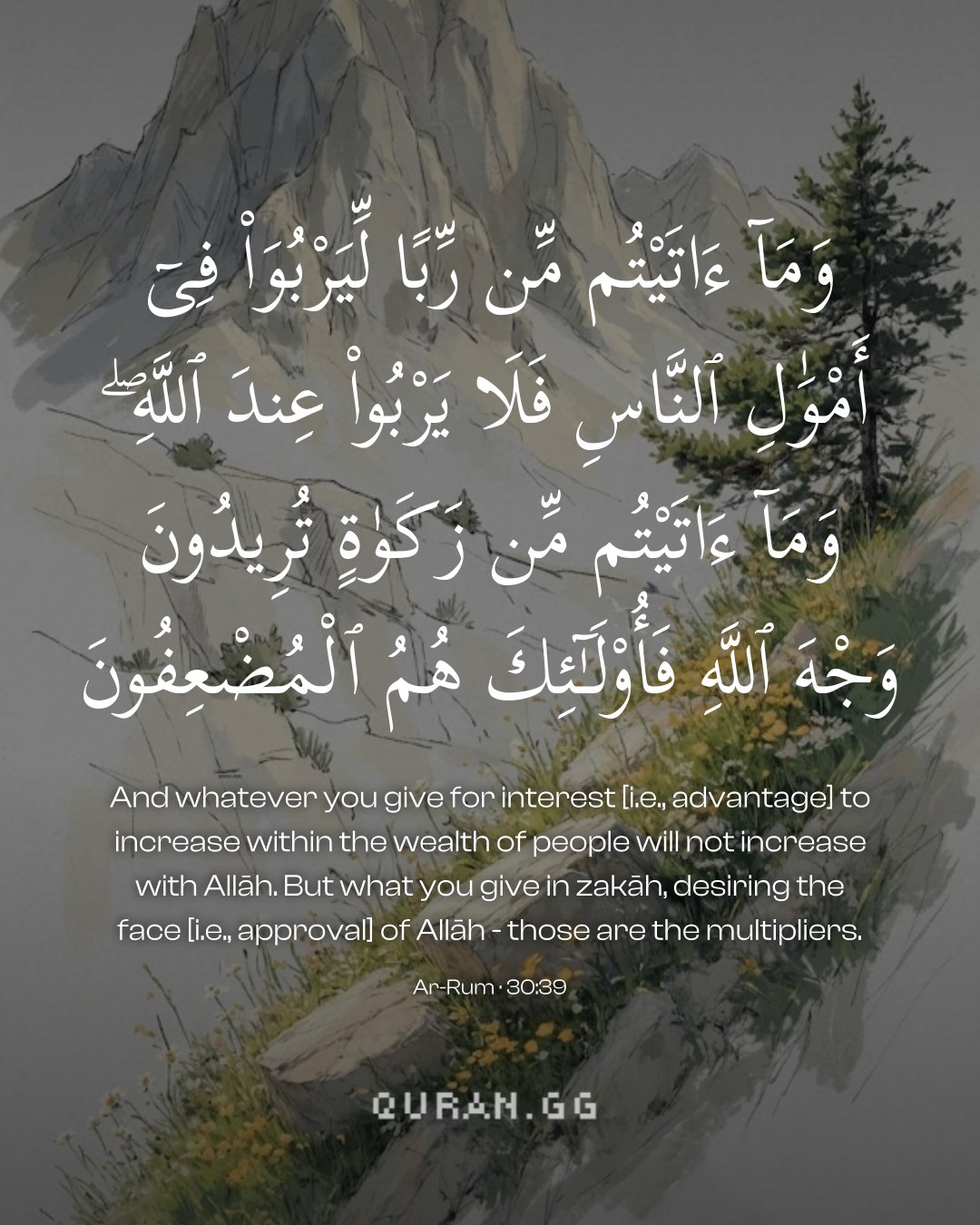
And whatever you give for interest [i.e., advantage] to increase within the wealth of people will not increase with Allāh. But what you give in zakāh, desiring the face [i.e., approval] of Allāh - those are the multipliers.
وَمَا آتَيْتُم مِّن رِّبًا لِّيَرْبُوَ فِي أَمْوَالِ النَّاسِ (And whatever Riba [ increased amount ] you give so that it may increase in the wealth of the people, - 30:39). This verse is meant to correct an evil custom which is common in close relatives and the families at large. When people extend a gift or a present to relatives, especially at the time of marriages, they make a note of the amount they have given, in the hope that they will get back an equal amount in return when it is their turn, rather a little more. This custom is known in Urdu as 'neota'. It is emphasized in this verse that the instruction given in the preceding verse about the rights of relatives should be implemented in a manner that neither it be shown as a favour, nor should it be given in the hope of any return. Whoever gives out money in the hope that it will bring back something more, then it is not worthy of reward in the sight of Allah. Qur'an has referred to it as riba, alluding that it is as bad as usury or interest.1
1. This explanation is based on the view of a number of exegetes of Qur an. The word used by the Holy Qur'an is rib a term commonly understood as equivalent to usury or interest, prohibition of which has been detailed in verses 275 to 281 of Sarah Al-Baqarah and verse 130 of Sarah 'Al ` Imran. Since, according to a large number of scholars, usury was prohibited in Madinah, while the present verse is Makkan, the word riba used here cannot mean usury or interest. Therefore, the word is interpreted here as a gift given to a relative in order to get back a gift of higher value from him. But some other commentators have taken the word riba in the same sense as in Sarah Al-Baqarah, i.e. usury and interest. They argue that usury was prohibited even in Makkah, but its implementation on a state level was carried out in Madinah. The esteemed author has reconciled between these two views by saying that the direct purpose of the verse is to correct the evil custom of giving gifts in the hope of getting a higher return, as mentioned in some traditions, but the word 'riba' is used to indicate that this practice is tantamount to the practice of usury where an increased amount is charged from a debtor. ( Muhammad Taqi ` Usmani)
Ruling
It is extremely contemptible for a person who extends a gift to someone that he expects a return for it, which is forbidden in this verse. But it is morally desirable for the one who receives a gift from someone, that he tries to give a gift to the former on his own accord, whenever he finds a suitable occasion. This was exactly the practice of the Holy Prophet ﷺ . He used to give present to the person who gave him one. (Qurtubi on authority of Sayyidah ` A'ishah ؓ . However, it should be avoided to give him an impression that the gift is being given in return of his own.
Tazkirul Quran
Maulana Wahiduddin Khan
A believer considers that both difficulties and ease come from God. Therefore, he turns towards God in good times and in bad. When in comfortable circumstances, he thanks God, and in adverse circumstances, he exercises patience. As opposed to this, one who denies the truth solely relies upon himself. So, when in easy circumstances, he is boastful. When his energies fail him, he is desperate, because he feels that he has reached the final limit. This is nature’s indication that the former type of mentality is the truly virtuous one, while the latter is improper and unworthy. One sign of a believer is that he spends his wealth for the pleasure of God. So, he shares his wealth with other needy persons who may or may not be his relatives. He spends his wealth to reap the benefits of the Hereafter and not to earn profits in this world like a usurer. A man’s creation, his being provided with the necessities of life day and night, his meeting death—all these events are so great that a universal power is required to bring them about. And no Being except the Creator of the Universe possesses such Universal powers. The fact is that the principle of the Oneness of God (monotheism) is its own proof and polytheism is its own contradiction.
Uthmani text of the Madinah mushaf (King Fahd Complex). Translation: Saheeh International. Tafsir via Quran.com.