In the Name of Allah, the Most Gracious, the Most Merciful.
Foretelling the Victory of the Romans
These Ayat were revealed about the victory of Sabur, the king of Persia, over Ash-Sham (Greater Syria), the adjoining partisan states of the Arabian Peninsula, and the outlying regions of the land of the Romans. Heraclius, the emperor of the Romans, was forced to flee to Constantinople where he was besieged for a lengthy period. Then Heraclius regained the upper hand. Imam Ahmad recorded that Ibn `Abbas, may Allah be pleased with him, commented on this Ayah:
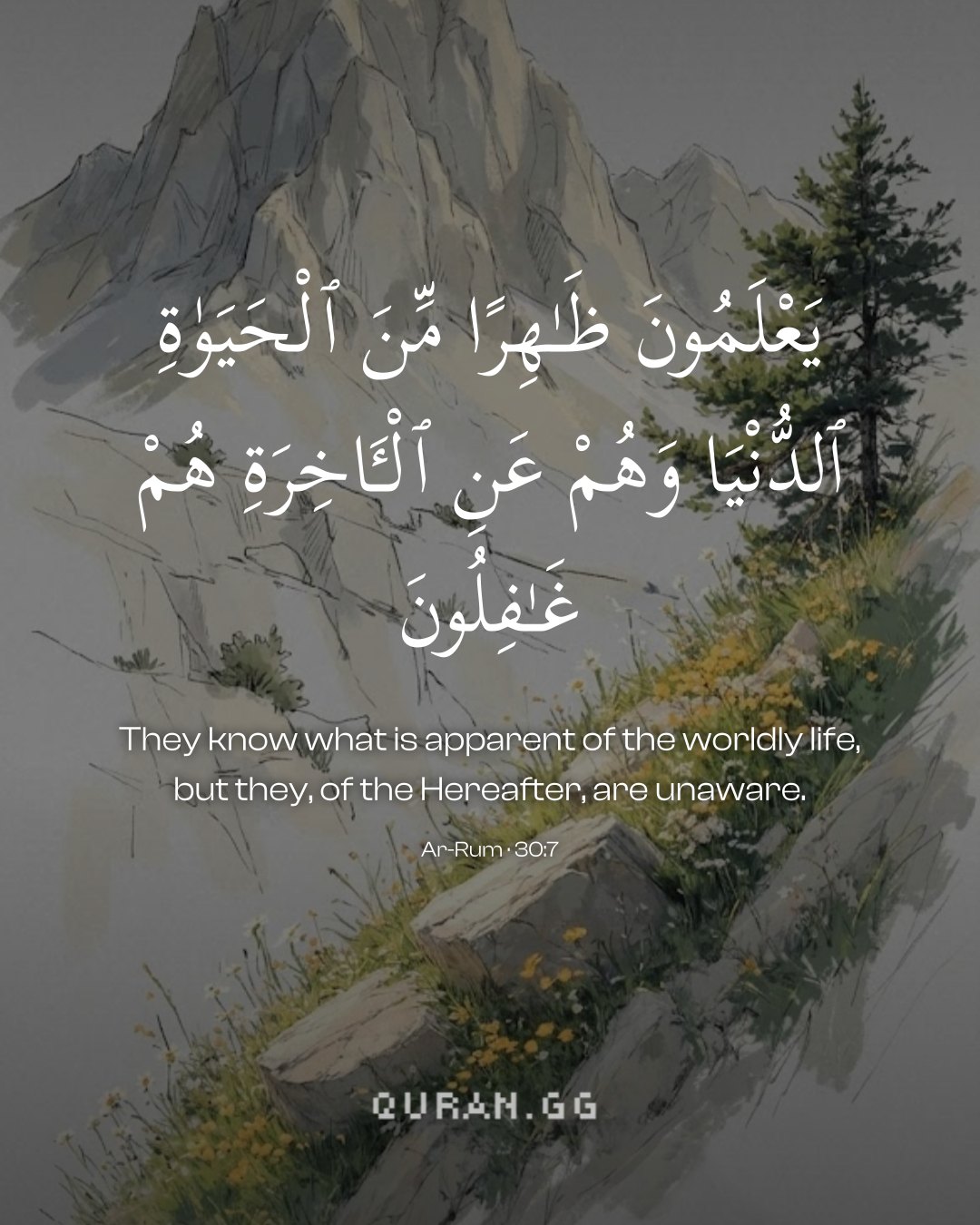
يَعْلَمُونَ ظَاهِرًا مِّنَ الْحَيَاةِ الدُّنْيَا وَهُمْ عَنِ الْآخِرَةِ هُمْ غَافِلُونَ (They know something superficial of the worldly life, but of the Hereafter they are negligent.-7). These disbelievers were quite conversant with the mundane needs, that is how to perform trading, which commodity should they trade in, where should they make purchases, where should they sell etc. Similarly, they knew well how to till, when to put seeds, and when to harvest. They were also equally knowledgeable about the construction of buildings and to furnish them with luxury goods. But they were totally ignorant and negligent about the other aspect of the worldly life which in fact is more important, and brings forth the real purpose of its creation; that is to appreciate that he is not a permanent resident of this world, rather his stay in the world is a temporary stay, like that of a visitor on a tourist visa. Man's permanent abode is in the Hereafter, and he has to collect here the goods for his comfort in the next life. The goods of comfort for the next life are the true faith and righteous deeds. This simple and straight-forward reality is not understood by these so-called intellectuals.
Another point worth consideration in this verse is about the wording used by the Holy Qur'an in this verse. The word "zahiran" with tanwin, according to the Arabic grammar, indicates that even superficial things of the worldly life are not fully known to them;1 what they know is only one aspect of it, while they are ignorant of its other aspects, and are totally negligent of the Hereafter.
1. This aspect of the language used by the Holy Qur’ an has been tried to be reflected in the translation above by the words, "something superficial " instead of "what is superficial".
Earning of mundane needs by neglecting the Hereafter is no sagacity
The Holy Qur'an is full of admonitory stories of the world. Those who had earned a name for collecting all sorts of luxuries and comforts for themselves, and then their disastrous end was witnessed in this very world, will also be subjected to everlasting torment of the Hereafter. So no sane person will call them intellectual or sagacious. Unfortunately, in the present day world the height of sagacity and wisdom is attributed to the one who could accumulate the largest quantity of wealth, and arrange for himself the best of comforts and luxuries. He is called the most successful and wise, no matter how low he might be in his morals. To call such a person wise is indeed an insult to wisdom - both by religious and moral standards. By Qur'anic standard, only those are wise who are conscious of Allah and the Hereafter, and strive for the comforts of the next life, keeping their needs of this wordly life at a level at which such needs are necessary; and do not make their achievement the sole purpose of their lives. The following verse depicts the same meaning:إِنَّ فِي خَلْقِ السَّمَاوَاتِ وَالْأَرْضِ وَاخْتِلَافِ اللَّيْلِ وَالنَّهَارِ لَآيَاتٍ لِّأُولِي الْأَلْبَابِ الَّذِينَ يَذْكُرُونَ اللَّـهَ قِيَامًا وَقُعُودًا وَعَلَىٰ جُنُوبِهِمْ وَيَتَفَكَّرُونَ فِي خَلْقِ السَّمَاوَاتِ وَالْأَرْضِ رَبَّنَا مَا خَلَقْتَ هَـٰذَا بَاطِلًا سُبْحَانَكَ فَقِنَا عَذَابَ النَّارِ (Surely, in the creation of the heavens and the earth, and in the alternation of night and day, there are signs for the people of wisdom, who remember Allah standing and sitting, and (lying) on their sides, and ponder on the creation of the heavens and the earth (saying:) "Our Lord, You have not created all this in vain. We proclaim Your purity. So, save us from the punishment of Fire." (3:190-191).
Tazkirul Quran
Maulana Wahiduddin KhanOn ayahs 5–9
At the time of the advent of Islam, there were two very great empires in the world —the Christian Roman Empire and the Zoroastrian Persian Empire. There were constant clashes between these two. In the year 603 A.D., Iran (Persia) attacked the Roman Empire, taking advantage of certain weaknesses in the latter. The Romans suffered defeat after defeat, so much so that by the year 616 A.D., a large part of the Roman Empire, including Jerusalem, had been captured by the Iranians. The Prophet received the prophethood in the year 610 A.D. and he started upon the task of explaining the Oneness of God in Makkah. This was the period of the struggle between monotheism and polytheism in that city. The polytheists of Makkah, taking their cue from the events on the border, told the Muslims that their polytheist brothers, the fire-worshipping Zoroastrians, had defeated the possessors of the Book and brothers of the Muslims (namely, the Christians) and that in the same manner they (the polytheists of Makkah) would finally overwhelm the Muslims. At that time, completely against the prevailing trend, the Quran predicted that within ten years, the Romans would regain supremacy over the Iranians. Roman historians say that immediately thereafter the vanquished King of the Romans, Heraclius, started undergoing a mysterious change, so much so that in the year 623 A.D., he led a retaliatory attack on Iran. In the year 624 A.D., he achieved a decisive victory over Iran. By the year 627 A.D., he had recovered all his occupied territories from the Iranians. Thus it was proved that the Quran was a revelation from God, as nobody else except God could have made such statements about the future so accurately. Moreover, these events indicate that victory or defeat are directly in the hands of God. It is according to His decision who gains and who loses power. The downfall of a nation and the rise of another nation, to all appearances seem to be ordinary, normal, worldly events, but appearances have an inner aspect to it. Every event is caused by a number of angels of God, though they are not visible to ordinary human eyes. Similarly, there is an invisible aspect of the present, outward world and it is the world of the Hereafter.