We mentioned a Hadith from `Abdullah bin Salam in that the Companions wanted to ask the Prophet of Allah about the best actions with Allah the Exalted and Most Honored, so they could practice them. Allah the Exalted sent down this Surah, including this Ayah,
(O you who believe! Shall I guide you to a trade that will save you from a painful torment) Allah then explained this great trade that will never fail, the trade that will earn one what he wishes and saves him from what he dislikes. Allah the Exalted said,
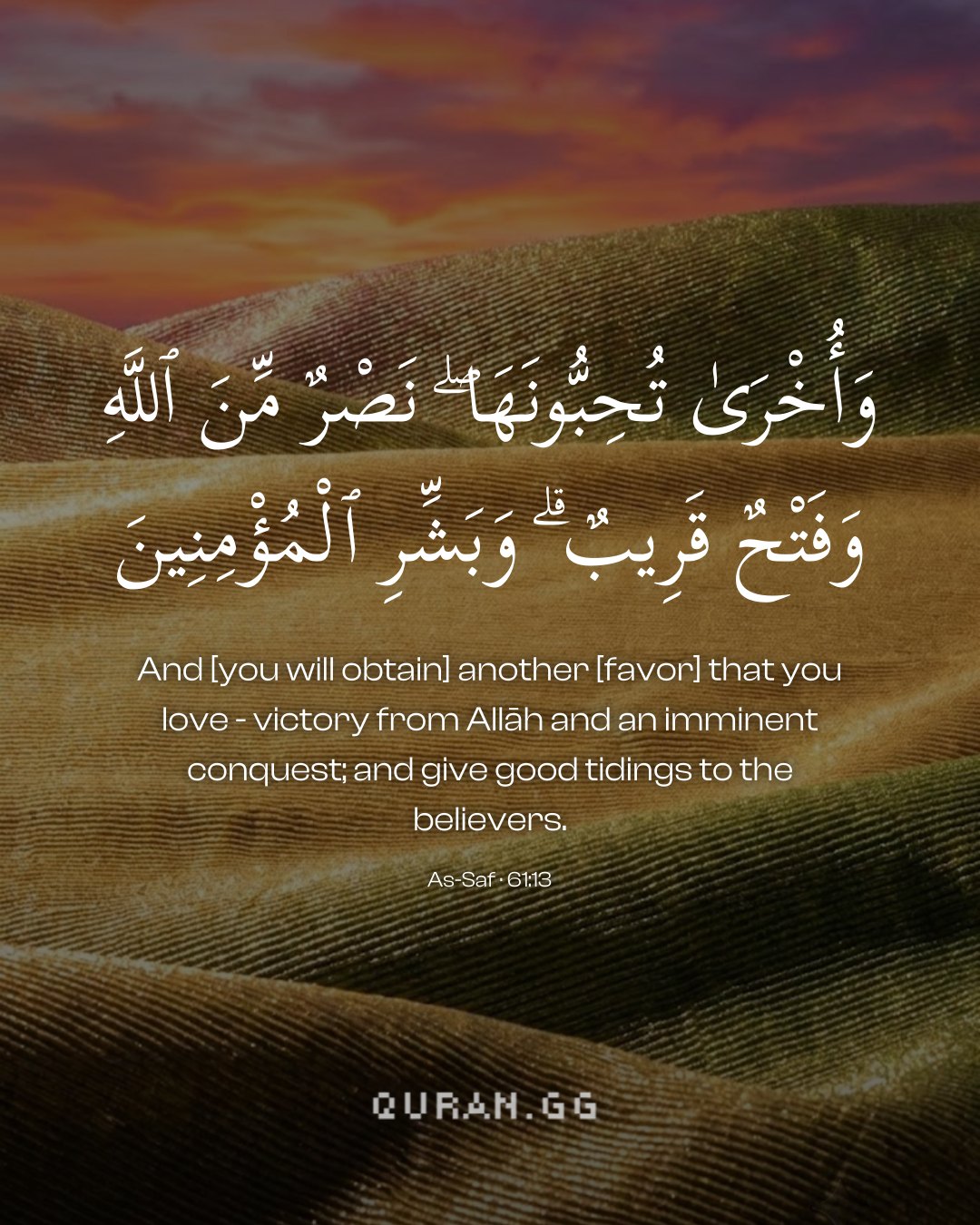
وَأُخْرَىٰ تُحِبُّونَهَا ۖ نَصْرٌ مِّنَ اللَّـهِ وَفَتْحٌ قَرِيبٌ (And [ He will give you ] another thing that you love: Help from Allah, and a victory, near at hand ...61:13) This verse adds that the blessings of this trade are not restricted to the Hereafter. There is one blessing that will be granted right here in this world, which is the Divine help and an imminent victory, that is, conquests of enemy territories. If the word qarib (near) is taken as the opposite of Hereafter, it would include all later Islamic conquests of Arab and non-Arab territories. And if the word qarib (near) is taken in its normal sense, it would, in the first instance, apply to the conquest of Khaibar, and in the second instance it would apply to the Conquest of Makkah. This 'near victory' is referred to as تُحِبُّونَهَا "that you love". It implies that this worldly blessing is dear to man, because he is by nature haste-prone as the Qur'an says وَكَانَ الْإِنسَانُ عَجُولًا "...and man is prone to haste. [ 17:11] This, however, does not imply that the blessings of the Hereafter are not dear to him. It simply means that the love of seeking the blessings of the Hereafter is quite obvious, but he naturally would love to have the blessings of this world as well. They too will be granted to him.
Tazkirul Quran
Maulana Wahiduddin KhanOn ayahs 11–13
In trade, a man first invests and then receives a return on his investment. In the struggle for Faith also one has to invest his strength and his possessions. From this view point, this is also a sort of trade. But, one receives the profit from worldly trade in this world, while in the religion-oriented trade, one receives the profit with further additions only in the Hereafter.
Uthmani text of the Madinah mushaf (King Fahd Complex). Translation: Saheeh International. Tafsir via Quran.com.