Ibrahim's Emigration, the Test of the Sacrifice of Isma`il, and how Allah blessed Him
Allah tells us that after He helped His close friend Ibrahim, peace be upon him, against his people, and after Ibrahim gave up hoping that they would ever believe despite all the mighty signs that they had witnessed, he emigrated away from them, and said:
وَقَالَ إِنِّى ذَاهِبٌ إِلَى رَبِّى سَيَهْدِينِ - رَبِّ هَبْ لِى مِنَ الصَّـلِحِينِ
(Verily, I am going to my Lord. He will guide me! My Lord! Grant me (offspring) from the righteous.) meaning, obedient children, in compensation for his people and relatives whom he had left. Allah said:
فَبَشَّرْنَـهُ بِغُلَـمٍ حَلِيمٍ
(So We gave him the glad tidings of a forbearing boy.) This child was Isma`il, peace be upon him, for he was the first child of whom glad tidings were given to Ibrahim, peace be upon him, and he was older than Ishaq. The Muslims and the People of the Book agree, and indeed it is stated in their Book, that Isma`il, peace be upon him, was born when Ibrahim, peace be upon him, was eighty-six years old, and Ishaq was born when Ibrahim was ninety-nine years old. According to their Book, Allah commanded Ibrahim to sacrifice his only son, and in another text it says his firstborn son. But here they falsely inserted the name of Ishaq. This is not right because it goes against what their own Scripture says. They inserted the name of Ishaq because he is their ancestor, while Isma`il is the ancestor of the Arabs. They were jealous of them, so they added this idea and changed the meaning of the phrase "only son" to mean `the only son who is with you,' because Isma`il had been taken with his mother to Makkah. But this is a case of falsification and distortion, because the words "only son" cannot be said except in the case of one who has no other son. Furthermore, the firstborn son has a special status that is not shared by subsequent children, so the command to sacrifice him is a more exquisite test.
Continue reading the tafsir of ayahs 99–113Ma'arif al-Qur'an
Mufti Muhammad Shafi
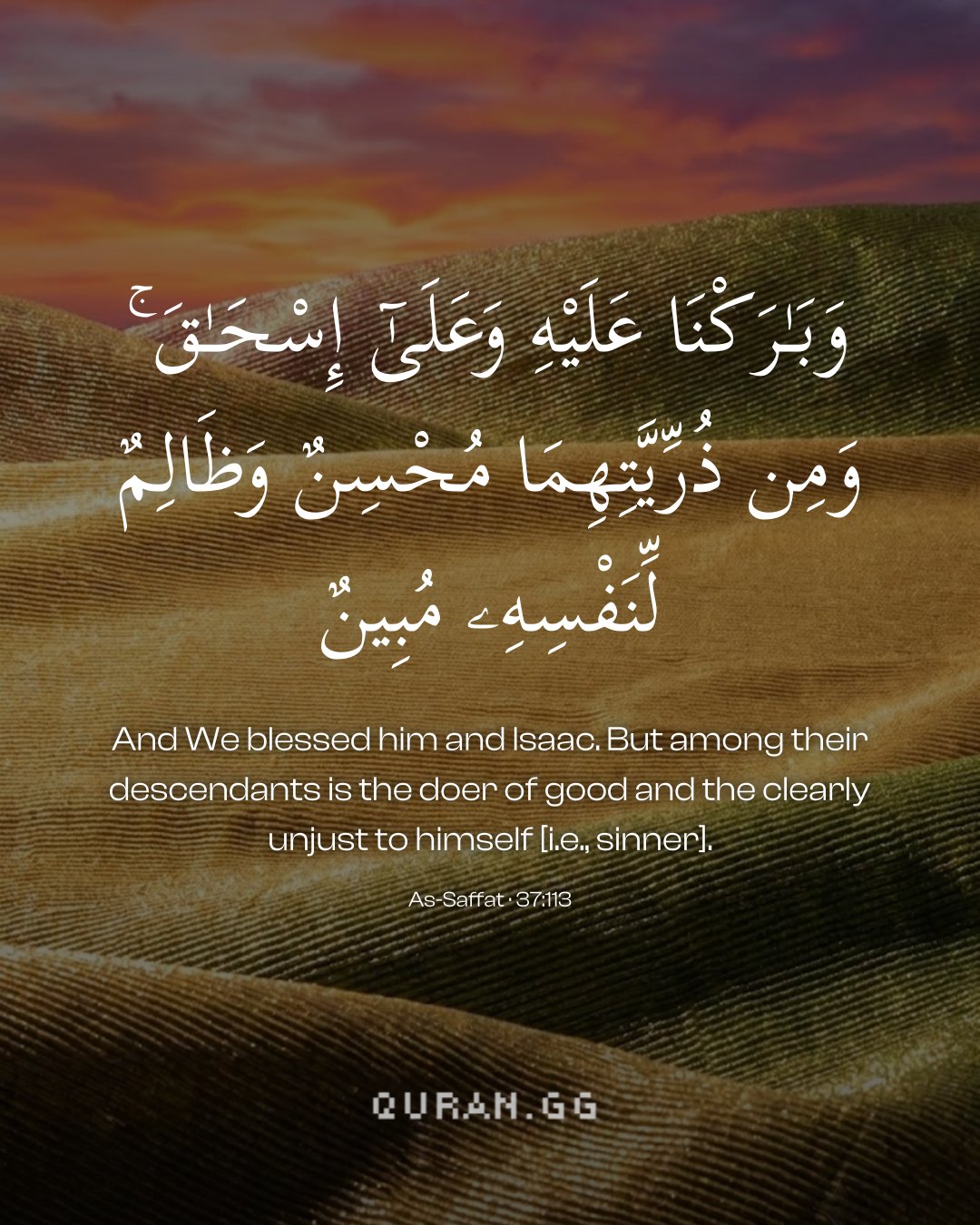
In the last verse, it was said: وَمِن ذُرِّيَّتِهِمَا مُحْسِنٌ وَظَالِمٌ لِّنَفْسِهِ مُبِينٌ (and among the progeny of both of them, some are good and some are utterly unjust to their own selves.- 37:113). Refuted through this verse is the false pride of the Jews that being among the progeny of these noble prophets (علیہم السلام) is in itself sufficient to bless one with merit and salvation. This verse openly declares that having lineal connection with a man of virtue is not a sufficient guarantee of one's salvation, in fact, this thing depends on one's own beliefs and deeds.
In the days of Abraham, polytheism was so dominant that its continuity in history had been long established. Now, any child born into this situation was influenced by the surrounding atmosphere and was so immersed in polytheism that no effort even at the level of the Prophet was successful in weaning him away from it. When Abraham left Iraq, after a long missionary struggle, there were only two believers with him—one his wife Sarah and the other his nephew, Lot. People did not adhere to the concept of the oneness of God, despite the utmost struggle on the part of Prophet Abaraham. So, Almighty God planned that a new race be brought into existence which should be nurtured far away from the atmosphere of polytheism. For this purpose, the area of Hijaz was selected. This area, being dry and without any vegetation, was desolate and uninhabited. The plan was that a devotee should be settled in this area where he would become the progenitor of a pure race. Hijaz (Mecca and Medina) was a waterless desert and to settle anyone in such arid surroundings amounted to sacrificing him alive. God ordered Abraham to offer his son Ishmael as a sacrifice, and in all obedience, Abraham submitted to God’s will. Abraham’s second son was Isaac. Prophethood continued in his line of descent until the advent of the last prophet who belonged to the Children of Ishmael (the younger brother of Isaac). The Prophet Muhammad brought about a revolution, which destroyed polytheism as a dominant school of thought.
Uthmani text of the Madinah mushaf (King Fahd Complex). Translation: Saheeh International. Tafsir via Quran.com.