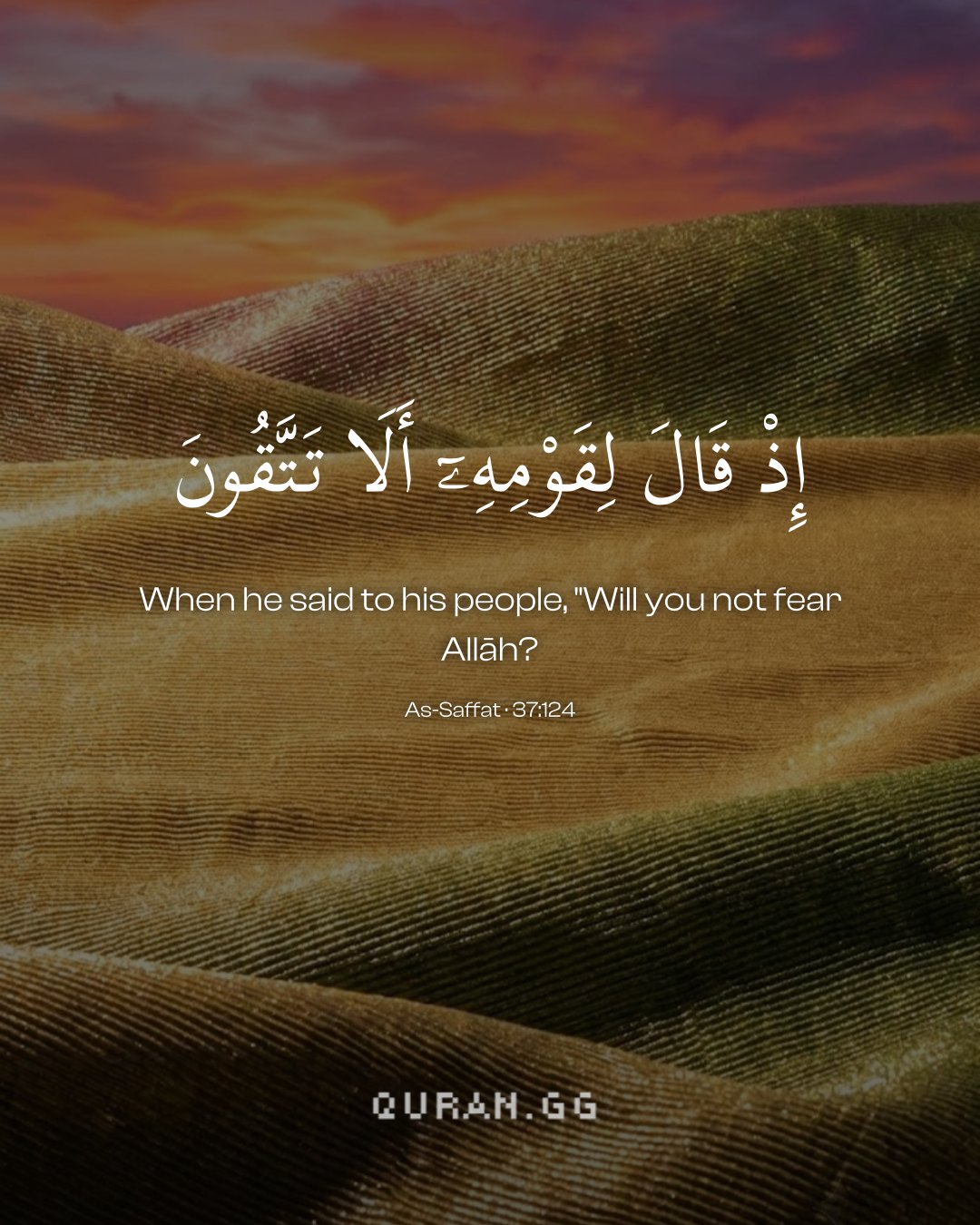
(Will you call upon Ba`l and forsake the Best of creators,) Ibn `Abbas, may Allah be pleased with him, Mujahid, `Ikrimah, Qatadah and As-Suddi said that the word Ba`l means lord. `Ikrimah and Qatadah said, "This is the language of the people of Yemen." According to another report from Qatadah, it is the language of Azd Shanu'ah. `Abdur-Rahman bin Zayd bin Aslam narrated from his father that it is the name of an idol which was worshipped by the people of a city called Ba`labak (Baalbek) which is to the west of Damascus. Ad-Dahhak said, "It is an idol which they used to worship."
Described in the verses cited above is the fourth event relating to Sayyidna Ilyas علیہ السلام . Before we take up the explanation of these verses, a few bits of information about Sayyidna Ilyas (علیہ السلام) are being given below.
Sayyidna Ilyas (علیہ السلام) has been mentioned in the noble Qur'an only at two places: Firstly, in Surah Al-An` am (6:85) and secondly, in these very verses of Surah As-Saffat (37:123) and (37:130). As for the reference in Surah AI-An'am, his good name appears there only as part of a list of righteous prophets, and no event finds mention there. However, at this place in the present Surah, an event relating to his mission and call has been described very briefly.
God helped the Prophet Moses and his community and relieved them from the oppression of Pharaoh. This was made possible through the dawah work performed by Moses. He preached the truth before Pharaoh. After the completion of the tenure of his dawah mission came the time for Pharaoh to be pronounced guilty and to be destroyed; and for Moses and his community to be victorious and dominant. In this context, one of the meanings of ‘showing the straight path’ is that the right solution to the problem of Pharaoh was revealed to them. Though this was a problem faced at the community level, its solution nevertheless lay in communicating the divine message. So, the victory and supremacy which they achieved was the result of dawah efforts and was not due to any national struggle or rebellion against Pharaoh in the usual sense.
Uthmani text of the Madinah mushaf (King Fahd Complex). Translation: Saheeh International. Tafsir via Quran.com.