The State of the People of Faith and Their Reward Allah states:
إِنَّمَا يُؤْمِنُ بِـَايَـتِنَا
(Only those believe in Our Ayat,) means, who accept them as true,
الَّذِينَ إِذَا ذُكِّرُواْ بِهَا خَرُّواْ سُجَّداً
(who, when they are reminded of them, fall down prostrate,) means, they listen to them and obey them in word and deed.
وَسَبَّحُواْ بِحَمْدِ رَبِّهِمْ وَهُمْ لاَ يَسْتَكْبِرُونَ
(and glorify the praises of their Lord, and they are not proud.) means, they are not too proud to follow them and submit to them, unlike the ignorant among the rebellious disbelievers. Allah says:
إِنَّ الَّذِينَ يَسْتَكْبِرُونَ عَنْ عِبَادَتِى سَيَدْخُلُونَ جَهَنَّمَ دَخِرِينَ
(Verily, those who scorn My worship, they will surely enter Hell in humiliation!) (40:60). Then Allah says:
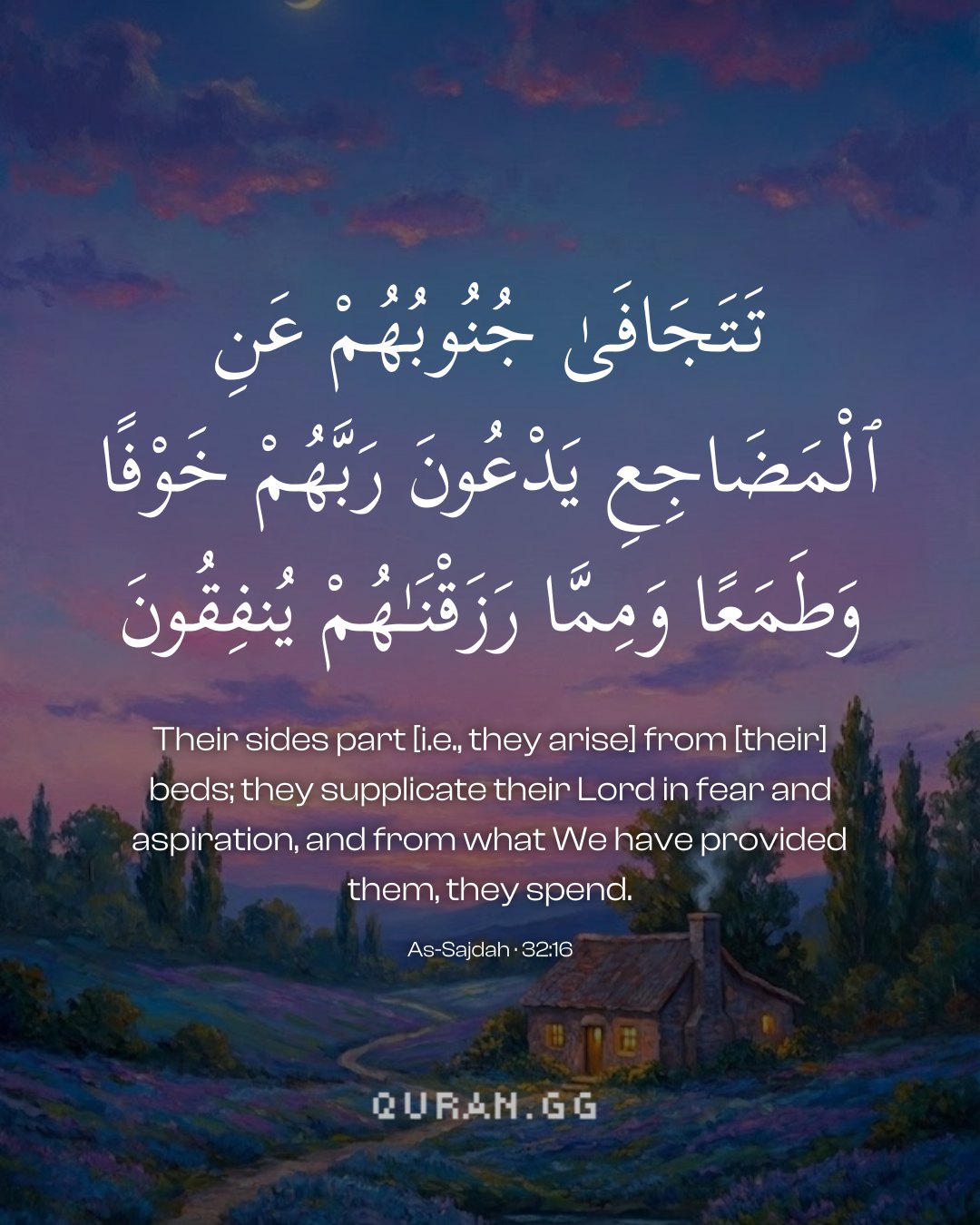
Continue reading the tafsir of ayahs 15–17 Before approaching verse 16: تَـتَجَافٰى جُنُوْبُهُمْ عَنِ الْمَضَاجِعِ يَدْعُوْنَ رَبَّهُمْ خَوْفًا وَّطَمَعًا (Their sides remain apart from their beds. They call their Lord with fear and hope - 16), it should be borne in mind that disbelievers, Mushriks and the deniers of the day of Qiyamah were warned in the verses previous to it. After that, starting from: اِنَّمَا يُؤْمِنُ بِاٰيٰتِنَا ! (Only those people believe in Our verses - 15) mentioned there are special attributes of sincere believers and the high ranks reserved for them. Pointed to in the cited verse is one such attribute of these believers: They leave the comfort of their beds, rise and get busy with the remembrance of Allah in submission and supplication - because, they are apprehensive of His displeasure and punishment while remaining hopeful of His mercy and reward. This very combination of fear and hope keeps them returning to Dhikr and Du'a' repeatedly, anxiously and animated at the same time.
The Salah of Tahajjud
The majority of commentators takes the expression denoting the leaving of beds and getting busy with Dhikr and Du'a' to mean the Salah of Tahajjud and Nawafil that are offered after rising from sleep (which is the saying of al-Hasan, Mujahid, Malik and al-Awza'i رحمۃ اللہ علیہم). And it is supported by narrations of Hadith as well.
According to a report in the Musnad of Ahmad, at-Tirmidhi, an-Nasa'i and others, Sayyidna Mu` adh Ibn Jabal v narrates: 'Once I was in the company of the Holy Prophet ﷺ on a journey. One morning during the course of the journey when I was near him, I requested: "Y Rasulallah, tell me to do something which helps me enter Paradise and keeps me away from Hell." He said, "You asked for something very difficult. But, for whomsoever Allah Ta’ ala makes it easy, for him it becomes easy." Then he said, "This is what you should do: Worship Allah and associate no one with Him, and establish Salah, and pay Zakah, and keep the fasts of Ramadan, and perform the Hajj of Baytullah." And then he said, "Here, now let me tell you about the gateways of righteousness: Fasting is a shield (that saves you from punishment). Sadaqah puts off the fire of one's sins - so does one's Salah in the middle of the night." And after having said that, he recited the cited verse of the Holy Qur'an: تَتَجَافَىٰ جُنُوبُهُمْ عَنِ الْمَضَاجِعِ (Their sides remain apart from their beds - 16).
Sayyidna Abu ad-Darda', Qatadah and Dahhak ؓ have said that this attribute of sides remaining apart from beds also applies to those who make their Salah of ` Isha' with Jama` ah and then go on to make their Salah of Fajr with Jama` ah. And according to a narration of Sayyidna Anas ؓ appearing in Tirmidhi with sound chains of authority, this verse: تَتَجَافَىٰ جُنُوبُهُمْ (Their sides remain apart) was revealed about people who do not sleep before the Salah of 'Isha' and keep waiting for the Jama’ ah of ` Isha'.
And according to some other reports, this verse is about people who offer nawafil between Maghrib and ` Isha' (reported by Muhammad Ibn Nasr). And about this verse, Sayyidna Ibn ` Abbas ؓ said: People who would, on waking up, remember Allah - lying, sitting and on sides - are also included therein.
Ibn Kathir and other Tafsir authorities have said that there is no contradiction in all these sayings. It is correct to say that this verse is inclusive of all - while the late night Salah remains the superior most. Bayan ul-Qur'an has also opted for this approach.
And Sayyidah Asma' bint Yazid ؓ narrates: The Holy Prophet ﷺ said, 'when Allah Ta’ ala will gather everyone from the first to the last, a proclaimer whose call will be heard by the entire creation will call: 'This day everyone on the plains of Resurrection will find out as to who is really deserving of honor and compliment.' Then, the proclaiming angel will proclaim: '0 people assembled on the plains of Resurrection, let those rise from among you, those whose attribute was: تَتَجَافَىٰ جُنُوبُهُمْ (Their sides remain apart from their beds - 16) '. At this call, these people will stand up, though their number will be small. (Ibn Kathir) And some words of the same narration say that these people will be sent to Paradise without reckoning. After that, all others will stand and face reckoning. (Mazhari)
Man’s creation for the first time is enough to convince mankind of the possibility of creation for the second time. But when a man does not believe in his accountability before God, he ridicules the possibility of a second creation, and he talks flippantly of it. But, this amounts to taking liberties throughout the period of freedom given for the purpose of putting man to test. And when this period expires and a man dies and is made to stand before Almighty God for the purpose of giving an account of himself, he will find himself speechless. At that time, the arrogant will say that they now accept the reality and will request that they be sent back into the world, so that they may perform righteous deeds. But this admission at that stage will be useless. Had God desired that people should accept reality in this way, He could have compelled them to accept it in the present world itself. Before God, that acceptance carries weight which is made without the reality being visible. Acceptance after seeing the reality has no value.
Uthmani text of the Madinah mushaf (King Fahd Complex). Translation: Saheeh International. Tafsir via Quran.com.