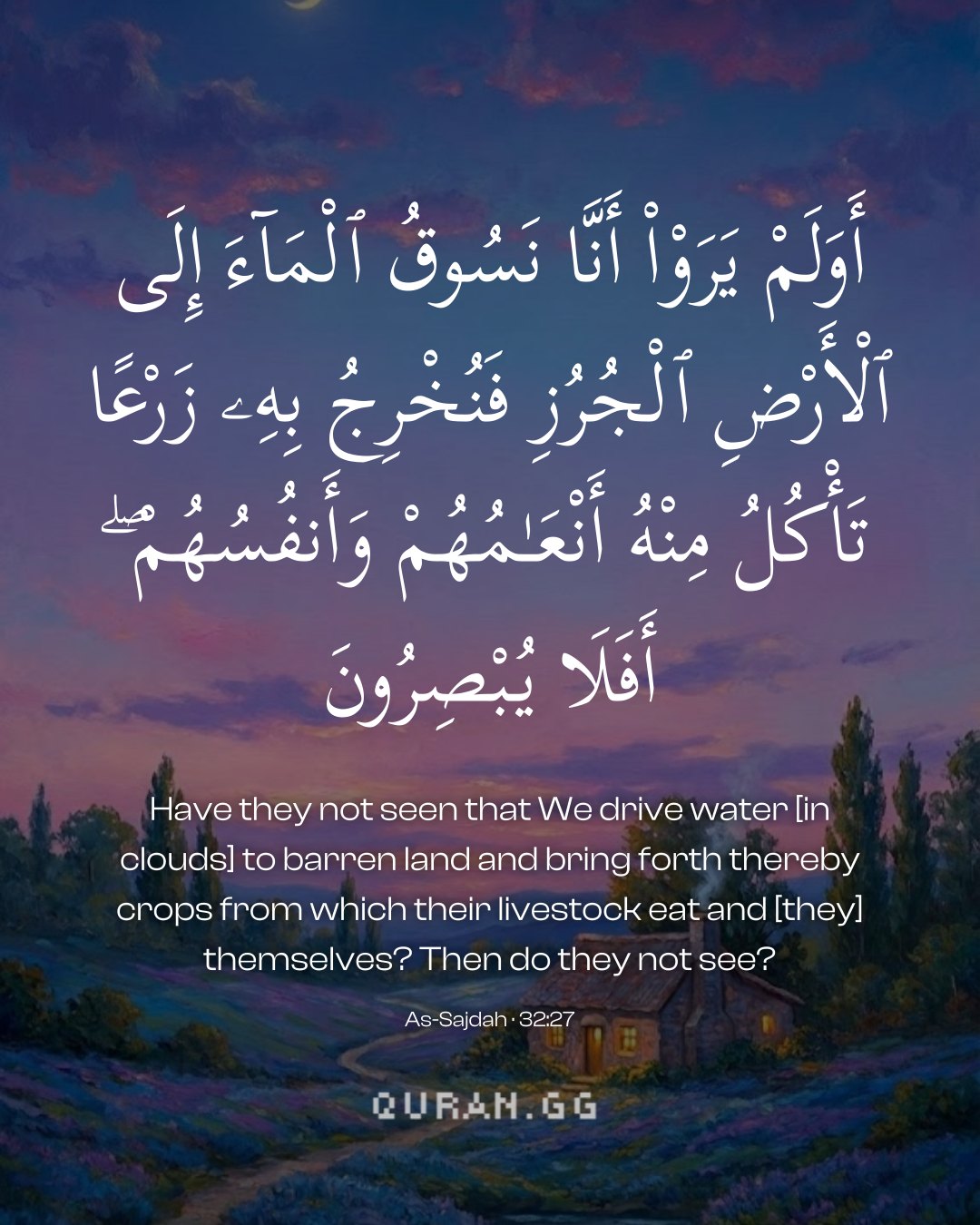
Have they not seen that We drive water [in clouds] to barren land and bring forth thereby crops from which their livestock eat and [they] themselves? Then do they not see?
Allah says: will these people who deny the Messengers not learn from the nations who came before them, whom Allah destroyed for their rejection of His Messengers and their opposition to what the Messengers brought them of the straight path No trace is left of them whatsoever.
(Can you find a single one of them or hear even a whisper of them) (19:98). Allah says:
يَمْشُونَ فِى مَسَـكِنِهِمْ
(in whose dwellings they do walk about) meaning, these disbelievers walk about in the places where those disbelievers used to live, but they do not see any of those who used to live there, for they have gone --
The word: جُرُز (al-juruz) in verse 27: أَوَلَمْ يَرَوْا أَنَّا نَسُوقُ الْمَاءَ إِلَى الْأَرْضِ الْجُرُزِ فَنُخْرِجُ (Have they not seen that We drive water to the dry land, then We bring forth crops thereby - 27) means barren land where trees do not grow.
A wise system of irrigation
Usually the Qur'an mentions the irrigating of dry lands and the growing of crops therein by saying that the land receives rain, and becomes moist and growth-worthy. But, there is no mention of rain in this verse. Instead of that, it has been said that water itself is directed to move aground towards the dry land and thereby bring forth the growth of trees. In other words, the rain is made to fall on some other land and it is from there that water is directed to move in the form of carrier channels on the ground all the way to the dry land that receives no rain.
There is a hint embedded here. Some lands are so soft that they cannot withstand rains. If regular rains were made to fall there, buildings may collapse or trees may be uprooted. Therefore, nature has made its own arrangements for such lands. As for the rain itself, it is sent on a land which is capable of holding it. After that, water is made to flow from here all the way to such lands which cannot withstand rains - like the land of Egypt. And there are commentators who have pointed out to some lands of Yaman and Syria as being referred to in this verse. (as reported from Ibn ` Abbas and Al-Hasan)
And as for the correct position, this subject includes all such lands, with the inclusion of the land of Egypt known for scanty rains particularly. But, water from the rains in the Abyssinian territory of Africa comes into Egypt through the Nile bringing with it particles of the indigenous red soil which is good for the growth of crops. Therefore, the people of Egypt, despite that they have no rains in their country, do benefit by a supply of new water and soil every year. فَتَبَارَكَ اللَّـهُ أَحْسَنُ الْخَالِقِينَ (So, glorious is Allah, the Best of creators - 23:14).
Tazkirul Quran
Maulana Wahiduddin KhanOn ayahs 26–29
The awarding of the Book of God to a group is tantamount to bestowing the keys of world leadership upon that group. But, such status is conferred on a group only when it exercises patience. ‘When they were steadfast’ has been explained as ‘When they were patient with the world.’ (Tafsir ibn Kathir). In other words, they attained the position of leadership when they exercised patience in the face of the adversity of this world. People accept that person (or group) as a leader or Imam who appears to be at higher level than their own—who lives for principles when others live for self-interest, who supports justice when others take the side of their own community; who shows tolerance on being wronged when others seek revenge; who reconciles with deprivation when others rush to find gains; who offers to make sacrifices for the sake of Truth when others know only how to sacrifice for self-interest. Such virtues are rooted in patience, and those who exercise this patience become leaders of the world. Man does not often learn lessons from events until the same disaster befalls him as has befallen others. Those who make innovative interpretations of religion and thus cause differences to arise, incur the risk of final rejection on the Day of judgement and thereafter experience nothing but unending denigration.
Uthmani text of the Madinah mushaf (King Fahd Complex). Translation: Saheeh International. Tafsir via Quran.com.