Here Allah tells us about His servant and Messenger Nuh, peace be upon him, who was the first Messenger sent by Allah to the people of earth after they started to worship idols. Allah sent him to forbid that and to warn people of the consequences of idol worship. But his people belied him and continued their evil practice of worshipping idols besides Allah. Allah revealed that their disbelieving in him was akin to disbelieving in all the Messengers, So Allah said:
(The people of Nuh belied the Messengers. When their brother Nuh said to them: "Will you not have Taqwa") meaning, `do you not fear Allah when you worship others instead of Him'
إِنِّي لَكُمْ رَسُولٌ أَمِينٌ
(I am a trustworthy Messenger to you.) means, `I am the Messenger of Allah to you, faithfully fulfilling the mission with which Allah has sent me. I convey the Messages of my Lord to you, and I do not add anything to them or take anything away from them.,
(So have Taqwa of Allah, and obey me. No reward do I ask of you for it;) means, `I do not want any payment for the advice I give you; I will save my reward for it with Allah. '
فَاتَّقُواْ اللَّهَ وَأَطِيعُونِ
(So have Taqwa of Allah, and obey me.) `It is clear to you that I am telling the truth and that I am faithfully fulfilling the mission with which Allah has entrusted me.'
Ma'arif al-Qur'an
Mufti Muhammad ShafiOn ayahs 109–110
Commentary
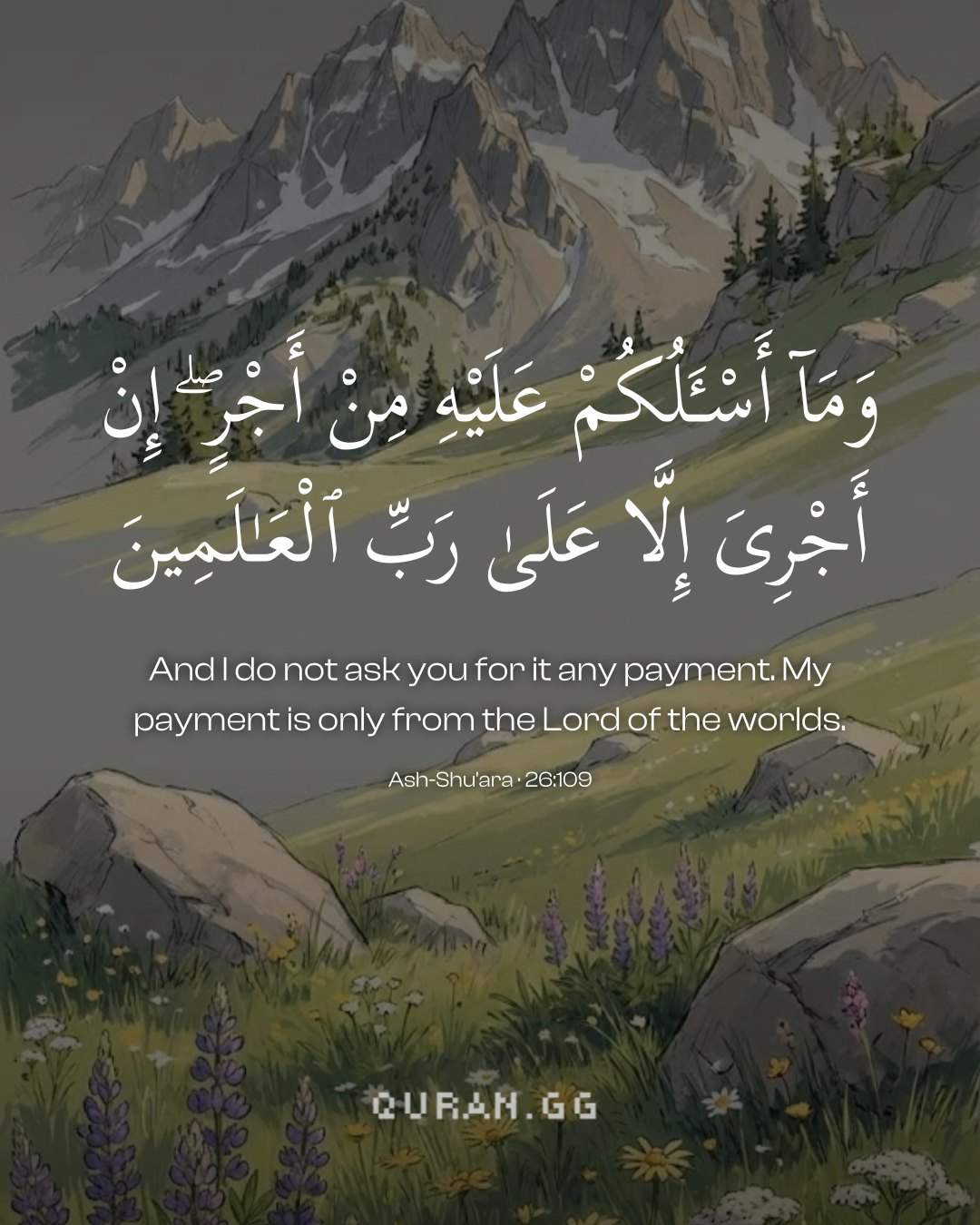
وَمَا أَسْأَلُكُمْ عَلَيْهِ مِنْ أَجْرٍ
And I do not claim from you any reward for it. - 26:109
It is learnt from this verse that charging and acceptance of wages against religious teachings and preaching is not right. Therefore, the righteous elders have ruled it as forbidden, but the later generations have allowed it under compelling circumstances. Its full details have been given under the explanation of the verse لَا تَشْتَرُوا بِآيَاتِي ثَمَنًا قَلِيلًا do not take a paltry price for My signs" - 2:41.
Special note
Here the verse فَاتَّقُوا اللَّـهَ وَأَطِيعُونِ (So, fear Allah and obey me - 110) is repeated twice to make clear that for the obedience of the Messenger and fear of Allah it was enough that the prophet has any one of the two qualities: One, his honesty and integrity, and the second, his teaching and preaching without a fee. But when the Messenger who is personified of all these traits, his obedience and the fear of his God becomes all the more necessary.
Tazkirul Quran
Maulana Wahiduddin KhanOn ayahs 104–114
A man’s heaven and hell are not far away from him. Only a curtain intervenes between them. When Doomsday removes that curtain, every man will see that he was standing just on the edge of his heaven or hell, though the negligent man considered it something very distant. There were false leaders (mujrimun), who enjoyed an elevated position in the society of their times. They did not accept the call for Truth simply because, thereafter, their greatness would be finished. Their false pride prevented them from accepting the Truth. As a result, their followers likewise did not consider the call for Truth worth responding to. Equating the leaders with the Lord of the Universe means giving the same status to their utterances as to those of the Lord of the Universe. The Quranic commentator, Ibn Kathir, portrays them as carrying out the orders of their leaders ‘as the orders of the Lord of the Universe are carried out.’ Those who accepted the pronouncements of their leaders as if they were God’s commandments in the world, will themselves, in the Hereafter, call those leaders blameworthy, but it will be of no avail. The place where one was required to recognise and differentiate between the falsifiers and the men of Truth was the world and not the Hereafter.
Uthmani text of the Madinah mushaf (King Fahd Complex). Translation: Saheeh International. Tafsir via Quran.com.