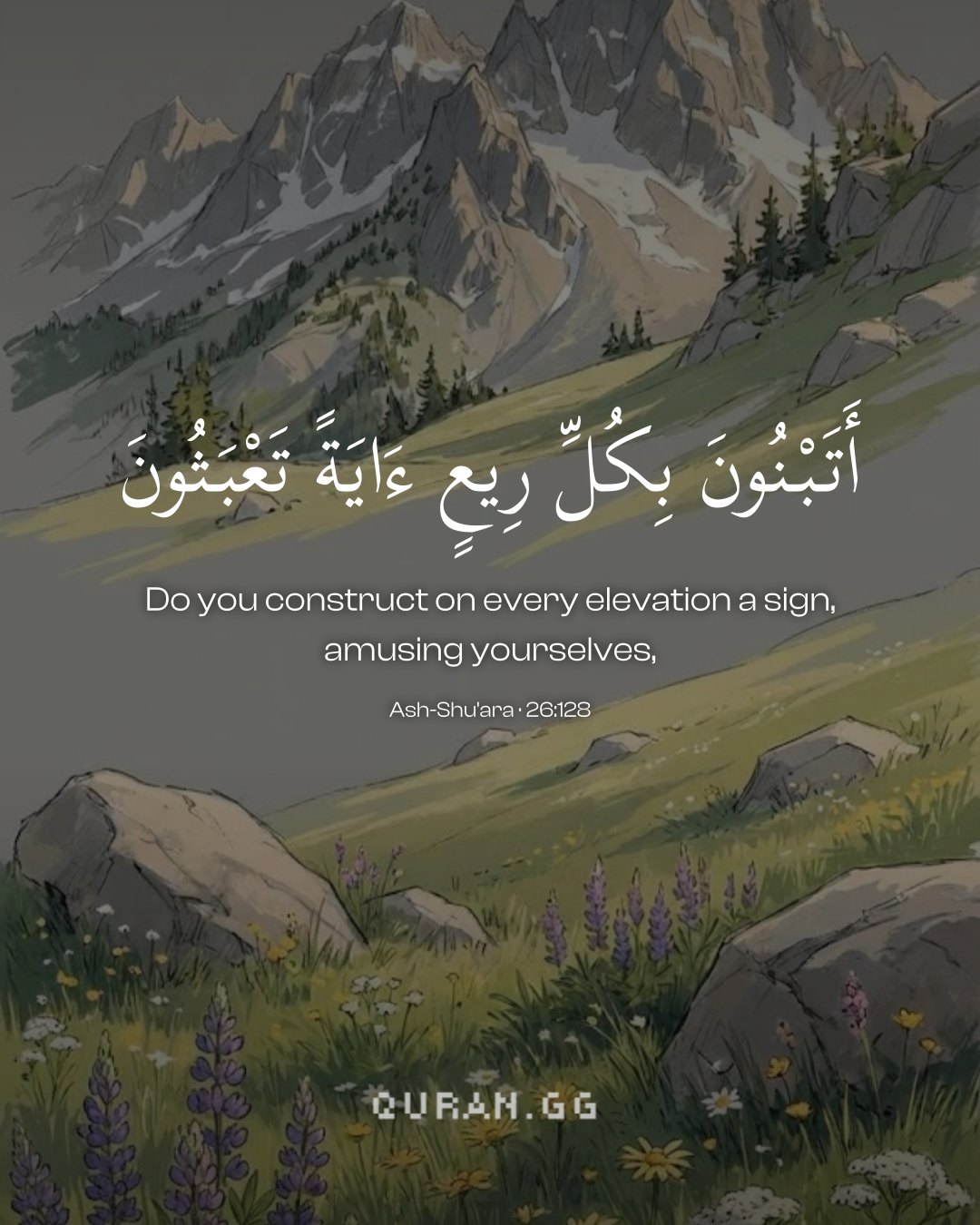
Here Allah tells us about His servant and Messenger Hud, when he called his people `Ad. His people used to live in the Ahqaf, curved sand-hills near Hadramawt, on the borders of Yemen. They lived after the time of Nuh, as Allah says in Surat Al-A`raf:
(And remember that He made you successors after the people of Nuh and increased you amply in stature) (7:69). This refers to the fact that they were physically strong and well-built, and very violent, and very tall; they had also been given a great deal of provisions, wealth, gardens, rivers, sons, crops and fruits. Yet despite all of that, they worshipped others besides Allah. So Allah sent Hud, one of their own, as a Messenger bringing them good news and delivering warnings. He called them to worship Allah alone, and he warned them of Allah's wrath and punishment if they were to go against him and treating him harshly. He said to them, as Nuh had said to his people:
Do you erect on every height a sign having no sound purpose, [ 128] and take the objects of architecture as if you are going to live forever, (26:128-129)
Ibn Jarir (رح) has related from Mujahid (رح) that the passage between two hills is called Ri (ریع). But Sayyidna Ibn ` Abbas ؓ and majority have taken the meaning of Ri (ریع) as a high place, and its derivative is ri`-un-na bat' (ریع البنات), which means growing and climbing vegetation. Literal meaning of 'Ayah (آیۃ) is symbol or sign, but here it means a high palace. تَعْبَثُونَ is derived from ` abath (عَبَث), which is something of no value and benefit neither in reality nor by implication. So, the meaning of the verse is that they used to make very high palaces of no benefit and which they did not need. It was just to fulfill their ego and pride. masani' (مَصَانِع) is the plural of Masna` (مَصنَع). Sayyidna Qatadah has taken masani' (مَصَانِع) for the water tank, whereas Hadrat Mujahid (رح) take it to mean strong palace.
لَعَلَّكُمْ تَخْلُدُونَ (as if you are going to live forever) Imam al-Bukhari (رح) has commented in Sahih al-Bukhari that the word la'alla (لَعَلَّ ) in the verse, is used as a word of simile, and that Sayyidna Ibn ` Abbas ؓ has translated it as کانَكُمْ تَخْلُدُونَ that is ` as if you are..'. (Ruh al-Ma’ ani)
Construction of buildings without any need is contemptible
This verse indicates that the construction of houses and buildings without need is a condemnable act. The hadith quoted by Imam Tirmidhi (رح) on the authority of Sayyidna Anas ؓ conveys exactly the same message: النفقۃ کلھا فی سبیل اللہ إلّا البناء فلا خیر فیہ (All spendings are in Allah's way, except construction, which has no merit). It means that the building which is constructed in excess of requirement has no benefit or virtue. Another narration of Sayyidna Anas ؓ also confirms this: اِن کُلّ بناء وبال علی صاحبہ إلّا – مَالا ، إلّا مالا، یعنی اِلَّا مالا بدّ منہ - ` Every building is a tribulation for the builder, except that which is necessary, because it is not a nuisance'. It is commented in Ruh al-Ma’ ani that without genuine requirement construction of tall buildings is contemptible and condemned under the Sharl'ah of the Holy Prophet ﷺ .
Tazkirul Quran
Maulana Wahiduddin KhanOn ayahs 122–134
Noah strove for centuries so that his community could realize the truth, but they refused to accept it. The moral debasement of his people had reached its acme and the disbelievers now threatened Noah either to stop preaching or be stoned to death. Noah then prayed to God to judge decisively between him and the disbelievers. His prayer was answered. At God’s behest, Noah constructed a large boat, in which all his companions and the male and female counterparts of each animal species were accommodated. Thereafter, God sent a severe storm; water gushed out of the earth, and there was a heavy downpour of rain from the skies. All the living creatures, except those on the boat, were destroyed. This historical example is an embodiment of the fact that while true believers would remain protected, all others would face destruction.
Uthmani text of the Madinah mushaf (King Fahd Complex). Translation: Saheeh International. Tafsir via Quran.com.