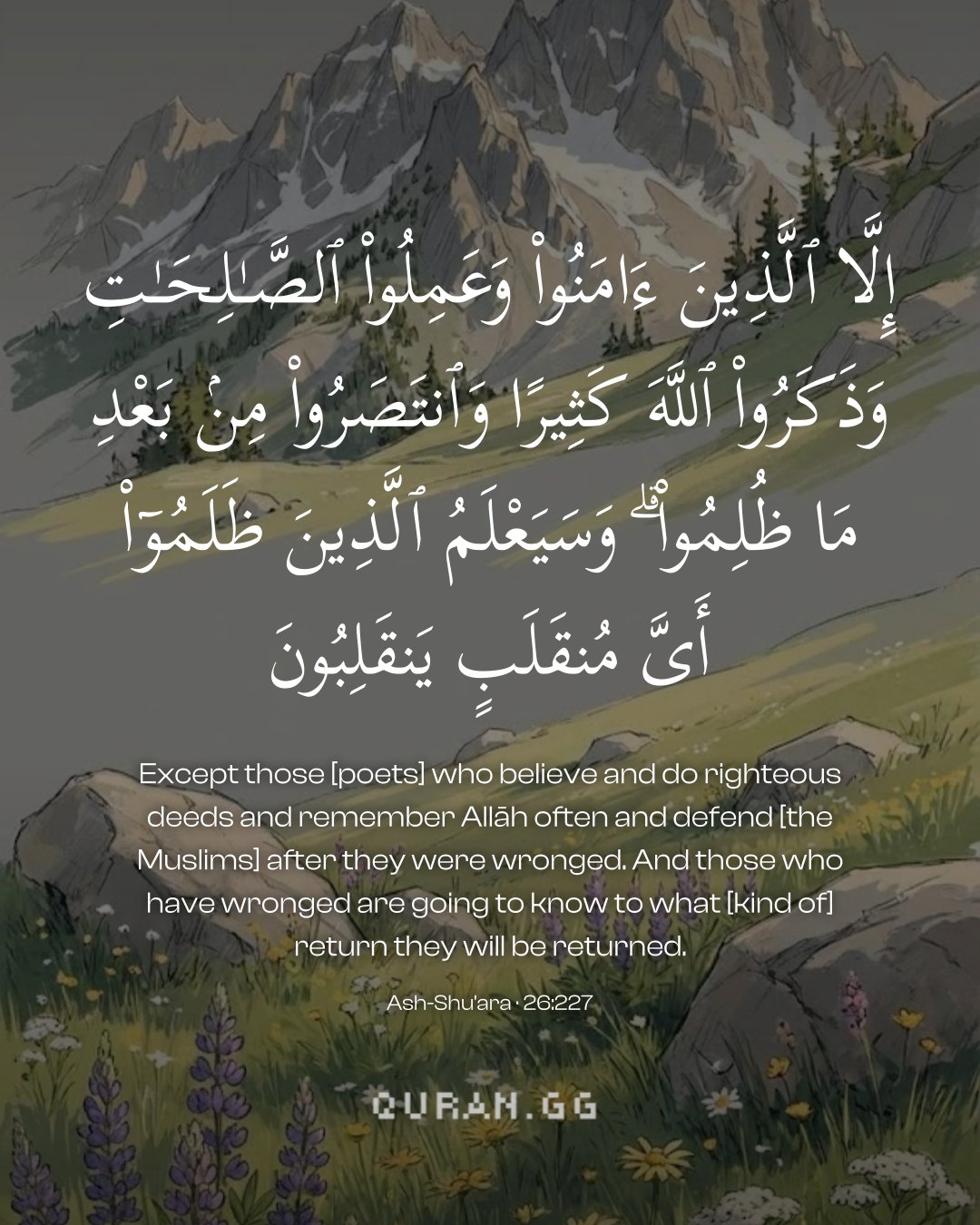
Except those [poets] who believe and do righteous deeds and remember Allāh often and defend [the Muslims] after they were wronged. And those who have wronged are going to know to what [kind of] return they will be returned.
Here Allah addresses those idolators who claimed that what was brought by the Messenger was not the truth but was merely something that he had made up by himself, or that it came to him in visions from the Jinn. Allah stated that His Messenger was above their claims and fabrications, and that what he had brought did indeed come from Allah, and that it was a revelation and inspiration, brought down by a noble, trustworthy and mighty angel. It did not come from the Shayatin, because they have no desire for anything like this Noble Qur'an -- they descend upon those who are like them, the lying fortune-tellers. Allah says:
As for the poets, they are followed by the straying people. - 26:224.
شِعر (Shi'r) which is the origin of Shu` ara' and is translated as poetry; is an Arabic word which lexically means any statement based on imagination and ideas not confirmed by serious proofs. It is not necessary for being a شِعر 'Shi'r' in original Arabic to have a particular rhythm or qafiyah or radif.
Since the technical شِعر shi` r (poetry) which is always based on particular rhythms is generally composed of imaginary thoughts, the technical definition of شِعر shi` r (poetry) is "a composition of words having a particular rhythm and a similar sound at the end of each line (Qafiyah) ". The pagans of Makkah used to call the Holy Prophet ﷺ a sha` ir (a poet) and the Holy Qur'an, a shi` r (poetry). Some commentators of the Holy Qur'an are of the view that the pagans of Makkah used to call the Qur'an a shi` r in its technical sense. But others are of the opinion that it was not so, because the infidels of Makkah were fully conversant with the code and principles of poetry, and it is obvious that Qur'an is not a book of poetry. Even a non-Arab would not accept that, not to say anything of the eloquent Arabs. On the contrary, the Arabs used to call him a poet in the literal sense of the word, that is they regarded his thoughts as imaginary. Their objective was to call him a liar, because the word Sha` ir is also used in the sense of lie, and Shi` r for a liar.
The extraordinary nature of the Prophet’s discourse was so telling that even those who denied the truth could not contradict what he had to say. So, they told their people, in order to satisfy them, that he was a magician or a sorcerer and that his superb preaching was due to his being a magician or a charmer, and not to his being a prophet. Similarly, they used to say that the Qur’an was the work of a poet. The answer to this was that it was enough to compare the prophet with the magicians and poets and then see the difference between them. A world of difference would be found between them and no serious-minded person would confuse the one with the other. The basis of poetry is imagination and not facts and realities. That is why poets have flights of fancy, allowing their ideas to go hither and thither. Unlike the poets, the Prophet and his companions focussed their entire attention upon God—the greatest Reality. Their lives were ideal examples of harmony between preaching and practice. Deep knowledge of God (ma‘rifah) made them remember their Creator on all occasions. They were extremely cautious and, if they took action against anyone, it was only in self-defence. One who is not serious about the life Hereafter cannot be serious about leading a God-oriented life in this world.
Uthmani text of the Madinah mushaf (King Fahd Complex). Translation: Saheeh International. Tafsir via Quran.com.